Kirjojen hintavertailu. Mukana 12 595 353 kirjaa ja 12 kauppaa.
Kirjailija
Matthew Lee Anderson
Kirjat ja teokset yhdessä paikassa: 3 kirjaa, julkaisuja vuosilta 2022-2025, suosituimpien joukossa Plough Quarterly No. 34 – Generations. Vertaile teosten hintoja ja tarkista saatavuus suomalaisista kirjakaupoista.
Confidence in Life offers a theologically-robust evaluation of the good of procreation, which emerges out of both careful interactions with contemporary analytic philosophy and a reconstructed reading of Karl Barth’s doctrine of (pro)creation. While analytic moral philosophy has rarely been brought into close proximity to Barth’s work, the conjunction underscores the deep difficulty of accounting for procreation’s value within non-theological frameworks, and helps clarify what is distinctive and valuable about Barth’s own moral reasoning on this subject. Though primarily staged as an intervention in Protestant moral theology, Confidence in Life’s rehabilitation of the Virgin Mary’s role in Barth’s thought has promise for an ecumenical retrieval of the good of procreating within the economy of redemption—and its retrieval of honour as an indispensable aspect of Barth’s theology will be of interest to Barth scholars and moral theologians alike.
Confidence in Life offers a theologically-robust evaluation of the good of procreation, which emerges out of both careful interactions with contemporary analytic philosophy and a reconstructed reading of Karl Barth’s doctrine of (pro)creation. While analytic moral philosophy has rarely been brought into close proximity to Barth’s work, the conjunction underscores the deep difficulty of accounting for procreation’s value within non-theological frameworks, and helps clarify what is distinctive and valuable about Barth’s own moral reasoning on this subject. Though primarily staged as an intervention in Protestant moral theology, Confidence in Life’s rehabilitation of the Virgin Mary’s role in Barth’s thought has promise for an ecumenical retrieval of the good of procreating within the economy of redemption—and its retrieval of honour as an indispensable aspect of Barth’s theology will be of interest to Barth scholars and moral theologians alike.
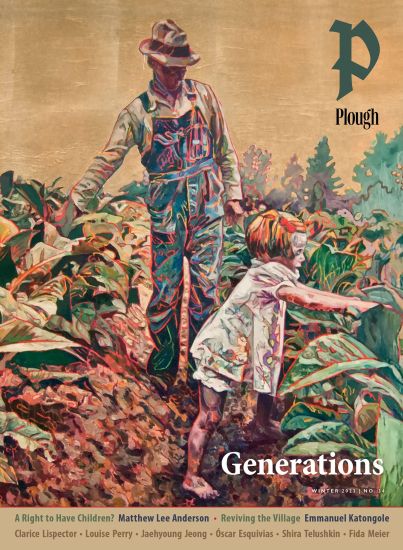
We’re born with a hunger for roots and a desire to pass on a legacy.The past two decades have seen a boom in family history services that combine genealogy with DNA testing, though this is less a sign of a robust connection to past generations than of its absence. Everywhere we see a pervasive rootlessness coupled with a cult of youth that thinks there is little to learn from our elders. The nursing home tragedies of the Covid-19 pandemic laid bare this devaluing of the old. But it’s not only the elderly who are negatively affected when the links between generations break down; the young lose out too. When the hollowing-out of intergenerational connections deprives youth of the sense of belonging to a story beyond themselves, other sources of identity, from trivial to noxious, will fill the void.Yet however important biological kinship is, the New Testament tells us it is less important than the family called into being by God’s promises. “Who is my mother, and who are my brothers?” Jesus asks a crowd of listeners, then answers: “Whoever does the will of my Father in heaven is my brother, and sister, and mother.” In this great intergenerational family, we are linked by a bond of brotherhood and sisterhood to believers from every era of the human story, past, present, and yet to be born. To be sure, our biological families and inheritances still matter, but heredity and blood kinship are no longer the primary source of our identity. Here is a cure for rootlessness.On this theme: - Matthew Lee Anderson argues that even in an age of IVF no one has a right to have a child. - Emmanuel Katongole describes how African Christians are responding to ecological degradation by returning to their roots. - Louise Perry worries that young environmentalist don’t want kids. - Helmuth Eiwen asks what we can do about the ongoing effects of the sins of our ancestors. - Terence Sweeney misses an absent father who left him nothing. - Wendy Kiyomi gives personal insight into the challenges of adopting children with trauma in their past. - Alastair Roberts decodes that long list of “begats” in Matthew’s Gospel. - Rhys Laverty explains why his hometown, Chessington, UK, is still a family-friendly neighborhood. - Springs Toledo recounts, for the first time, a buried family story of crime and forgiveness. - Monica Pelliccia profiles three generations of women who feed migrants riding the trains north.Also in the issue: - A new Christmas story by Óscar Esquivias, translated from the Spanish - Original poetry by Aaron Poochigian - Reviews of Kim Haines-Eitzen’s Sonorous Desert, Matthew P. Schneider’s God Loves the Autistic Mind, Adam Nicolson’s Life between the Tides, and Ash Davidson’s Damnation Spring. - An appreciation for Augustine’s mother, Monica - Short sketches by Clarice Lispector of her father and sonPlough Quarterly features stories, ideas, and culture for people eager to apply their faith to the challenges we face. Each issue includes in-depth articles, interviews, poetry, book reviews, and art.