Kirjojen hintavertailu. Mukana 12 595 353 kirjaa ja 12 kauppaa.

Kirjailija

Matthew M Hurley

Kirjat ja teokset yhdessä paikassa: 4 kirjaa, julkaisuja vuosilta 2012-2023, suosituimpien joukossa Afri Research Paper 2010-2, on the Fly. Vertaile teosten hintoja ja tarkista saatavuus suomalaisista kirjakaupoista.

Mukana myös kirjoitusasut: Matthew M. Hurley

4 kirjaa

Kirjojen julkaisuhaarukka 2012-2023.

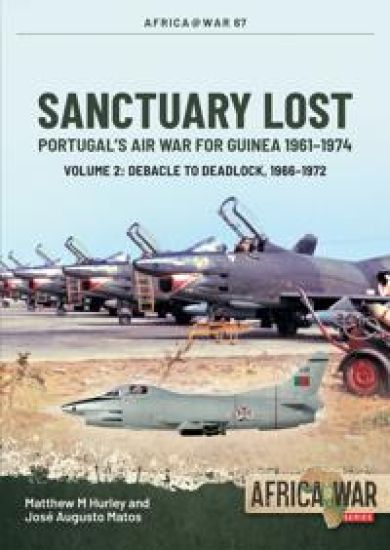
Sanctuary Lost: Portugal's Air War for Guinea, 1961-1974 Volume 2
From 1963 to 1974, Portugal and its nationalist enemies fought an increasingly intense war for the independence of "Portuguese" Guinea, then a colony but now the Republic of Guinea-Bissau. For most of the conflict Portugal enjoyed virtually unchallenged air supremacy, and increasingly based its military strategy and political pacification program on this singular advantage. The Portuguese Air Force (For a A rea Portuguesa, abbreviated FAP) consequently played a crucial role in the Guinean war. Indeed, throughout the conflict, the FAP - despite the many challenges it faced - proved to be the most effective and responsive military argument against the PAIGC rebels, which was fighting for the colony's independence from European rule.The air war for Guinea stands as a remarkable episode in air power history for several reasons. It was, for example, the first conflict in which a non-state irregular force deployed defensive missiles against an organized air force. Moreover, the degree to which Portugal relied on its air power was such that its effective neutralization doomed Lisbon's military strategy in the province. Ultimately, the FAP's unexpected combat losses initiated a cascade of effects that degraded, in turn, its own operational initiative; the battlefield effectiveness of increasingly air-dependent ground forces; Portuguese military morale and national resilience; and ultimately, Lisbon's tenability as an imperial power. The air war for Portuguese Guinea thus represents a compelling illustration of the value - and vulnerabilities - of air power in a counter-insurgency context, as well as the negative impacts of overreliance on air supremacy.This work is part of a three-volume history. This volume, the second, examines the evolution of Portuguese air power and guerrilla air defenses during the conflict's most active years, as both sides sought the means and methods required to counter the other's efforts to control Guinea's airspace.
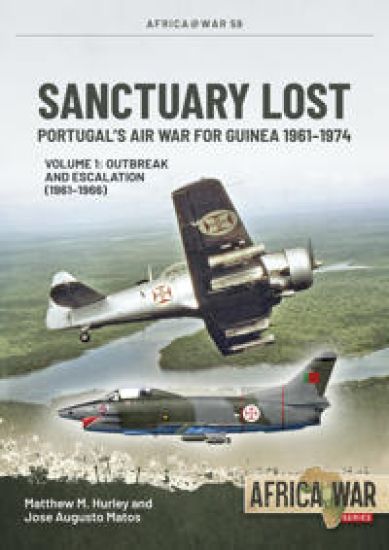
Santuary Lost

Santuary Lost

Matthew M. Hurley; Jose Augusto Matos

Helion Company
2022
nidottu
From 1963 to 1974, Portugal and its nationalist enemies fought an increasingly intense war for the independence of "Portuguese" Guinea, then a colony but now the Republic of Guinea-Bissau. For most of the conflict, Portugal enjoyed virtually unchallenged air supremacy, and increasingly based its strategy on this advantage. The Portuguese Air Force (Força Aérea Portuguesa, abbreviated FAP) consequently played a crucial role in the Guinean war. Indeed, throughout the conflict, the FAP - despite the many challenges it faced - proved to be the most effective and responsive military argument against the PAIGC, which was fighting for Guinea's independence. The air war for Guinea is unique for historians and analysts for several reasons. It was the first conflict in which a non-state irregular force deployed defensive missiles against an organised air force. Moreover, the degree to which Portugal relied on its air power was such that its effective neutralisation doomed Lisbon's military strategy in the province. The FAP's unexpected combat losses initiated a cascade of effects that degraded in turn its own operational freedom and the effectiveness of the increasingly air-dependent surface forces, which felt that the war against the PAIGC was lost. The air war for Guinea thus represents a compelling illustration of the value - and vulnerabilities - of air power in a counter-insurgency context, as well as the negative impacts of overreliance on air supremacy.
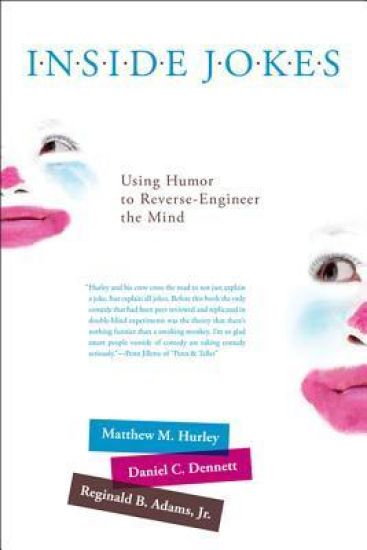
Inside Jokes

Inside Jokes

Matthew M. Hurley; Daniel C. Dennett; Reginald B. Adams Jr.

MIT Press
2013
pokkari
An evolutionary and cognitive account of the addictive mind candy that is humor.Some things are funny-jokes, puns, sitcoms, Charlie Chaplin, The Far Side, Malvolio with his yellow garters crossed-but why? Why does humor exist in the first place? Why do we spend so much of our time passing on amusing anecdotes, making wisecracks, watching The Simpsons? In Inside Jokes, Matthew Hurley, Daniel Dennett, and Reginald Adams offer an evolutionary and cognitive perspective. Humor, they propose, evolved out of a computational problem that arose when our long-ago ancestors were furnished with open-ended thinking. Mother Nature-aka natural selection-cannot just order the brain to find and fix all our time-pressured misleaps and near-misses. She has to bribe the brain with pleasure. So we find them funny. This wired-in source of pleasure has been tickled relentlessly by humorists over the centuries, and we have become addicted to the endogenous mind candy that is humor.