Kirjojen hintavertailu. Mukana 12 595 353 kirjaa ja 12 kauppaa.

Kirjailija

Matthew S. Allen

Kirjat ja teokset yhdessä paikassa: 3 kirjaa, julkaisuja vuosilta 2019-2026, suosituimpien joukossa Engineering Dynamics. Vertaile teosten hintoja ja tarkista saatavuus suomalaisista kirjakaupoista.

3 kirjaa

Kirjojen julkaisuhaarukka 2019-2026.

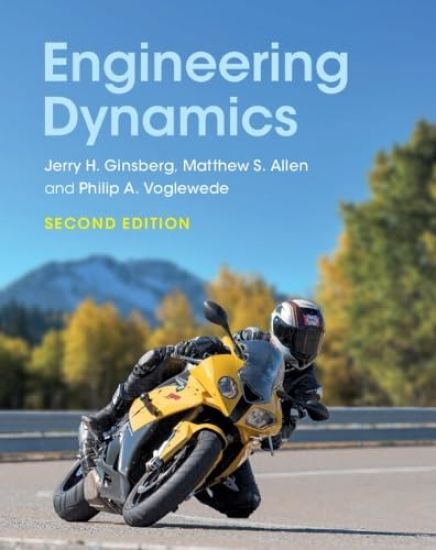
Engineering Dynamics

Engineering Dynamics

Jerry H. Ginsberg; Matthew S. Allen; Philip A. Voglewede

Cambridge University Press
2026
sidottu
Fully revised and updated, the new edition of Engineering Dynamics provides a comprehensive, self-contained and accessible treatment of classical dynamics. All chapters have been reworked to enhance student understanding, and new features include a stronger emphasis on computational methods, including rich examples using both Matlab and Python; new capstone computational examples extend student understanding, including modelling the flight of a rocket and the unsteady rolling of a disk. The coverage of Lagrange's equations is improved, spanning simple systems and systems relevant to engineers. It provides students with clear, systematic methods for solving problems in dynamics, demonstrates how to solve equations of motion numerically, and explains all mathematical operators. Including over 150 real-world examples to motivate student learning, over 400 homework problems, and accompanied online by Matlab and Python repositories and supplemental material, the new edition of this classic is ideal for senior undergraduate and graduate students in engineering.
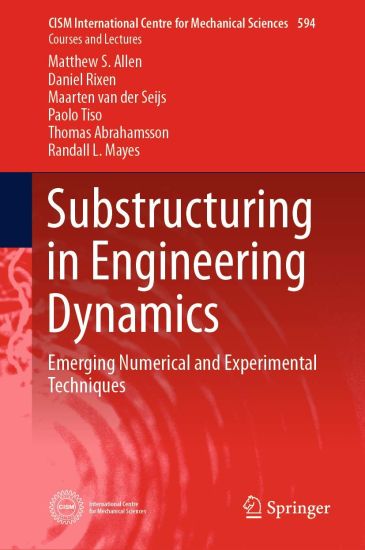
Substructuring in Engineering Dynamics

Substructuring in Engineering Dynamics

Matthew S. Allen; Daniel Rixen; Maarten van der Seijs; Paolo Tiso; Thomas Abrahamsson; Randall L. Mayes

Springer Nature Switzerland AG
2020
nidottu
This book reviews the most common state-of-the art methods for substructuring and model reduction and presents a framework that encompasses most method, highlighting their similarities and differences. For example, popular methods such as Component Mode Synthesis, Hurty/Craig-Bampton, and the Rubin methods, which are popular within finite element software, are reviewed. Similarly, experimental-to-analytical substructuring methods such as impedance/frequency response based substructuring, modal substructuring and the transmission simulator method are presented. The overarching mathematical concepts are reviewed, as well as practical details needed to implement the methods. Various examples are presented to elucidate the methods, ranging from academic examples such as spring-mass systems, which serve to clarify the concepts, to real industrial case studies involving automotive and aerospace structures. The wealth of examples presented reveal both the potential and limitations of the methods.
Substructuring in Engineering Dynamics

Substructuring in Engineering Dynamics

Matthew S. Allen; Daniel Rixen; Maarten van der Seijs; Paolo Tiso; Thomas Abrahamsson; Randall L. Mayes

Springer Nature Switzerland AG
2019
sidottu
This book reviews the most common state-of-the art methods for substructuring and model reduction and presents a framework that encompasses most method, highlighting their similarities and differences. For example, popular methods such as Component Mode Synthesis, Hurty/Craig-Bampton, and the Rubin methods, which are popular within finite element software, are reviewed. Similarly, experimental-to-analytical substructuring methods such as impedance/frequency response based substructuring, modal substructuring and the transmission simulator method are presented. The overarching mathematical concepts are reviewed, as well as practical details needed to implement the methods. Various examples are presented to elucidate the methods, ranging from academic examples such as spring-mass systems, which serve to clarify the concepts, to real industrial case studies involving automotive and aerospace structures. The wealth of examples presented reveal both the potential and limitations of the methods.