Kirjojen hintavertailu. Mukana 12 595 353 kirjaa ja 12 kauppaa.

Kirjailija

Matthew Silverman

Kirjat ja teokset yhdessä paikassa: 7 kirjaa, julkaisuja vuosilta 2011-2025, suosituimpien joukossa Baseball Miscellany. Vertaile teosten hintoja ja tarkista saatavuus suomalaisista kirjakaupoista.

7 kirjaa

Kirjojen julkaisuhaarukka 2011-2025.

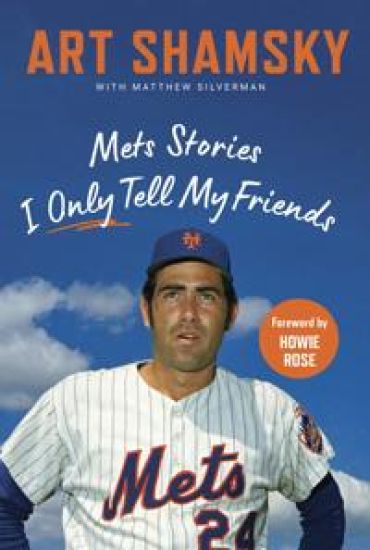
Mets Stories I Only Tell My Friends

Mets Stories I Only Tell My Friends

Art Shamsky; Matthew Silverman

TRIUMPH BOOKS
2025
sidottu
Art Shamsky, 1969 New York Met and noted author, shares with readers stories and anecdotes from his 50-year association with the New York Mets. Through stories of varying lengths, readers will be privy to behind-the-scenes and first-hand accounts of the New York Mets from lovable losers to impossible winners in 1969, and beyond, including stories about today’s players. We witness the leadership of Tom Seaver, the steady hand of manager Gil Hodges, what it was like to share right field with charismatic Ron Swoboda, what it was like to grace a magazine cover with 1960s supermodel Lauren Hutton, in addition to a wealth of stories about the Mets, the organization, and its star players over the past half century.
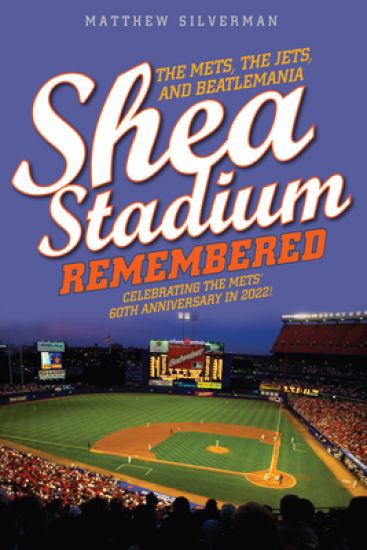
Shea Stadium Remembered

Shea Stadium Remembered

Matthew Silverman

The Lyons Press
2022
pokkari
Few remember that Shea Stadium—and indeed the Mets baseball club itself—arose out of a dispute between two oversized egos: New York City official Robert Moses and Brooklyn Dodgers owner Walter O’Malley. While O’Malley wanted complete control over a new stadium and all of its concessions in Brooklyn, Moses insisted that the stadium be built by the city in Queens and leased to the Dodgers. The impasse led to the Dodgers following the Giants out to the West Coast, where The City of Los Angeles granted O’Malley all of the concessions he had sought in New York. With now no National League team in the New York area, the National League office awarded a new franchise to the city in 1960 on conditional that it fund and build a new stadium, which the Mets (and later the AFL Jets) would lease. The stadium was named in honor of William Shea, the person most responsible for returning National League baseball to New York.Over its forty-four year existence Shea Stadium witnessed a colorful cavalcade of sporting and entertainment events, all detailed in this lively, skimable tribute to a memorable New York landmark.It’s all here: the memorable games; the unforgettable characters such as Tom Seaver, Joe “Willie” Namath, and Seinfeld buddy Keith Hernandez; and even the solemn moments such as when Shea was used as a staging area for first responders after 9/11. By the time of its demolition in 2008, the Mets had played more games at Shea than the Dodgers had ever played at Ebbets Field, and the stadium had hosted seven National League Championship Series, four World Series, three Jets playoff games, and the American Football League Championship game in 1968.
Baseball Miscellany: Everything You Ever Wanted to Know about Baseball
Why does a curveball curve? What is a "can of corn"? Why was Joe DiMaggio called the "Yankee Clipper"? Who wrote "Take Me Out to the Ball Game"? How many times did Ty Cobb steal home? In this edition of Baseball Miscellany, the fascinating history and lore of our national pastime is finally revealed For example, the reason a curveball curves is that its spin drags a layer of air across one surface of the ball faster than it does across the opposite surface. A "can of corn" is slang for an easy-to-catch fly ball, the term originating from a general store clerk reaching up and dropping a can from a high shelf. Sportswriters dubbed Joe DiMaggio the "Yankee Clipper" because he glided about the outfield with beauty and grace, like a clipper ship on the ocean. The lyrics to "Take Me Out to the Ball Game" were written in 1908 by vaudeville star Jack Norworth, who, while riding the subway, was inspired by a sign that said "Baseball Today--Polo Grounds." And the great Ty Cobb stole home a whopping fifty-four times--fifty more than the career leader in total stolen bases, Rickey Henderson. Packed with all manner of delightful surprises, beautiful illustrations and photographs, and delicious nuggets of information, Baseball Miscellany demystifies the origins and customs of America's most celebrated game. From spring training through the World Series, you'll be entertained with fun, little-known facts. Why do baseball players wear stirrup socks? Who invented the catcher's mask? What major-league team passed up on signing eighteen-year-old Willie Mays in 1949?
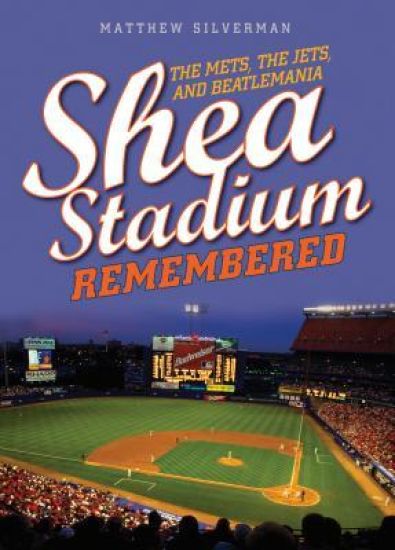
Shea Stadium Remembered

Shea Stadium Remembered

Matthew Silverman

The Lyons Press
2019
sidottu
Few remember that Shea Stadium—and indeed the Mets baseball club itself—arose out of a dispute between two oversized egos: New York City official Robert Moses and Brooklyn Dodgers owner Walter O’Malley. While O’Malley wanted complete control over a new stadium and all of its concessions in Brooklyn, Moses insisted that the stadium be built by the city in Queens and leased to the Dodgers. The impasse led to the Dodgers following the Giants out to the West Coast, where The City of Los Angeles granted O’Malley all of the concessions he had sought in New York. With now no National League team in the New York area, the National League office awarded a new franchise to the city in 1960 on conditional that it fund and build a new stadium, which the Mets (and later the AFL Jets) would lease. The stadium was named in honor of William Shea, the person most responsible for returning National League baseball to New York. Over its forty-four year existence Shea Stadium witnessed a colorful cavalcade of sporting and entertainment events, all detailed in this lively, skimable tribute to a memorable New York landmark. It’s all here: the memorable games; the unforgettable characters such as Tom Seaver, Joe “Willie” Namath, and Seinfeld buddy Keith Hernandez; and even the solemn moments such as when Shea was used as a staging area for first responders after 9/11. By the time of its demolition in 2008, the Mets had played more games at Shea than the Dodgers had ever played at Ebbets Field, and the stadium had hosted seven National League Championship Series, four World Series, three Jets playoff games, and the American Football League Championship game in 1968.
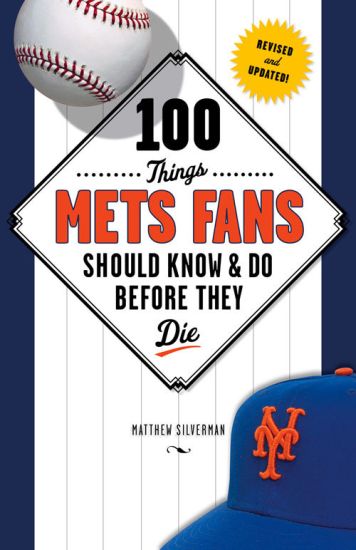
100 Things Mets Fans Should Know & Do Before They Die
With trivia boxes, records, and team lore, this lively, detailed book explores the personalities, events, and facts every Mets fan should know. It contains crucial information such as important dates, player nicknames, memorable moments, and outstanding achievements by singular players. This guide to all things New York Mets covers Robin Ventura's 1999 Grand-Slam single, the 1969 shoe polish incident, and the history behind the names and numbers on the left-field wall. Updated for 2015, this new edition features a new generation of Mets stars, including pitchers Jason deGrom, Matt Harvey, and Noah Syndergaard.
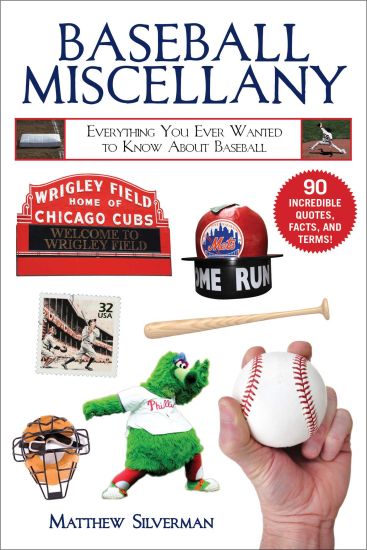
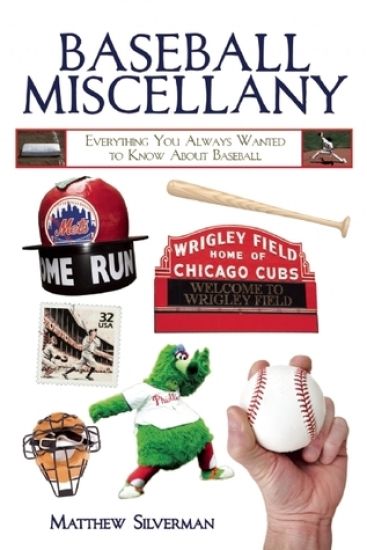
Baseball Miscellany

Baseball Miscellany

Matthew Silverman

Sky Pony Press
2015
pokkari
Why does a curveball curve? What is a ?can of corn”? Why was Joe DiMaggio called the ?Yankee Clipper”? Who wrote ?Take Me Out to the Ball Game”? How many times did Ty Cobb steal home? In this reissue of Baseball Miscellany, the fascinating history and lore of our national pastime is finally revealed! For example, the reason a curveball curves is that its spin drags a layer of air across one surface of the ball faster than it does across the opposite surface. A ?can of corn” is slang for an easy-to-catch fly ball, the term originating from a general store clerk reaching up and dropping a can from a high shelf. Sportswriters dubbed Joe DiMaggio the ?Yankee Clipper” because he glided about the outfield with beauty and grace, like a clipper ship on the ocean. The lyrics to ?Take Me Out to the Ball Game” were written in 1908 by vaudeville star Jack Norworth, who, while riding the subway, was inspired by a sign that said ?Baseball Today?Polo Grounds.” And the great Ty Cobb stole home a whopping fifty-four times?fifty more than the career leader in total stolen bases, Rickey Henderson. Packed with all manner of delightful surprises, beautiful illustrations and photographs, and delicious nuggets of information, Baseball Miscellany demystifies the origins and customs of America’s most celebrated game. From spring training through the World Series, you’ll be entertained with fun, little-known facts. Why do baseball players wear stirrup socks? Who invented the catcher’s mask? What major-league team passed up on signing eighteen-year-old Willie Mays in 1949? Skyhorse Publishing, as well as our Sports Publishing imprint, are proud to publish a broad range of books for readers interested in sports?books about baseball, pro football, college football, pro and college basketball, hockey, or soccer, we have a book about your sport or your team. Whether you are a New York Yankees fan or hail from Red Sox nation; whether you are a die-hard Green Bay Packers or Dallas Cowboys fan; whether you root for the Kentucky Wildcats, Louisville Cardinals, UCLA Bruins, or Kansas Jayhawks; whether you route for the Boston Bruins, Toronto Maple Leafs, Montreal Canadiens, or Los Angeles Kings; we have a book for you. While not every title we publish becomes a New York Times bestseller or a national bestseller, we are committed to publishing books on subjects that are sometimes overlooked by other publishers and to authors whose work might not otherwise find a home.
Baseball Miscellany

Baseball Miscellany

Matthew Silverman

Skyhorse Publishing
2011
sidottu
Why does a curveball curve? What is a ?can of corn”? Why was Joe DiMaggio called the ?Yankee Clipper”? ?Who wrote ?Take Me Out to the Ballgame”? How many times did Ty Cobb steal home? In Baseball Miscellany, the fascinating history and lore of our national pastime is finally revealed! For example, the reason a curveball curves is that its spin drags a layer of air across one surface of the ball faster than it does across the opposite surface. A ?can of corn” is slang for an easy-to-catch fly ball, the term originating from a general store clerk reaching up and dropping a can from a high shelf. Sportswriters dubbed Joe DiMaggio the ?Yankee Clipper” because he glided about the outfield with beauty and grace, like a clipper ship on the ocean. The lyrics to ?Take Me Out to the Ballgame” were written in 1908 by vaudeville star Jack Norworth, who, while riding the subway, was inspired by a sign that said ?Baseball Today?Polo Grounds.” And the great Ty Cobb stole home a whopping fifty-four times?fifty more than the career leader in total stolen bases, Rickey Henderson. Packed with all manner of delightful surprises, beautiful illustrations and photographs, and delicious nuggets of information, Baseball Miscellany demystifies the origins and customs of America’s most celebrated game. From spring training through the World Series, you’ll be entertained with fun, little-known facts. Why do baseball players wear stirrup socks? Who invented the catcher’s mask? What Major League team passed up on signing eighteen-year-old Willie Mays in 1949? Settle into your favorite armchair, grab some peanuts or Cracker Jacks, and find out!