Kirjojen hintavertailu. Mukana 12 595 353 kirjaa ja 12 kauppaa.

Kirjailija

Matthew Wright

Kirjat ja teokset yhdessä paikassa: 39 kirjaa, julkaisuja vuosilta 2001-2026, suosituimpien joukossa Fake-Checking. Vertaile teosten hintoja ja tarkista saatavuus suomalaisista kirjakaupoista.

39 kirjaa

Kirjojen julkaisuhaarukka 2001-2026.

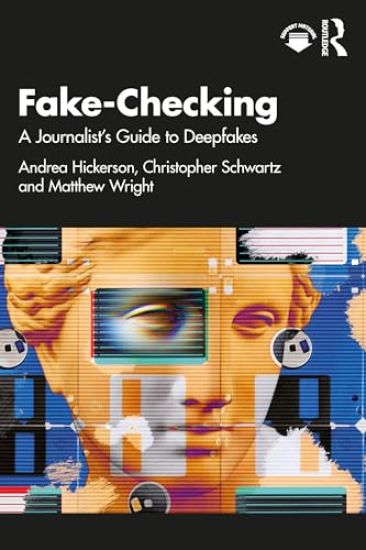
Fake-Checking

Fake-Checking

Andrea Hickerson; Christopher Schwartz; Matthew Wright

TAYLOR FRANCIS LTD
2025
nidottu
Designed to help journalists keep pace with the rapid evolution of deepfakes as well as integrate ‘fake-checking’ methods into their routine reporting practices, this book offers a concise and accessible guide for reporters navigating this evolving challenge. This guide aims to assist journalists in understanding the complexities of deepfakes from a number of angles including philosophical, historical, technical, and methodological. Rather than approaching deepfakes as a ‘journalistic apocalypse,’ this book contextualises them in the larger historical practice of fact-checking and on a continuum of technological advances in image and video manipulation. Encouraging readers to view fact-checking as a multimodal process, it stresses the importance of combining philosophical and technical tools, especially ones based in epistemology and artifical intelligence (AI), in addition to the ‘pavement pounding’ essentials of good journalism. The book concludes with a chapter addressing how to explain deepfakes to a public progressively more concerned about the realities and consequences of AI and misinformation. Fake-Checking serves as a practical reference for journalists and advanced media students who are increasingly required to identify and verify potential deepfakes and their future iterations. This book is supported by online resources which can be accessed at www.routledge.com/9781032741321.

Fake-Checking

Fake-Checking

Andrea Hickerson; Christopher Schwartz; Matthew Wright

TAYLOR FRANCIS LTD
2025
sidottu
Designed to help journalists keep pace with the rapid evolution of deepfakes as well as integrate ‘fake-checking’ methods into their routine reporting practices, this book offers a concise and accessible guide for reporters navigating this evolving challenge. This guide aims to assist journalists in understanding the complexities of deepfakes from a number of angles including philosophical, historical, technical, and methodological. Rather than approaching deepfakes as a ‘journalistic apocalypse,’ this book contextualises them in the larger historical practice of fact-checking and on a continuum of technological advances in image and video manipulation. Encouraging readers to view fact-checking as a multimodal process, it stresses the importance of combining philosophical and technical tools, especially ones based in epistemology and artifical intelligence (AI), in addition to the ‘pavement pounding’ essentials of good journalism. The book concludes with a chapter addressing how to explain deepfakes to a public progressively more concerned about the realities and consequences of AI and misinformation. Fake-Checking serves as a practical reference for journalists and advanced media students who are increasingly required to identify and verify potential deepfakes and their future iterations. This book is supported by online resources which can be accessed at www.routledge.com/9781032741321.

Kiwi Air Power: A history of the RNZAF to the end of the Cold War
This is the story of New Zealand's military aviation from its modest beginnings in 1914 to the formation of the Royal New Zealand Air Force in 1936, the struggles of the Second World War and then the gyrations of the Cold War, wrapping up with the transition to the very different post-Cold War world of the 1990s. It is a story of politics, of aircraft, and especially of people - of the everyday New Zealanders who fought the Second World War, who served with the RNZAF and the RAF, then and later; and who found strengths in themselves that, perhaps, they did not know they had.
Euripides' Escape-Tragedies

Euripides' Escape-Tragedies

Matthew Wright

Oxford University Press
2005
sidottu
This is the first major critical study of three late plays of Euripides: Helen, Andromeda and Iphigenia among the Taurians. Matthew Wright offers a sustained reading of the plays, arguing that they are a thematically connected trilogy. He re-examines central themes such as myth, geography, cultural identity, philosophy, religion, and (crucially) genre. These are not separate topics, but are seen as being joined together to form an intricate nexus of ideas. The book has implications for our view of Euripides and the tragic genre as a whole.
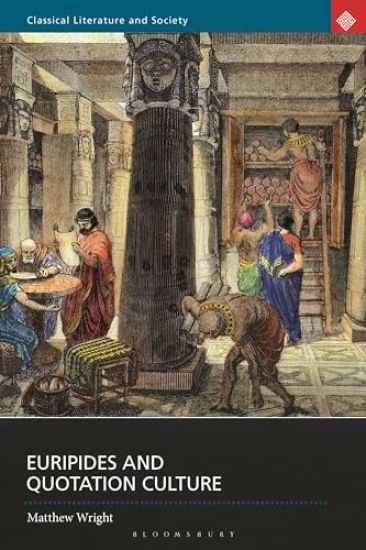
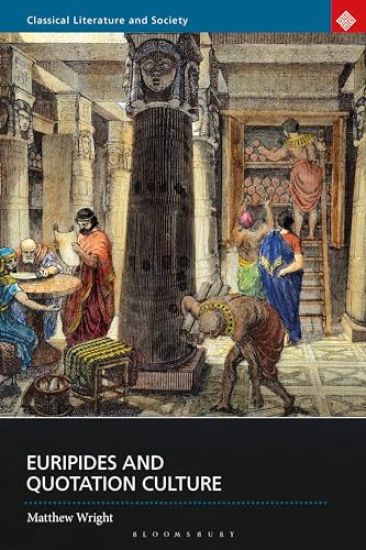
Euripides and Quotation Culture

Euripides and Quotation Culture

Matthew Wright

BLOOMSBURY PUBLISHING PLC
2026
nidottu
Presenting a new approach to Euripides’ plays, this book explores the playwright’s ancient tragedies in relation to quotation culture. Treating extant works and lost works side-by-side, Matthew Wright presents a selective survey of ways in which Euripidean tragedy was quoted within antiquity, both in social contexts (on the comic stage, at symposia, in law courts, in education) and in different literary genres (drama, biography, oratory, philosophy, literary scholarship, history and anthologies). There is also a discussion of the connection between quotability and classic status, where Wright asks what quotations can tell us about ancient reading habits. The implication is that Euripides actively participated in quotation culture by deliberately making certain portions of his plays stand out as especially quotable. Within classical antiquity, Euripides was the most widely quoted author apart from Homer. His plays are full of ‘quotable quotes’, which were repeated so often that they acquired a life of their own. Hundreds of famous verses from Euripidean drama circulated widely within the ancient world, even after the plays in which they originally featured became forgotten or vanished completely. Indeed, the majority of Euripides’ tragedies now survive only in the form of scattered quotations, otherwise known to us as ‘fragments’. It is this corpus of fragmentary quotations, along with his extant plays, that makes Euripides such an interesting case study in the world of quotation culture. This book is the first of its kind to understand Euripides’ work through this lens, as well as opening up quotation culture as a major theme of interest within classical scholarship.
Ernest Rutherford and the Birth of Modern Physics
A fascinating history of physicist Ernest Rutherford, who developed the key concepts underlying modern physics today. By the mid-nineteenth century, physicists believed they had discovered the last secrets of the universe. Then a new world opened up: one of waves, particles, and new, fundamental forces. This mysterious world swiftly captured the public imagination, not least because of the technical revolution that emerged from it, giving the world everything from radio to TV, X-ray machines, smoke detectors, and more. One of the key movers of this new world was Ernest Rutherford, who became popularly known as the "father of the atom" in recognition of his pioneering role in particle physics. But he was far more than that. Through his roles at Manchester University and then the Cavendish Laboratory in England, he steered a new generation of highly influential physicists such as Niels Bohr, helping to shape much of the way we understand physics today--from quantum mechanics to the "standard model" of particles. This immersive history explores the discovery of that science, using Rutherford's life as a vehicle to steer the journey. It explains just why this science seized the public imagination of the day, and why Rutherford's contribution was integral not just to the technical revolution of the twentieth century, but to the way we now understand the nature of the universe. And it explains how that science works, in engaging, accessible terms.
Ernest Rutherford and the Birth of Modern Physics

Ernest Rutherford and the Birth of Modern Physics

Matthew Wright

Scribe Publications
2025
sidottu
How key concepts in modern physics came from the work of a New Zealander whom Einstein labelled ‘a second Newton’. By the mid-nineteenth century, physicists believed they had discovered the last secrets of the universe. Then a new world opened up: one of waves, particles, and new, fundamental forces. This mysterious world swiftly captured the public imagination, not least because of the technical revolution that emerged from it, giving the world everything from radio to TV, X-ray machines, smoke detectors, and more. One of the key movers of this new world was Ernest Rutherford, a no-nonsense New Zealander who became popularly known as the ‘father of the atom’ in recognition of his pioneering role in particle physics. But he was far more than that. Through his roles at Manchester University and then the Cavendish Laboratory in England, he steered a new generation of highly influential physicists such as Niels Bohr, helping to shape much of the way we understand physics today — from quantum mechanics to the ‘standard model’ of particles. This book explores the discovery of that science, using Rutherford’s life as a vehicle to steer the journey. It explains just why this science seized the public imagination of the day, and why Rutherford’s contribution was integral not just to the technical revolution of the twentieth century, but to the way we now understand the nature of the universe. And it explains how that science works, in terms clear to the widest readership.
Euripides and Quotation Culture

Euripides and Quotation Culture

Matthew Wright

BLOOMSBURY PUBLISHING PLC
2024
sidottu
Presenting a new approach to Euripides’ plays, this book explores the playwright’s ancient tragedies in relation to quotation culture. Treating extant works and lost works side-by-side, Matthew Wright presents a selective survey of ways in which Euripidean tragedy was quoted within antiquity, both in social contexts (on the comic stage, at symposia, in law courts, in education) and in different literary genres (drama, biography, oratory, philosophy, literary scholarship, history and anthologies). There is also a discussion of the connection between quotability and classic status, where Wright asks what quotations can tell us about ancient reading habits. The implication is that Euripides actively participated in quotation culture by deliberately making certain portions of his plays stand out as especially quotable. Within classical antiquity, Euripides was the most widely quoted author apart from Homer. His plays are full of ‘quotable quotes’, which were repeated so often that they acquired a life of their own. Hundreds of famous verses from Euripidean drama circulated widely within the ancient world, even after the plays in which they originally featured became forgotten or vanished completely. Indeed, the majority of Euripides’ tragedies now survive only in the form of scattered quotations, otherwise known to us as ‘fragments’. It is this corpus of fragmentary quotations, along with his extant plays, that makes Euripides such an interesting case study in the world of quotation culture. This book is the first of its kind to understand Euripides’ work through this lens, as well as opening up quotation culture as a major theme of interest within classical scholarship.
Immigration in the Court of Public Opinion

Immigration in the Court of Public Opinion

Jack Citrin; Morris S. Levy; Matthew Wright

JOHN WILEY AND SONS LTD
2022
nidottu
What does a nation of immigrants think and feel about immigration? Recent accounts of immigration policy routinely cast Americans as divided into two warring camps – one fueled by threat to livelihoods and way of life, the other by a fervent cosmopolitanism that sees the nation-state as passé. This counter-intuitive book shows that these accounts miss the mark. First, almost all Americans hold a mix of ""pro-"" and ""anti-immigrant"" opinions. Their views are pragmatic and flexible rather than dead-set. Second, opinions about immigration are more powerfully influenced by liberal values and concerns about the well-being of American society as a whole than by identity politics. Third, the assimilation Americans demand from immigrants matches patterns of integration that Hispanic and Asian immigrants overwhelmingly follow. Finally, American attitudes toward immigrants are ""exceptional"" for their openness and respect for cultural pluralism. In Citrin, Levy, and Wright's view, long-elusive comprehensive immigration reform can win in the court of public opinion – but only if leaders heed their constituents rather than the polarized activists who claim to speak on their behalf. This expert analysis rethinks the role of public opinion in immigration matters: its insights will be welcomed by all interested in immigration debates and public policy.
Immigration in the Court of Public Opinion

Immigration in the Court of Public Opinion

Jack Citrin; Morris S. Levy; Matthew Wright

JOHN WILEY AND SONS LTD
2022
sidottu
What does a nation of immigrants think and feel about immigration? Recent accounts of immigration policy routinely cast Americans as divided into two warring camps – one fueled by threat to livelihoods and way of life, the other by a fervent cosmopolitanism that sees the nation-state as passé. This counter-intuitive book shows that these accounts miss the mark. First, almost all Americans hold a mix of ""pro-"" and ""anti-immigrant"" opinions. Their views are pragmatic and flexible rather than dead-set. Second, opinions about immigration are more powerfully influenced by liberal values and concerns about the well-being of American society as a whole than by identity politics. Third, the assimilation Americans demand from immigrants matches patterns of integration that Hispanic and Asian immigrants overwhelmingly follow. Finally, American attitudes toward immigrants are ""exceptional"" for their openness and respect for cultural pluralism. In Citrin, Levy, and Wright's view, long-elusive comprehensive immigration reform can win in the court of public opinion – but only if leaders heed their constituents rather than the polarized activists who claim to speak on their behalf. This expert analysis rethinks the role of public opinion in immigration matters: its insights will be welcomed by all interested in immigration debates and public policy.
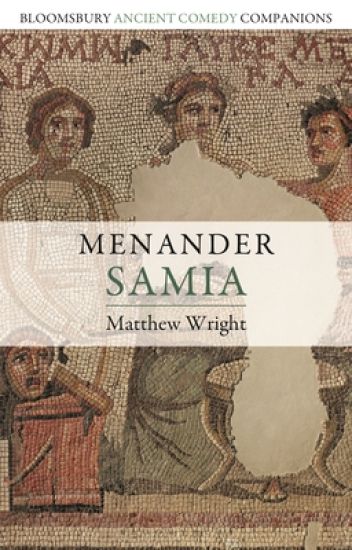
Menander: Samia

Menander: Samia

Matthew Wright

Bloomsbury Academic
2020
sidottu
Matthew Wright brings Menander’s Samia to life by explaining how it achieves its comic effects and how it fits within the broader context of fourth-century Greek drama and society. He offers a scene-by-scene reading of the play, combining close attention to detail with broader consideration of major themes, in an approach designed to bring out the humour and nuance of each individual moment on stage, while also illuminating Menander’s comic art.The play dramatizes a tangled story of mistakes, mishaps and misapprehensions leading up to the marriage of Moschion and Plangon. For most of the action the characters are at odds with one another owing to accidental delusions or deliberate deceptions, and it seems as if the marriage will be cancelled or indefinitely postponed; but ultimately everyone’s problems are solved and the play ends happily. Samia is one of the best-preserved examples of fourth-century Greek comedy: celebrated within antiquity but subsequently lost for many years, it miraculously came back to light, in almost complete form, as a result of Egyptian papyrus finds during the 20th century.
Menander: Samia

Menander: Samia

Matthew Wright

Bloomsbury Academic
2020
nidottu
Matthew Wright brings Menander’s Samia to life by explaining how it achieves its comic effects and how it fits within the broader context of fourth-century Greek drama and society. He offers a scene-by-scene reading of the play, combining close attention to detail with broader consideration of major themes, in an approach designed to bring out the humour and nuance of each individual moment on stage, while also illuminating Menander’s comic art.The play dramatizes a tangled story of mistakes, mishaps and misapprehensions leading up to the marriage of Moschion and Plangon. For most of the action the characters are at odds with one another owing to accidental delusions or deliberate deceptions, and it seems as if the marriage will be cancelled or indefinitely postponed; but ultimately everyone’s problems are solved and the play ends happily. Samia is one of the best-preserved examples of fourth-century Greek comedy: celebrated within antiquity but subsequently lost for many years, it miraculously came back to light, in almost complete form, as a result of Egyptian papyrus finds during the 20th century.
Britain's Last Battleships

Britain's Last Battleships

Matthew Wright

Intruder Books
2020
nidottu
Britain's last generation of battleships emerged in the 1930s to the backdrop of a fading Empire. Industrial production had fallen sharply since the First World War, and Britain's economic position was poor. These constraints shaped the nature of Britain's last battleships - a continuum of designs that culminated in HMS Vanguard, completed after the war when a near-bankrupt Britain had to confront the reality of a lost empire.This short book, a monograph, explores the way that British designers responded to this challenging framework, revealing the context within which the decisions that shaped Britain's last battleships were made.
Immigration and the American Ethos

Immigration and the American Ethos

Morris Levy; Matthew Wright

Cambridge University Press
2020
pokkari
What do Americans want from immigration policy and why? In the rise of a polarized and acrimonious immigration debate, leading accounts see racial anxieties and disputes over the meaning of American nationhood coming to a head. The resurgence of parochial identities has breathed new life into old worries about the vulnerability of the American Creed. This book tells a different story, one in which creedal values remain hard at work in shaping ordinary Americans' judgements about immigration. Levy and Wright show that perceptions of civic fairness - based on multiple, often competing values deeply rooted in the country's political culture - are the dominant guideposts by which most Americans navigate immigration controversies most of the time and explain why so many Americans simultaneously hold a mix of pro-immigrant and anti-immigrant positions. The authors test the relevance and force of the theory over time and across issue domains.
Immigration and the American Ethos

Immigration and the American Ethos

Morris Levy; Matthew Wright

Cambridge University Press
2020
sidottu
What do Americans want from immigration policy and why? In the rise of a polarized and acrimonious immigration debate, leading accounts see racial anxieties and disputes over the meaning of American nationhood coming to a head. The resurgence of parochial identities has breathed new life into old worries about the vulnerability of the American Creed. This book tells a different story, one in which creedal values remain hard at work in shaping ordinary Americans' judgements about immigration. Levy and Wright show that perceptions of civic fairness - based on multiple, often competing values deeply rooted in the country's political culture - are the dominant guideposts by which most Americans navigate immigration controversies most of the time and explain why so many Americans simultaneously hold a mix of pro-immigrant and anti-immigrant positions. The authors test the relevance and force of the theory over time and across issue domains.
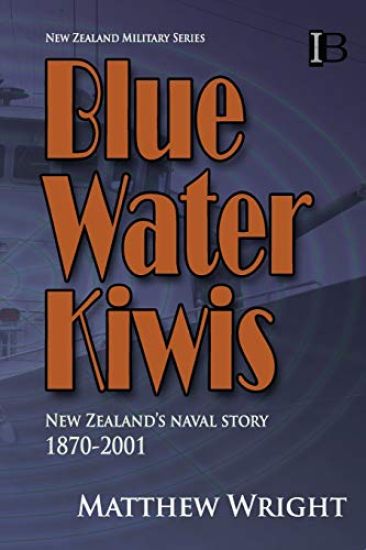
Blue Water Kiwis: New Zealand's Naval Story 1870-2001
In the summer of 1873, New Zealand was rocked by a scandal: Auckland newspaper editor David Leckie insisted that Russian terrorists had taken over a British warship in Auckland's Waitemata harbour and held the town to ransom. It was a hoax, of course, but he did it to highlight New Zealand's growing sense of vulnerability as one of Britain's furthest-flung colonies. So, in earnest, began New Zealand's naval story - one that extended through the highs and lows of the twentieth century: the First World War - when New Zealand naval forces and personnel fought from the North Sea to the Pacific - to the Second, when New Zealand's naval forces and personnel served in most of the major theatres, and finally the Cold War. It was a dramatic, exciting and ultimately human tale of people, politics, heroism and struggle, played out over more than 130 tumultuous years.