Kirjojen hintavertailu. Mukana 12 549 585 kirjaa ja 12 kauppaa.

Kirjailija

Matthias Schmelzer

Kirjat ja teokset yhdessä paikassa: 6 kirjaa, julkaisuja vuosilta 2017-2025, suosituimpien joukossa Degrowth / Postwachstum zur Einführung. Vertaile teosten hintoja ja tarkista saatavuus suomalaisista kirjakaupoista.

6 kirjaa

Kirjojen julkaisuhaarukka 2017-2025.

Freedom for Capital, Not People

Freedom for Capital, Not People

Matthias Schmelzer

Verso Books
2025
nidottu
Based on new archival sources, Freedom for Capital, Not People tells the story of how the Mont Pèlerin Society transformed the world economy. Founded in 1947 by economist Friedrich von Hayek, by the turn of the 1970s the society commanded influence at the highest levels of international monetary policy - with debates sparked by Hayek, Milton Friedman and Ludwig von Mises emigrating from the seminar room to the halls of power. The group's collective agenda, the result of years of fierce argument and shrewd political strategising, would dominate the next half century of global capitalism.
The Future is Degrowth

The Future is Degrowth

Matthias Schmelzer; Andrea Vetter; Aaron Vansintjan

Verso Books
2022
nidottu
Economic growth isn't working, and it cannot be made to work. Offering a counter-history of how economic growth emerged in the context of colonialism, fossil-fueled industrialization, and capitalist modernity, The Future Is Degrowth argues that the ideology of growth conceals the rising inequalities and ecological destructions associated with capitalism, and points to desirable alternatives to it. Not only in society at large, but also on the left, we are held captive by the hegemony of growth. Even proposals for emancipatory Green New Deals or postcapitalism base their utopian hopes on the development of productive forces, on redistributing the fruits of economic growth and technological progress. Yet growing evidence shows that continued economic growth cannot be made compatible with sustaining life and is not necessary for a good life for all. This book provides a vision for postcapitalism beyond growth. Building on a vibrant field of research, it discusses the political economy and the politics of a non-growing economy. It charts a path forward through policies that democratise the economy, "now-topias" that create free spaces for experimentation, and counter-hegemonic movements that make it possible to break with the logic of growth. Degrowth perspectives offer a way to step off the treadmill of an alienating, expansionist, and hierarchical system. A handbook and a manifesto, The Future Is Degrowth is a must-read for all interested in charting a way beyond the current crises.
Degrowth in Movement(s)

Degrowth in Movement(s)

Nina Treu; Matthias Schmelzer; Corinna Burkhart

John Hunt Publishing
2020
nidottu
Degrowth is an emerging social movement that overlaps with proposals for systemic change such as anti-globalization and climate justice, commons and transition towns, basic income and Buen Vivir. Degrowth in Movement(s) reflects on the current situation of social movements aiming at overcoming capitalism, industrialism and domination. The essays ask: What is the key idea of the respective movement? Who is active? What is the relation with the degrowth movement? What can the degrowth movement learn from these other movements and the other way around? Which common proposals, but also which contradictions, oppositions and tensions exist? And what alliances could be possible for broader systemic transformations? Corinna Bukhart, Matthias Schmelzer, and Nina Treu have curated an impressive demonstration that there are, beyond regressive neoliberalism and techno-fixes, emancipatory alternatives contributing to a good life for all. Degrowth in Movement(s) explores this mosaic for social-ecological transformation - an alliance strengthened by diversity.
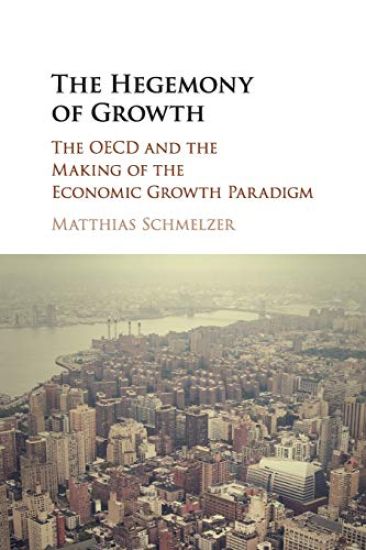
The Hegemony of Growth

The Hegemony of Growth

Matthias Schmelzer

Cambridge University Press
2017
pokkari
In modern society, economic growth is considered to be the primary goal pursued through policymaking. But when and how did this perception become widely adopted among social scientists, politicians and the general public? Focusing on the OECD, one of the least understood international organisations, Schmelzer offers the first transnational study to chart the history of growth discourses. He reveals how the pursuit of GDP growth emerged as a societal goal and the ways in which the methods employed to measure, model and prescribe growth resulted in statistical standards, international policy frameworks and widely accepted norms. Setting his analysis within the context of capitalist development, post-war reconstruction, the Cold War, decolonization, and industrial crisis, The Hegemony of Growth sheds new light on the continuous reshaping of the growth paradigm up to the neoliberal age and adds historical depth to current debates on climate change, inequality and the limits to growth.