

Kirjailija
Max Dresden
Kirjat ja teokset yhdessä paikassa: 3 kirjaa, julkaisuja vuosilta 1997-2013, suosituimpien joukossa H.A. Kramers Between Tradition and Revolution. Vertaile teosten hintoja ja tarkista saatavuus suomalaisista kirjakaupoista.
3 kirjaa
Kirjojen julkaisuhaarukka 1997-2013.

H.A. Kramers Between Tradition and Revolution
Max Dresden
Springer-Verlag New York Inc.
2011
nidottu
It is now a little more than 11 years since the idea of writing a personal and scientific biography of H. A. Kramers took hold of me. A few days earlier I had been lecturing, in a course on field theory, on the renormalization proce dures of relativistic quantum field theory. Since the students had considerable trouble understanding the physical basis of the procedure, at the end of the lecture T explained that renormalization is not an exclusive quantum or relativistic procedure. A careful treatment of classical electron theory as started by Lorentz and developed in detail by Kramers also requires re normalization. The students appeared quite interested and I promised them that I would explain all this in more detail in the next lecture. I could have looked up this material in Kramers' book, but I remembered that Kramers had stressed this idea in a course I had attended in Leiden in 1938-1939. I did dig up some of these old notes and, although they were considerably less transparent than my recollection seemed to indicate, they reminded me force fully of the thrilling days I had spent in Leiden with Kramers. Kramers' deep insight and originality were apparent even when distorted by my opaque notes. The students had never heard of these ideas of Kramers' and were totally unaware of his work in field theory.
A Guide to Physics Problems
Sidney B. Cahn; Max Dresden; Gerald D. Mahan; Boris E. Nadgorny
Kluwer Academic/Plenum Publishers
1997
nidottu
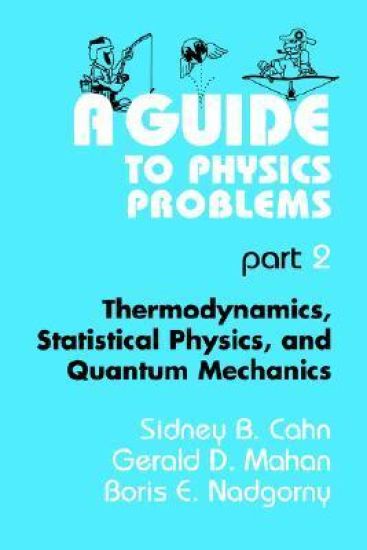
In order to equip hopeful graduate students with the knowledge necessary to pass the qualifying examination, the authors have assembled and solved standard and original problems from major American universities – Boston University, University of Chicago, University of Colorado at Boulder, Columbia, University of Maryland, University of Michigan, Michigan State, Michigan Tech, MIT, Princeton, Rutgers, Stanford, Stony Brook, University of Tennessee at Knoxville, and the University of Wisconsin at Madison – and Moscow Institute of Physics and Technology. A wide range of material is covered and comparisons are made between similar problems of different schools to provide the student with enough information to feel comfortable and confident at the exam. Guide to Physics Problems is published in two volumes: this book, Part 2, covers Thermodynamics, Statistical Mechanics and Quantum Mechanics; Part 1, covers Mechanics, Relativity and Electrodynamics. Praise for A Guide to Physics Problems: Part 2: Thermodynamics, Statistical Physics, and Quantum Mechanics: "… A Guide to Physics Problems, Part 2 not only serves an important function, but is a pleasure to read. By selecting problems from different universities and even different scientific cultures, the authors have effectively avoided a one-sided approach to physics. All the problems are good, some are very interesting, some positively intriguing, a few are crazy; but all of them stimulate the reader to think about physics, not merely to train you to pass an exam. I personally received considerable pleasure in working the problems, and I would guess that anyone who wants to be a professional physicist would experience similar enjoyment. … This book will be a great help to students and professors, as well as a source of pleasure and enjoyment." (From Foreword by Max Dresden) "An excellent resource for graduate studentsin physics and, one expects, also for their teachers." (Daniel Kleppner, Lester Wolfe Professor of Physics Emeritus, MIT) "A nice selection of problems … Thought-provoking, entertaining, and just plain fun to solve." (Giovanni Vignale, Department of Physics and Astronomy, University of Missouri at Columbia) "Interesting indeed and enjoyable. The problems are ingenious and their solutions very informative. I would certainly recommend it to all graduate students and physicists in general … Particularly useful for teachers who would like to think about problems to present in their course." (Joel Lebowitz, Rutgers University) "A very thoroughly assembled, interesting set of problems that covers the key areas of physics addressed by Ph.D. qualifying exams. … Will prove most useful to both faculty and students. Indeed, I plan to use this material as a source of examples and illustrations that will be worked into my lectures." (Douglas Mills, University of California at Irvine)