Kirjojen hintavertailu. Mukana 12 390 323 kirjaa ja 12 kauppaa.

Kirjailija

Max G. Manwaring

Kirjat ja teokset yhdessä paikassa: 31 kirjaa, julkaisuja vuosilta 2008-2024, suosituimpien joukossa Confronting the Evolving Global Security Landscape. Vertaile teosten hintoja ja tarkista saatavuus suomalaisista kirjakaupoista.

Mukana myös kirjoitusasut: Max G Manwaring

31 kirjaa

Kirjojen julkaisuhaarukka 2008-2024.

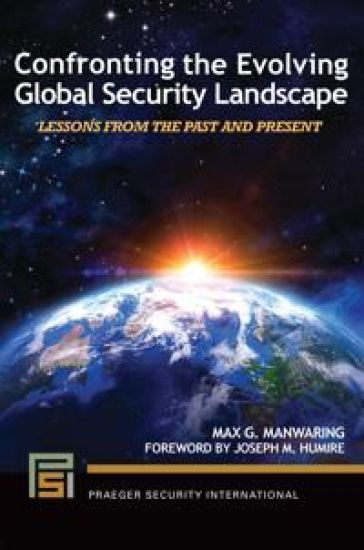
Confronting the Evolving Global Security Landscape

Confronting the Evolving Global Security Landscape

Max G. Manwaring; Joseph M. Humire

BLOOMSBURY PUBLISHING PLC
2024
nidottu
Helps civilian and military leaders, opinion makers, scholars, and interested citizens come to grips with the realities of the 21st-century global security arena by dissecting lessons from both the past and the present. This book accomplishes four tasks: first, it outlines the evolution of the national and international security concept from the Treaty of Westphalia (1648) to the present; second, it examines the circular relationship of the elements that define contemporary security; third, it provides empirical examples to accompany the discussion of each element—security, development, governance, and sovereignty; and fourth, it argues that substantially more sophisticated stability-security concepts, policy structures, and policymaking precautions are required in order for the United States to play more effectively in the global security arena. Case studies provide the framework to join the various chapters of the book into a cohesive narrative, while the theoretical linear analytic method it employs defines its traditional approach to case studies. For each case study, it discusses the issue in context, findings and outcomes of the issue, and conclusions and implications. Issue and Context sections outline the political-historical situation and answer the "What?" question, Findings and Outcome sections answer the "Who?", "Why?", "How?", and "So What?" questions, and Conclusions and Implications sections address Key Points and Lessons.
The Complexity of Modern Asymmetric Warfare

The Complexity of Modern Asymmetric Warfare

Max G. Manwaring; John T. Fishel; Edwin G. Corr

UNIVERSITY OF OKLAHOMA PRESS
2022
nidottu
Today more than one hundred small, asymmetric, and revolutionary wars are being waged around the world. This book provides invaluable tools for fighting such wars by taking enemy perspectives into consideration. The third volume of a trilogy by Max G. Manwaring, it continues the arguments the author presented in Insurgency, Terrorism, and Crime and Gangs, Pseudo-Militaries, and Other Modern Mercenaries. Using case studies, Manwaring outlines vital survival lessons for leaders and organizations concerned with national security in our contemporary world.The insurgencies Manwaring describes span the globe. Beginning with conflicts in Algeria in the 1950s and 1960s and El Salvador in the 1980s, he goes on to cover the Shining Path and its resurgence in Peru, Al Qaeda in Spain, popular militias in Cuba, Haiti, and Brazil, the Russian youth group Nashi, and drugs and politics in Guatemala, as well as cyber warfare.Large, wealthy, well-armed nations such as the United States have learned from experience that these small wars and insurgencies do not resemble traditional wars fought between geographically distinct nation-state adversaries by easily identified military forces. Twenty-first-century irregular conflicts blur traditional distinctions among crime, terrorism, subversion, insurgency, militia, mercenary and gang activity, and warfare.Manwaring’s multidimensional paradigm offers military and civilian leaders a much needed blueprint for achieving strategic victories and ensuring global security now and in the future. It combines military and police efforts with politics, diplomacy, economics, psychology, and ethics. The challenge he presents to civilian and military leaders is to take probable enemy perspectives into consideration, and turn resultant conceptions into strategic victories.
Uncomfortable Wars

Uncomfortable Wars

Max G Manwaring

TAYLOR FRANCIS LTD
2022
sidottu
This volume aims to operationalize General John R. Galvin's call for a new paradigm to fight the most prevalent form of conflict in the world today-insurgency. It contributes to the understanding needed to formulate and implement efforts in the contemporary international security arena.
Gray Area Phenomena

Gray Area Phenomena

Max G. Manwaring

Routledge
2021
nidottu
This book addresses the challenge of international narcotics control by applying "the Manwaring paradigm." The paradigm is the basis for an improved strategy and theory of engagement for weak governments of the developing world, built around the concept of the "gray area phenomenon."
Managing Contemporary Conflict

Managing Contemporary Conflict

Max G Manwaring

Routledge
2020
nidottu
This book focuses on contemporary conflicts and how we can use the experience and knowledge gained from the Cold War to construct an effective program. It includes the elements for a theory of engagement and identifies management concepts for instructing foreign policy.
Uncomfortable Wars

Uncomfortable Wars

Max G Manwaring

Routledge
2020
nidottu
This volume aims to operationalize General John R. Galvin's call for a new paradigm to fight the most prevalent form of conflict in the world today-insurgency. It contributes to the understanding needed to formulate and implement efforts in the contemporary international security arena.
Gangs, Pseudo-militaries, and Other Modern Mercenaries

Gangs, Pseudo-militaries, and Other Modern Mercenaries

Max G. Manwaring; John T. Fishel; Edwin G. Corr

University of Oklahoma Press
2020
nidottu
As the first decade of the twenty-first century has made brutally clear, the very definitions of war and the enemy have changed almost beyond recognition. Threats to security are now as likely to come from armed propagandists, popular militias, or mercenary organizations as they are from conventional armies backed by nation-states. In this timely book, national security expert Max G. Manwaring explores a little-understood actor on the stage of irregular warfare - the gang.Since the end of the Cold War, some one hundred insurgencies or irregular wars have erupted throughout the world. Gangs have figured prominently in more than half of those conflicts, yet these and other nonstate actors have received little focused attention from scholars or analysts. This book fills that void.Employing a case study approach, and believing that shadows from the past often portend the future, Manwaring begins with a careful consideration of the writings of V. I. Lenin. He then scrutinizes the Piqueteros in Argentina, gangs in Colombia, private armies in Mexico, Hugo Chavez's use of popular militias in Venezuela, and the looming threat of Al Qaeda in Western Europe.As conventional warfare is increasingly eclipsed by these irregular and ""uncomfortable"" wars, Manwaring boldly diagnoses the problem and recommends solutions that policymakers should heed.
Gray Area Phenomena

Gray Area Phenomena

Max G. Manwaring

Routledge
2019
sidottu
This book addresses the challenge of international narcotics control by applying "the Manwaring paradigm." The paradigm is the basis for an improved strategy and theory of engagement for weak governments of the developing world, built around the concept of the "gray area phenomenon."
Confronting the Evolving Global Security Landscape

Confronting the Evolving Global Security Landscape

Max G. Manwaring; Joseph M. Humire

Praeger Publishers Inc
2019
sidottu
Helps civilian and military leaders, opinion makers, scholars, and interested citizens come to grips with the realities of the 21st-century global security arena by dissecting lessons from both the past and the present.This book accomplishes four tasks: first, it outlines the evolution of the national and international security concept from the Treaty of Westphalia (1648) to the present; second, it examines the circular relationship of the elements that define contemporary security; third, it provides empirical examples to accompany the discussion of each element—security, development, governance, and sovereignty; and fourth, it argues that substantially more sophisticated stability-security concepts, policy structures, and policymaking precautions are required in order for the United States to play more effectively in the global security arena.Case studies provide the framework to join the various chapters of the book into a cohesive narrative, while the theoretical linear analytic method it employs defines its traditional approach to case studies. For each case study, it discusses the issue in context, findings and outcomes of the issue, and conclusions and implications. Issue and Context sections outline the political-historical situation and answer the "What?" question, Findings and Outcome sections answer the "Who?", "Why?", "How?", and "So What?" questions, and Conclusions and Implications sections address Key Points and Lessons.

Managing Contemporary Conflict

Managing Contemporary Conflict

Max G Manwaring

Routledge
2019
sidottu
Departing from conventional policy rhetoric on the unconventional "new world disorder," Max G. Manwaring, Wm. J. Olson, and their colleagues here build upon Ambassador David C. Miller, Jr.'s three pillars of success for foreign policy and military management. They provide a sound intellectual road map through the dense fog of the contemporary inter
U.S. Security Policy in the Western Hemisphere: Why Colombia, Why Now, and What is to be Done?
This is one in the Special Series of monographs stemming from the February 2001 conference on Plan Colombia cosponsored by the Strategic Studies Institute of the U.S. Army War College and The Dante B. Fascell North-South Center of the University of Miami. In this monograph, Dr. Max G. Manwaring provides a comprehensive analysis of the Colombian crisis situation and makes viable recommendations to deal with it more effectively. In substantive U.S. national security terms, Dr. Manwaring addresses the questions, "Why Colombia, Why Now, and What Is To Be Done?" He explains the importance of that troubled country to the United States. He points out that the fragile democracy of Colombia is at risk, and that the violent spillover effects of three simultaneous wars pose a threat to the rest of the Western Hemisphere and the interdependent global community. Then Dr. Manwaring makes a case against continued tactical and operational approaches to the Colombian crisis and outlines what must be done.
Internal Wars: Rethinking Problem and Response

Internal Wars: Rethinking Problem and Response

Max G. Manwaring; Strategic Studies Institute

Lulu.com
2014
nidottu
Dr. Max Manwaring wrote this monograph in response to the fact that today over half the countries in the global community are faced with one variation or another of asymmetric guerrilla war. Insurgencies, internal wars, and other small-scale contingencies (SSCs) are the most pervasive and likely type of conflict in the post-Cold War era. That the United States will become involved directly or indirectly in some of these conflicts is almost certain. The Balkans, Colombia, Mexico, Somalia, and the Philippines are only a few cases in point. Yet, little or no recognition and application of the strategic-level lessons of the Vietnam War and the hundreds of other smaller conflicts that have taken place over the past several years are evident.
The Inescapable Global Security Arena

The Inescapable Global Security Arena

Max G. Manwaring; Strategic Studies Institute

Lulu.com
2014
nidottu
The common denominator intent of any terrorist group is to impose self-determined desires for "change" on a society, a nation-state, and/or other perceived symbols of power in the global community. The solution to the terrorism threat is not simply to destroy small bands of terrorist fanatics and the governments that support them. Additional measures are needed. That is, once a terrorist group is brought under control or neutralized, multifaceted efforts must be taken to preclude the seeds that created that organization from germinating again. Given these realities within the context of the contemporary global security environment, the United States has little choice but to reexamine and rethink national and global stability and security--and a peaceful and more prosperous tomorrow.
Nonstate Actors in Colombia: Threat and Response

Nonstate Actors in Colombia: Threat and Response

Max G. Manwaring; Strategic Studies Institute

Lulu.com
2014
nidottu
The common denominator intent of any terrorist group is to impose self-determined desires for "change" on a society, a nation-state, and/or other perceived symbols of power in the global community. The solution to the terrorism threat is not simply to destroy small bands of terrorist fanatics and the governments that support them. Additional measures are needed. That is, once a terrorist group is brought under control or neutralized, multifaceted efforts must be taken to preclude the seeds that created that organization from germinating again. Given these realities within the context of the contemporary global security environment, the United States has little choice but to reexamine and rethink national and global stability and security--and a peaceful and more prosperous tomorrow.
Building Regional Security Cooperation in the Western Hemisphere: Issues and Recommendations

Building Regional Security Cooperation in the Western Hemisphere: Issues and Recommendations

Max G. Manwaring; Wendy Fontela; Mary Grizzard; Dennis Rempe; Strategic Studies Institute

Lulu.com
2014
nidottu
Often, when a conference is over-it is over. More often than not, attendees and presenters return to their normal duties thinking good or ambivalent thoughts about what they heard and learned. At the same time, there might be a fleeting moment-or two or three-when one wonders how a particular set of ideas expressed at that conference might be implemented. But, again, "the fat lady has sung her song," and everyone has resumed normal routines. In the case of the conference co-sponsored by the U.S. Army War College, U.S. Southern Command, and University of Miami North- South Center held last March, entitled "Building Regional Security in the Western Hemisphere," we have generated a substantive set of issues and recommendations. Dr. Max Manwaring and his team of conference rapporteurs have reviewed hours of tapes and reams of notes to clarify the issues and develop actionable recommendations.
Security in the Americas: Neither Evolution nor Devolution - Impasse

Security in the Americas: Neither Evolution nor Devolution - Impasse

Max G. Manwaring; Strategic Studies Institute

Lulu.com
2014
nidottu
This monograph comes at a time of promise for greater economic integration between the United States and Latin America, but also one of profound concern about the deteriorating security situation in several countries in the region. Importantly, the benefi ts of stability, economic growth, and democracy depend on effective national sovereignty and security. These realities are gaining credence as we grow to understand that Colombia is a paradigm of the failing state, and that has enormous implications for the well-being of the Western Hemisphere. Yet, no consensus on the threat and how to deal with it has emerged. As a consequence, hemispheric security cooperation is at an impasse. In this context, Dr. Max Manwaring identifi es the political-strategic challenge of effective sovereignty and security, with a focus on nontraditional threats. He recommends that leaders rethink the problem of nontraditional threats and develop the conceptual and strategicpolitical multilateral responses...
Venezuela's Hugo Chavez, Bolivarian Socialism, and Asymmetric Warfare

Venezuela's Hugo Chavez, Bolivarian Socialism, and Asymmetric Warfare

Max G. Manwaring; Strategic Studies Institute

Lulu.com
2014
nidottu
This monograph comes at a time when the U.S. and Venezuelan governments are intensifying an ongoing series of acrimonious charges and countercharges. Each country has argued repeatedly that the other is engaged in a political-economic-military struggle for Western Hemisphere hegemony. On a more personal level, the United States maintains that President Hugo Chavez of Venezuela is playing a destabilizing role in the region, and is compromising the quality of democracy and the exercise of power in Venezuela and other parts of the Americas. Chavez rebuts that the only destabilizing factor in the hemisphere is President George W. Bush, and that democracy and power long since have been perverted by American capitalists and local elites for their own purposes. And the U.S.-Venezuelan verbal sparing match continues unabated. The author's intent is to explain who Hugo Chavez is, where it appears that he is going, and how he intends to get there; and the implications for democracy and stability in Latin America.
Street Gangs: the New Urban Insurgency

Street Gangs: the New Urban Insurgency

Max G. Manwaring; Strategic Studies Institute

Lulu.com
2014
nidottu
The intent of this monograph is to identify some of the most salient characteristics of contemporary criminal street gangs (that is, the gang phenomenon or third generation gangs), and to explain the linkage to insurgency. As a corollary, Dr. Max G. Manwaring argues that gang-related crime, in conjunction with the instability it wreaks upon governments, is now a serious national security and sovereignty problem in important parts of the global community. Although differences between gangs and insurgents exist, in terms of original motives and modes of operation, this linkage infers that the gang phenomenon is a mutated form of urban insurgency. That is, these nonstate actors must eventually seize political power to guarantee the freedom of action and the commercial environment they want. The common denominator that can link gangs and insurgents is that some gangs' and insurgents' ultimate objective is to depose or control the governments of targeted countries.
Latin America's New Security Reality: Irregular Asymmetric Conflict and Hugo Chavez
Since his election as President of Venezuela in 1998, Hugo Chavez has encouraged and continues to encourage his Venezuelan and other Latin American followers to pursue a confrontational "defensive," populist, and nationalistic agenda that will supposedly liberate Latin America from the economic dependency and the political imperialism of the North American "Colossus" (the United States). Chavez argues that liberation, New Socialism, and Bolivarianismo (the dream of a Latin American Liberation Movement against U.S. hegemony) will only be achieved by (1) radically changing the traditional politics of the Venezuelan state to that of "direct" (totalitarian) democracy; (2) destroying North American hegemony thoughout all of Latin America by (3) conducting an irregular and asymmetric "Super Insurgency," or "Fourth-Generation Warfare" to depose the illegitimate external enemy; and, 4) building a new Bolivarian state, beginning with Venezuela and extending to the whole of Latin America. This is not the
A Contemporary Challenge to State Sovereignty: Gangs and Other Illicit Transnational Criminal Organizations in Central America, El Salvador, Mexico, Jamaica, and Brazil
In this monograph, Dr. Max Manwaring builds on his 2005 SSI monograph, Street Gangs: The New Urban Insurgency, and illustrates gang and Transnational Criminal Organization (TCO) linkage to instability and its aftermath. He explains that gang-generated instability leads to threats to national, regional, and global security, nation-state sovereignty, failing and failed states, and a "clash of civilizations." Thus, whether a gang or another TCO is specifically a criminal or an insurgent type organization is irrelevant. The putative objective of all these illegal nonstate entities-taken together, the analytical commonality that directly links gangs, TCOs, and insurgents-is to neutralize, control, or depose governments to assure their own commercial or ideological expectations. In this connection, gangs and their various possible allies (the gang phenomenon) are attempting to ensure that they have maximum freedom of movement and action within and between "sovereign" national territories.