Kirjojen hintavertailu. Mukana 12 595 353 kirjaa ja 12 kauppaa.

Kirjailija

Max M. Houck

Kirjat ja teokset yhdessä paikassa: 10 kirjaa, julkaisuja vuosilta 2003-2026, suosituimpien joukossa Successful Expert Testimony. Vertaile teosten hintoja ja tarkista saatavuus suomalaisista kirjakaupoista.

10 kirjaa

Kirjojen julkaisuhaarukka 2003-2026.

Successful Expert Testimony

Successful Expert Testimony

Max M. Houck; Christine Funk; Harlan A. Feder

TAYLOR FRANCIS LTD
2026
sidottu
This book outlines the role of expert testimony in a trial, including explanations of methods, testing, and science, the legal process, and an overview of the roles of each player. In this, it details the expert witness’s role in promoting effective, impactful courtroom testimony. Succeeding as an expert witness requires a basic understanding of who and what experts are and what role they play in rendering their opinions within the courts. The new edition has been fully updated to present key information on the most vital functions the expert plays. This includes the deposition, a discussion of the dangers of false or unsupported testimony, adherence to scientific principles, and the direct and cross-examination testimony of expert witnesses. Each chapter includes key terms, review questions, and thought-provoking discussion questions for further consideration of the topics addressed. Given many recent high-profile cases and increasing incidents of misconduct, this edition focuses heavily on the role of ethics in expert testimony and forensic practice. Outlining established trial-tested tips, forensic scientist Max M. Houck and attorney Christine Funk update renowned lawyer Harold A. Feder’s classic book. This is an essential reference for forensic science students entering the work force—in labs and investigative positions—in addition to serving as a crucial resource for more experienced civil, private, and testifying experts in all disciplines.
Forensic Science Laboratory Benchmarking

Forensic Science Laboratory Benchmarking

Max M. Houck; Paul J. Speaker

TAYLOR FRANCIS LTD
2024
nidottu
Forensic Science Laboratory Benchmarking: The FORESIGHT Manual takes a step-by-step instructional approach to utilizing FORESIGHT data, detailing how labs can participate in the process to improve efficiencies. The FORESIGHT Project—a business benchmarking process for forensic service providers—was created in 2008 to collect and report data while offering improvement to processes through analysis, comparisons, and best practice evaluations. The program has grown to include more than 200 participating forensic laboratories worldwide.FORESIGHT offers the capability for labs to improve core functions, provide and benefit from metrics, and thus, improve the labs capabilities and functioning for the public good, while maintaining their often limited, fixed budgets. Due to ever-increasing caseloads, forensic laboratories are constantly plagued by backlogged casework—cases submitted to the laboratory but not yet worked. This leads to inefficiencies, delays, and unhappy agencies expecting timely results. Unfortunately, even if a lab’s slates were wiped clean and the backlog were erased, many of the inefficient processes—that created the backlog—would still be in place. Eventually, and inevitably, the lab would develop a new backlog.Unique coverage and features:Presents critical and proven cutting-edge measures to utilize FORESIGHT data improve laboratory testing, operational efficiency, and policies without added additional costs.Synthesizes the data input from more than 200 labs and a decade’s worth of analytics to illustrate process improvements and the advantages of participating.Outlines how to develop data-driven responses to solve current and future problems.Forensic Science Laboratory Benchmarking will be of interest to quality assurance specialists, economists, supervisors in the parent agencies of the labs, managers at all levels of any of the hundreds of public laboratories around the world, and anyone concerned about the effectiveness and efficiency of laboratory testing. As an operational guide, the book provides a helpful roadmap to help public science agencies and forensic labs analyze how they operate, improve on what works, and change what doesn’t to better meet their mission and serve their community’s goals.
Forensic Science Laboratory Benchmarking

Forensic Science Laboratory Benchmarking

Max M. Houck; Paul J. Speaker

TAYLOR FRANCIS LTD
2024
sidottu
Forensic Science Laboratory Benchmarking: The FORESIGHT Manual takes a step-by-step instructional approach to utilizing FORESIGHT data, detailing how labs can participate in the process to improve efficiencies. The FORESIGHT Project—a business benchmarking process for forensic service providers—was created in 2008 to collect and report data while offering improvement to processes through analysis, comparisons, and best practice evaluations. The program has grown to include more than 200 participating forensic laboratories worldwide.FORESIGHT offers the capability for labs to improve core functions, provide and benefit from metrics, and thus, improve the labs capabilities and functioning for the public good, while maintaining their often limited, fixed budgets. Due to ever-increasing caseloads, forensic laboratories are constantly plagued by backlogged casework—cases submitted to the laboratory but not yet worked. This leads to inefficiencies, delays, and unhappy agencies expecting timely results. Unfortunately, even if a lab’s slates were wiped clean and the backlog were erased, many of the inefficient processes—that created the backlog—would still be in place. Eventually, and inevitably, the lab would develop a new backlog.Unique coverage and features:Presents critical and proven cutting-edge measures to utilize FORESIGHT data improve laboratory testing, operational efficiency, and policies without added additional costs.Synthesizes the data input from more than 200 labs and a decade’s worth of analytics to illustrate process improvements and the advantages of participating.Outlines how to develop data-driven responses to solve current and future problems.Forensic Science Laboratory Benchmarking will be of interest to quality assurance specialists, economists, supervisors in the parent agencies of the labs, managers at all levels of any of the hundreds of public laboratories around the world, and anyone concerned about the effectiveness and efficiency of laboratory testing. As an operational guide, the book provides a helpful roadmap to help public science agencies and forensic labs analyze how they operate, improve on what works, and change what doesn’t to better meet their mission and serve their community’s goals.
Successful Expert Testimony

Successful Expert Testimony

Max M. Houck; Christine Funk; Harold A. Feder

CRC Press
2021
nidottu
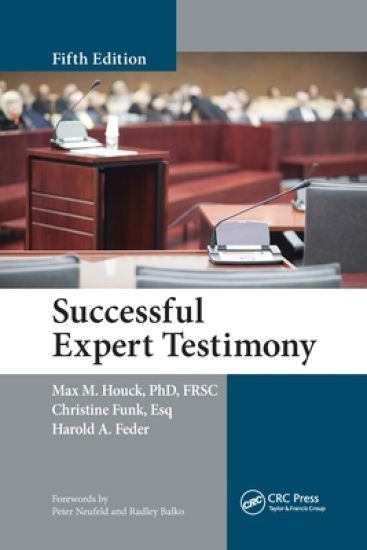
A major revision of the landmark book on expert testimony Feder’s Succeeding as an Expert Witness, Successful Expert Testimony, Fifth Edition highlights the book’s value to both attorneys and expert witnesses in promoting effective, impactful courtroom testimony. The book outlines the role of expert testimony in a trial, including explanations of methods, testing, and science, the legal process, and an overview of the roles of each player. Succeeding as an expert witness requires a basic understanding of who and what experts are and what role they play in rendering their opinions within the courts. The new edition has been fully updated to present key information on the most vital topics, including the deposition, a discussion of false or unsupported testimony, adherence to scientific principles, and direct and cross-examination testimony of expert witnesses. Each chapter includes key terms, review questions, and thought-provoking discussion questions for further consideration of the topics addressed.Given many high profile cases and increasing incidents of misconduct, this edition focuses heavily on the role of ethics in expert testimony and forensic practice. The full revised chapter on ethics, covers unethical conduct of forensic witnesses, admissibility of expert testimony, inter-professional relations, abuse of and by experts, and forensic professional codes of ethics.Offering useful career insights and established trial-tested tips, forensic scientist Max M. Houck and attorney Christine Funk update renowned lawyer Harold A. Feder’s classic book. Successful Expert Testimony, Fifth Edition serves as an ideal reference for forensic science students entering the work force—in labs and investigative positions—in addition to serving as a crucial resource for more experienced civil, private, and testifying experts in all disciplines.
Successful Expert Testimony

Successful Expert Testimony

Max M. Houck; Christine Funk; Harold A. Feder

CRC Press
2018
sidottu
A major revision of the landmark book on expert testimony Feder’s Succeeding as an Expert Witness, Successful Expert Testimony, Fifth Edition highlights the book’s value to both attorneys and expert witnesses in promoting effective, impactful courtroom testimony. The book outlines the role of expert testimony in a trial, including explanations of methods, testing, and science, the legal process, and an overview of the roles of each player. Succeeding as an expert witness requires a basic understanding of who and what experts are and what role they play in rendering their opinions within the courts. The new edition has been fully updated to present key information on the most vital topics, including the deposition, a discussion of false or unsupported testimony, adherence to scientific principles, and direct and cross-examination testimony of expert witnesses. Each chapter includes key terms, review questions, and thought-provoking discussion questions for further consideration of the topics addressed.Given many high profile cases and increasing incidents of misconduct, this edition focuses heavily on the role of ethics in expert testimony and forensic practice. The full revised chapter on ethics, covers unethical conduct of forensic witnesses, admissibility of expert testimony, inter-professional relations, abuse of and by experts, and forensic professional codes of ethics.Offering useful career insights and established trial-tested tips, forensic scientist Max M. Houck and attorney Christine Funk update renowned lawyer Harold A. Feder’s classic book. Successful Expert Testimony, Fifth Edition serves as an ideal reference for forensic science students entering the work force—in labs and investigative positions—in addition to serving as a crucial resource for more experienced civil, private, and testifying experts in all disciplines.
The Science of Crime Scenes

The Science of Crime Scenes

Max M. Houck; Frank Crispino; Terry McAdam

Academic Press Inc
2017
sidottu
The Science of Crime Scenes, Second Edition offers a science-based approach to crime scenes, emphasizing that understanding is more important than simply knowing. Without sacrificing technical details, the book adds significantly to the philosophy and theory of crime scene science. This new edition addresses the science behind the scenes and demonstrates the latest methods and technologies with updated figures and images. It covers the philosophy of the crime scene, the personnel involved at a scene (including the media), the detection of criminal traces and their reconstruction, and special crime scenes, such as mass disasters and terroristic events. Written by an international trio of authors with decades of crime scene experience, this book is the next generation of crime scene textbooks. This volume will serve both as a textbook for forensic programs, and as an excellent reference for forensic practitioners and crime scene technicians with science backgrounds.
Fundamentals of Forensic Science

Fundamentals of Forensic Science

Max M. Houck; Jay A. Siegel

Academic Press Inc
2015
sidottu
Fundamentals of Forensic Science, Third Edition, provides current case studies that reflect the ways professional forensic scientists work, not how forensic academicians teach. The book includes the binding principles of forensic science, including the relationships between people, places, and things as demonstrated by transferred evidence, the context of those people, places, and things, and the meaningfulness of the physical evidence discovered, along with its value in the justice system. Written by two of the leading experts in forensic science today, the book approaches the field from a truly unique and exciting perspective, giving readers a new understanding and appreciation for crime scenes as recent pieces of history, each with evidence that tells a story.
The Science of Crime Scenes

The Science of Crime Scenes

Max M. Houck; Frank Crispino; Terry McAdam

Academic Press Inc
2012
sidottu
The Science of Crime Scenes addresses the science of crime scene investigation and processing, including the latest methods and technologies. This book covers the philosophy of crime scenes as historical events, the personnel involved at a scene (including the media), the detection of criminal traces and their reconstruction, and special crime scenes, such as mass disasters and terrorist events. Written by an international trio of authors with decades of crime scene experience, it is the next generation of crime scene textbooks. The book provides in-depth coverage of disasters and mass murder, terror crime scenes, and CBRN (chemical, biological, radioactive and nuclear) – topics not covered in any other text. It includes an instructor website with lecture slides, test bank, outlines, definitions, and activities, along with a student companion site with an image collection. This text will be of interest to advanced undergraduate and graduate students in forensic science programs, as well as to forensic practitioners and crime scene technicians.
Forensic Science

Forensic Science

Max M. Houck

Praeger Publishers Inc
2007
sidottu
From Poe's Dupin and Doyle's Holmes to the television hits Quincy and CSI, the public's fascination with science employed to solve crimes continues and grows. But this understanding of how science works in the forensic laboratory is filtered through the fictional worlds of books and television-how is science really used to fight crime? What techniques are used to catch criminals and free the innocent? Forensic scientists work with police, investigators, medical personnel, attorneys, and others to uphold justice, but their methods are often misunderstood, overestimated, underestimated, revered, or disputed. Here, the author answers many common questions about forensic science: How is the science conducted and by whom? What are the real limits, and real benefits, of forensic science? What new techniques are emerging to catch 21st Century criminals? Readers are treated to an insider's overview of the realties of forensic science.Forensic Science: Modern Methods of Solving Crime covers the basic concepts of forensic science and how it assists in criminal investigations. Starting with a brief history of forensic science, from its early days in Europe to the modern advances of today, the book describes each method and presents cases that highlight the applications of the methods. Houck profiles pioneers in forensic science, offers an overview of such forensic topics as DNA, fibers, fingerprints, and firearms, takes readers through the collection and processing of evidence, and uses frequent examples and anecdotes to illustrate all the major areas of forensic science. This introduction to the field is a useful starting point for anyone wishing to learn more about the real world of forensic science.
Trace Evidence Analysis

Trace Evidence Analysis

Max M. Houck

Academic Press Inc
2003
sidottu
Trace Evidence Analysis continues and builds upon the tradition of its successful companion title Mute Witnesses (2000). The book contains nine entirely new cases, each self-contained in its own chapter, covering everything from homicides to accident reconstruction. It includes contributions from some of the premier forensic scientists in the field who provide detailed accounts of the process of collection, classification, and analysis of microscopic evidence to draw definitive conclusions that solved actual cases. The book discusses the role of evidence in solving cases and explores the legal and ethical responsibility of the forensic scientist. It examines real-world application of scientific methods and analytic principles, including evidence gathering, instrumentation, sampling methods, analysis, and interpretation; and features over 160 full-color figures that illustrate the relevant case evidence. This book is a recommended resource for forensic microscopists and trace evidence analysts, crime laboratories, crime scene technicians, criminal investigators, forensic science professionals and students, and the legal community.