Kirjojen hintavertailu. Mukana 12 595 353 kirjaa ja 12 kauppaa.

Kirjailija

Max Planck

Kirjat ja teokset yhdessä paikassa: 68 kirjaa, julkaisuja vuosilta 1897-2026, suosituimpien joukossa A Survey of Physics. Vertaile teosten hintoja ja tarkista saatavuus suomalaisista kirjakaupoista.

68 kirjaa

Kirjojen julkaisuhaarukka 1897-2026.

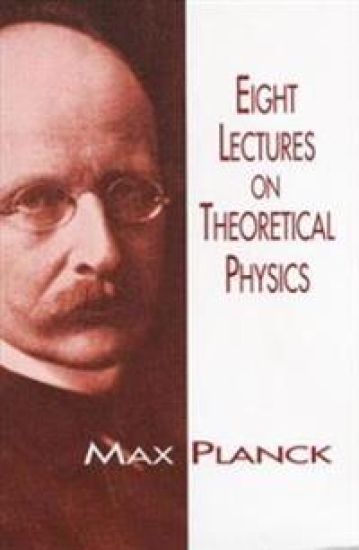
Eight Lectures on Theoretical Physics

Eight Lectures on Theoretical Physics

Max Planck

Dover Publications Inc.
2003
nidottu
In 1909 the great German physicist and Nobel Prize winner Max Planck (1858-1947) delivered a series of eight lectures at Columbia University giving a fascinating overview of the new state of physics, which he had played a crucial role in bringing about.The first, third, fifth, and sixth lectures present his account of the revolutionary developments occasioned when he first applied the quantum hypothesis to blackbody radiation. The reader is given a valuable opportunity to witness Planck's thought processes both on the level of philosophical principles as well as their application to physical processes on the microscopic and macroscopic scales. In the second and fourth lectures Planck shows how the new ideas of statistical mechanics transformed the understanding of chemical physics. The seventh lecture discusses the principle of least action, while the final one gives an account of the theory of special relativity, of which Planck had been an early champion.These lectures are especially important since they reflect Planck's reconsiderations and rethinking of his original discovery of quantum theory. A new Introduction by Peter Pesic places this book in historical perspective among Planck's works and those of his contemporaries. Now available in this inexpensive edition, it will be of particular interest to students of modern physics and of the philosophy and history of science.
Vorträge Reden Erinnerungen

Vorträge Reden Erinnerungen

Max Planck

Springer-Verlag Berlin and Heidelberg GmbH Co. K
2001
sidottu
MAX PLANCK (1858-1947) ist als Begründer der Quantentheorie der herausragende Physiker Deutschlands. 1918 erhielt er den Nobelpreis für Physik. Er hat sich in Wort und Schrift zu brennenden Problemen aus Kultur, Religion und Wissenschaft geäußert. Viele dieser Beiträge haben bis heute ihre Aussagekraft nicht verloren. Die vorliegende Sammlung, zusammengestellt und herausgegeben von Hans Roos und Armin Hermann, würdigt den Menschen und Physiker anläßlich des 100jährigen Jubiläums der Geburtsstunde der Quantentheorie (14.12.1900). Das Buch richtet sich an eine breite Leserschaft.
Treatise on Thermoynamics

Treatise on Thermoynamics

Max Planck

Hawk Press
1985
pokkari
PART I.FUNDAMENTAL FACTS AND DEFINITIONS.I. TemperatureII. Molecular WeightIII. Quantity of HeatPART II.THE FIRST FUNDAMENTAL PRINCIPLE OF THERMODYNAMICS.I. General ExpositionII. Applications to Homogeneous SystemsIII. Applications to Non-Homogeneous SystemsPART III.THE SECOND FUNDAMENTAL PRINCIPLE OF THERMODYNAMICSI. IntroductionII. ProofIII. General DeductionsPART IV.APPLICATIONS TO SPECIAL STATES OF EQUILIBRIUM.I. Homogeneous SystemsII. System in Different States of AggregationIII. System of any Number of Independent ConstituentsIV. Gaseous SystemV. Dilute SolutionsCatalogue of the Author's Papers on ThermodynamicsIndex
Treatise on Thermoynamics

Treatise on Thermoynamics

Max Planck

Hawk Press
1985
sidottu
PART I.FUNDAMENTAL FACTS AND DEFINITIONS.I. TemperatureII. Molecular WeightIII. Quantity of HeatPART II.THE FIRST FUNDAMENTAL PRINCIPLE OF THERMODYNAMICS.I. General ExpositionII. Applications to Homogeneous SystemsIII. Applications to Non-Homogeneous SystemsPART III.THE SECOND FUNDAMENTAL PRINCIPLE OF THERMODYNAMICSI. IntroductionII. ProofIII. General DeductionsPART IV.APPLICATIONS TO SPECIAL STATES OF EQUILIBRIUM.I. Homogeneous SystemsII. System in Different States of AggregationIII. System of any Number of Independent ConstituentsIV. Gaseous SystemV. Dilute SolutionsCatalogue of the Author's Papers on ThermodynamicsIndex
The Theory of Heat Radiation

The Theory of Heat Radiation

Max Planck

Hawk Press
1985
sidottu
PART I FUNDAMENTAL FACTS AND DEFINITIONSI. General Introduction II. Radiation at Thermodynamic Equilibrium. Kirchhoff's Law Black Radiation PART II DEDUCTIONS FROM ELECTRODYNAMICS AND THERMODYNAMICSI. Maxwell's Radiation Pressure II. Stefan-Boltzmann Law of Radiation III. Wien's Displacement Law IV. Radiation of Any Arbitrary Spectral Distribution of Energy. Entropy and Temperature of Monochromatic Radiation V. Electrodynamical Processes in a Stationary Field of Radiation PART III ENTROPY AND PROBABILITYI. Fundamental Definitions and Laws. Hypothesis of Quanta II. Ideal Monatomic Gases III. Ideal Linear Oscillators IV. Direct Calculation of the Entropy in The Case of Thermodynamic EquilibriumPART IV A SYSTEM OF OSCILLATORS IN A STATIONARY FIELD OF RADIATIONI. The Elementary Dynamical Law for The Vibrations of an Ideal Oscillator. Hypothesis of Emission of Quanta II. Absorbed EnergyIII. Emitted Energy. Stationary StateIV. The Law of the Normal Distribution Of Energy. Elementary Quanta Of Matter and Electricity PART V IRREVERSIBLE RADIATION PROCESSESI. Fields of Radiation in GeneralII. One Oscillator in the Field of Radiation III. A System of Oscillators IV. Conservation of Energy and Increase Of Entropy. Conclusion
Scientific Autobiography and Other Papers

Scientific Autobiography and Other Papers

Max Planck

Philosophical Library
1968
sidottu
In this fascinating autobiography from the foremost genius of twentieth-century physics, Max Planck tells the story of his life, his aims, and his thinking. Published posthumously, the papers in this volume were written for the general reader and make accessible his scientific theories as well as his philosophical ideals, including his thoughts on ethics and morals. Max (Karl Ernst Ludwig) Planck was a German physicist and philosopher known for his quantum theory, for which he won the Nobel Prize in Physics in 1918. Planck was born in Kiel, Germany, in 1858 to an academic family, and he valued education from a young age. He attended the Universities of Munich and Berlin to study physics under the great scientific leaders Kirchhoff and Helmholtz. His early work mainly focused on the study of thermodynamics, and in 1900 he published a paper on his quantum theory that would change the face of modern physics. Planck worked as a professor at Berlin University his entire life, and he also served as the president of the Kaiser Wilhelm Society for the Promotion of Science. During World War II, Planck experienced great hardships while he remained in Germany but openly opposed the Nazi regime. One of his two sons was executed during this time for an unsuccessful attempt on Hitler's life, and Planck's home in Berlin was eventually bombed. He continued to write on physics and philosophy until his death in 1947.
25 Jahre Kaiser Wilhelm-Gesellschaft zur Förderung der Wissenschaften

25 Jahre Kaiser Wilhelm-Gesellschaft zur Förderung der Wissenschaften

Max Planck

Springer-Verlag Berlin and Heidelberg GmbH Co. K
1936
nidottu
Dieser Buchtitel ist Teil des Digitalisierungsprojekts Springer Book Archives mit Publikationen, die seit den Anfängen des Verlags von 1842 erschienen sind. Der Verlag stellt mit diesem Archiv Quellen für die historische wie auch die disziplingeschichtliche Forschung zur Verfügung, die jeweils im historischen Kontext betrachtet werden müssen. Dieser Titel erschien in der Zeit vor 1945 und wird daher in seiner zeittypischen politisch-ideologischen Ausrichtung vom Verlag nicht beworben.