Kirjojen hintavertailu. Mukana 12 595 353 kirjaa ja 12 kauppaa.

Kirjailija

Max Welling

Kirjat ja teokset yhdessä paikassa: 5 kirjaa, julkaisuja vuosilta 2019-2026, suosituimpien joukossa Structured Representation Learning. Vertaile teosten hintoja ja tarkista saatavuus suomalaisista kirjakaupoista.

5 kirjaa

Kirjojen julkaisuhaarukka 2019-2026.

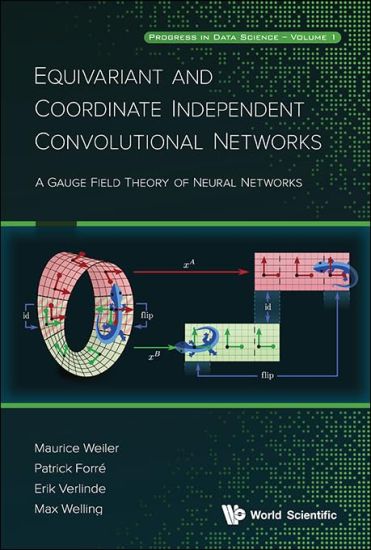
Equivariant And Coordinate Independent Convolutional Networks: A Gauge Field Theory Of Neural Networks

Equivariant And Coordinate Independent Convolutional Networks: A Gauge Field Theory Of Neural Networks

Patrick Forre; Erik Verlinde; Maurice Weiler; Max Welling

WORLD SCIENTIFIC PUBLISHING CO PTE LTD
2025
sidottu
What is the appropriate geometric structure for neural networks for processing spatial signals like images, point clouds, or tensor fields? This question takes us on a journey towards a gauge field theory of convolutional neural networks.A considerable part of machine learning applications is concerned with analyzing fields of feature vectors on Euclidean spaces or more general manifolds. Model predictions should thereby remain consistent when applying geometric transformations to the fields or the coordinate systems describing them. This book derives and characterizes the implied symmetry constraints on thus defined equivariant convolutional neural networks. Instead of focusing on one specific setting, it develops a general representation theoretic formulation for arbitrary symmetry groups and spaces. The theory is made concrete in several chapters discussing implementations of equivariant convolutional networks on various manifolds.This monograph is essential reading for anyone interested in signal processing in the presence of symmetries. It is relevant for any applications where patterns appear in various geometric poses, including, for instance, medical and satellite imaging, molecule generation, or climate modeling.
Structured Representation Learning

Structured Representation Learning

Yue Song; Thomas Anderson Keller; Nicu Sebe; Max Welling

Springer International Publishing AG
2025
sidottu
This book introduces approaches to generalize the benefits of equivariant deep learning to a broader set of learned structures through learned homomorphisms. In the field of machine learning, the idea of incorporating knowledge of data symmetries into artificial neural networks is known as equivariant deep learning and has led to the development of cutting edge architectures for image and physical data processing. The power of these models originates from data-specific structures ingrained in them through careful engineering. To-date however, the ability for practitioners to build such a structure into models is limited to situations where the data must exactly obey specific mathematical symmetries. The authors discuss naturally inspired inductive biases, specifically those which may provide types of efficiency and generalization benefits through what are known as homomorphic representations, a new general type of structured representation inspired from techniques in physics and neuroscience. A review of some of the first attempts at building models with learned homomorphic representations are introduced. The authors demonstrate that these inductive biases improve the ability of models to represent natural transformations and ultimately pave the way to the future of efficient and effective artificial neural networks.
An Introduction to Variational Autoencoders

An Introduction to Variational Autoencoders

Diederik P. Kingma; Max Welling

now publishers Inc
2019
nidottu
In this monograph, the authors present an introduction to the framework of variational autoencoders (VAEs) that provides a principled method for jointly learning deep latent-variable models and corresponding inference models using stochastic gradient descent. The framework has a wide array of applications from generative modeling, semi-supervised learning to representation learning.The authors expand earlier work and provide the reader with the fine detail on the important topics giving deep insight into the subject for the expert and student alike. Written in a survey-like nature the text serves as a review for those wishing to quickly deepen their knowledge of the topic.An Introduction to Variational Autoencoders provides a quick summary for the of a topic that has become an important tool in modern-day deep learning techniques.
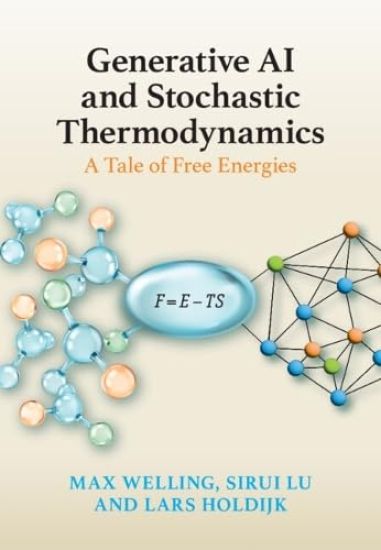
Generative AI and Stochastic Thermodynamics

Generative AI and Stochastic Thermodynamics

Max Welling; Sirui Lu; Lars Holdijk

Cambridge University Press
2026
sidottu
Originating from lectures delivered at the African Institute of Mathematical Sciences, this book presents a unifying perspective on traditional and modern methods in generative AI and stochastic thermodynamics. By relating the core topics in machine learning to the notion of (variational) free-energy, a bridge is built between methods such as latent variable models, variational auto-encoders, optimal control, optimal transport, normalizing flows and diffusion models and concepts such as entropy production and fluctuation theorems in stochastic thermodynamics. Structured into three main parts, the book commences by setting up the required mathematical and statistical physics preliminaries needed to make it broadly accessible. The largest part of the book then focuses on building intuition of major advances in generative AI by considering discrete time processes and their relationship to topics in stochastic thermodynamics. Finally, the authors take a short excursion to the continuous time domain for the more advanced learner.
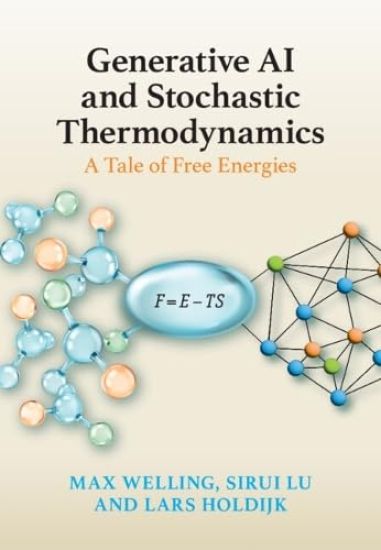
Generative AI and Stochastic Thermodynamics

Generative AI and Stochastic Thermodynamics

Max Welling; Sirui Lu; Lars Holdijk

Cambridge University Press
2026
nidottu
Originating from lectures delivered at the African Institute of Mathematical Sciences, this book presents a unifying perspective on traditional and modern methods in generative AI and stochastic thermodynamics. By relating the core topics in machine learning to the notion of (variational) free-energy, a bridge is built between methods such as latent variable models, variational auto-encoders, optimal control, optimal transport, normalizing flows and diffusion models and concepts such as entropy production and fluctuation theorems in stochastic thermodynamics. Structured into three main parts, the book commences by setting up the required mathematical and statistical physics preliminaries needed to make it broadly accessible. The largest part of the book then focuses on building intuition of major advances in generative AI by considering discrete time processes and their relationship to topics in stochastic thermodynamics. Finally, the authors take a short excursion to the continuous time domain for the more advanced learner.