Kirjojen hintavertailu. Mukana 12 484 706 kirjaa ja 12 kauppaa.

Kirjailija

Maxwell A. Cameron

Kirjat ja teokset yhdessä paikassa: 4 kirjaa, julkaisuja vuosilta 1992-2018, suosituimpien joukossa Democracy and Authoritarianism in Peru. Vertaile teosten hintoja ja tarkista saatavuus suomalaisista kirjakaupoista.

4 kirjaa

Kirjojen julkaisuhaarukka 1992-2018.

Political Institutions and Practical Wisdom

Political Institutions and Practical Wisdom

Maxwell A. Cameron

Oxford University Press Inc
2018
sidottu
Societies create rules that govern our practices. Such rules can only be effective, however, if the intermediaries between rules and practices--institutions--harness the skill, knowledge, and motivation of practitioners. Yet, everywhere institutions seem to be failing. Over-reliance on rules and incentives has not only corrupted the intrinsic motivations that arise from practice, it has also promoted the spread of competitive utility maximizing and thereby discouraged the kind of moral agency necessary for institutions to work well. In Political Institutions and Practical Wisdom, Maxwell Cameron takes this basic insight as his starting point to argue that the rapid spread of the tenets of a neoliberal political-economic philosophy in our era has contributed to the erosion of institutional capacity. The book contributes to an emerging field of social science research grounded in the Aristotelian idea of phronesis, or practical wisdom. Drawing on a wide range of examples, Cameron not only shows how good institutions depend on wise practitioners, he argues that contemporary democratic institutions are being assaulted by excessive partisanship and the hollowing-out of democratic deliberation, by the corrupting effects of money in politics, and by the use of neoliberal techniques of governance that are designed to foster competition rather than the pursuit of common goods. At once a valuable guide to designing effective institutions and a trenchant critique of contemporary institutional failure, Political Institutions and Practical Wisdom promises to reshape our understanding of one of the most basic building blocks of contemporary social and political life.
The Making of NAFTA

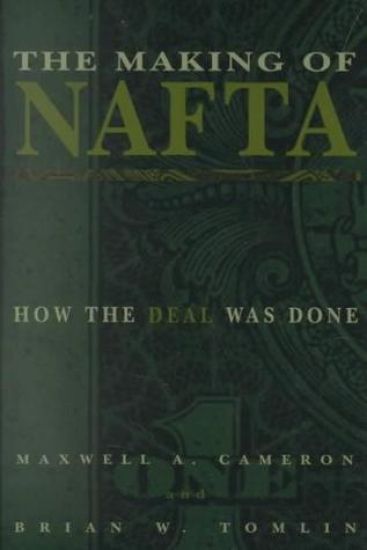
The Making of NAFTA

Maxwell A. Cameron; Brian W. Tomlin

Cornell University Press
2001
pokkari
How exactly do countries negotiate major international agreements? Until now, reliably impartial accounts of how deals are made have been rare and usually describe only one side of a multiparty process. Here, Maxwell Cameron and Brian Tomlin provide the first full, three-country account of the negotiations surrounding the controversial North American Free Trade Agreement, which went into effect on January 1, 1994. Through extensive interviews with participants from all sides, Cameron and Tomlin develop a detailed picture of the process by which the United States, Mexico, and Canada pursued closer economic relations and of the political realities that influenced the politicians and policymakers in each country. Written in an engaging and accessible style, The Making of NAFTA is a faithful account, built on insider views, of how the representatives of the three countries prepared for, negotiated, and implemented the agreement. Cameron and Tomlin show how NAFTA was influenced by the personalities and the multiple, sometimes conflicting objectives of the individuals involved. They also explore what the negotiations can reveal more generally about the making of public policy and the importance of international negotiations.
Democracy and Authoritarianism in Peru

Democracy and Authoritarianism in Peru

Maxwell A. Cameron

Palgrave Macmillan
1994
sidottu
Under what conditions is democracy stable? What forces undermine or reinforce democratic institutions in Latin America? This book suggests answers to these questions in the context of Peru, one of Latin America's least stable democracies. It identifies the micro and macro causes that explain the gradual breakdown of democracy in the period between the 1980 transition from authoritarian rule and the 1992 suspension of the Constitution and closure of Congress by President Alberto Fujimore. Similar 'self-coups' were subsequently threatened in Bolivia, unsuccessfully attempted in Guatemala, and actively considered in Brazil. Democracy and Authoritarianism in Peru stresses how recent changes in the class structure - particularly the informalization of the economy - created social conditions unfavorable to stable political coalitions in Peru. However, it also traces the mechanisms through which democracy has been undermined by exploring the choices and strategies of political actors in response to changing structural conditions. The book provides an analysis of the crisis of Peruvian democracy that weighs the importance of structural constraints and political choices. It is of broad interest to anyone concerned with problems of democratic consolidation.
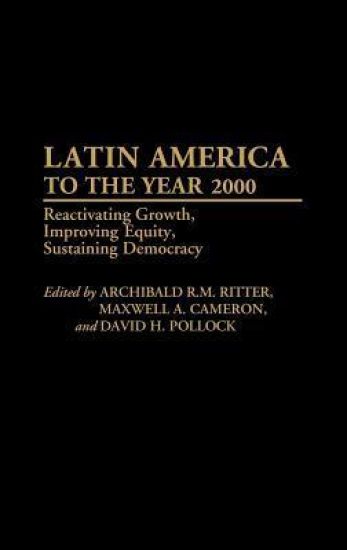
Latin America to the Year 2000

Latin America to the Year 2000

Maxwell A. Cameron; David Pollock; Archibald Ritter

Praeger Publishers Inc
1992
sidottu
Can the experience of the 1980s in Latin America be analyzed and evaluated to shed light on prospects for the 1990s? The central objective of this volume is to survey the development experience of the Latin American region in the 1980s and explore prospects for the coming decade. In this context, themes of crucial importance for the region are examined, including democratic consolidation, income distribution, the environment, hyperinflation, and the debt problem. Although socioeconomic and political aspects are emphasized, issues of equity and the environment are of special importance. Case studies of Peru, Chile, Mexico, Argentina, and Cuba provide fresh information on these issues in specific countries. The book focuses on the problem of development at a critical juncture in the evolution of the region. Not surprisingly, the contributors express differing points of view, but have in common the sense of the urgency of development problems that face Latin America.Central issues concerning the region's economy are the focus in the first part of the book. In the second part, key issue areas for the future are discussed. Of central concern in an exploration of the prospects for Latin America is the sustainability and improvement of democratization which proceeded in the 1980s. On the whole, the authors are not optimistic. The immense economic difficulties faced by the region--the debt overhang, the large and continuing overflow of financial and real resources, hyperinflation in some countries--will not be easy to manage. Although there are no guarantees that income distribution will be improved, among the positive developments foreseen for the 1990s are improved economic management, the addressing of environmental issues, and greater attention to issues of women's rights. This book should serve as a useful and timely guide to a complex region for both students and policymakers.