Kirjojen hintavertailu. Mukana 12 657 676 kirjaa ja 12 kauppaa.

Kirjailija

McKenzie Wark

Kirjat ja teokset yhdessä paikassa: 30 kirjaa, julkaisuja vuosilta 1994-2025, suosituimpien joukossa Writing on Raving. Vertaile teosten hintoja ja tarkista saatavuus suomalaisista kirjakaupoista.

30 kirjaa

Kirjojen julkaisuhaarukka 1994-2025.

I'm Very into You

I'm Very into You

Kathy Acker; McKenzie Wark; John Kinsella

Semiotext (E)
2015
pokkari
The tempestuous email correspondence between Kathy Acker and McKenzie Wark, shimmering with insight, gossip, sex, and cultural commentary."Why am I telling you all this? Partly 'cause the whole queerness/identity thing for me stretches through everything, absolutely everything. Slipping between straight/gay is child's play compared to slipping between writer/teacher/influence-peddler whatever. I forget who I am. You reminded me of who I prefer to be." [M.W.]"It's two in the morning... I know what you mean about slipping roles: I love it, going high low, power helpless even captive, male female, all over the place, space totally together and brain-sharp, if it wasn't for play I'd be bored stiff and I think boredom is the emotion I find most unbearable... " [KA]-from I'm Very into YouAfter Kathy Acker met McKenzie Wark on a trip to Australia in 1995, they had a brief fling and immediately began a heated two-week email correspondence. Their emails shimmer with insight, gossip, sex, and cultural commentary. They write in a frenzy, several times a day; their emails cross somewhere over the International Date Line, and themselves become a site of analysis. What results is an index of how two brilliant and idiosyncratic writers might go about a courtship across 7,500 miles of airspace-by pulling in Alfred Hitchcock, stuffed animals, Georges Bataille, Elvis Presley, phenomenology, Marxism, The X-files, psychoanalysis, and the I Ching.Their corresepondence is a Plato's Symposium for the twenty-first century, but written for queers, transsexuals, nerds, and book geeks. I'm Very Into You is a text of incipience, a text of beginnings, and a set of notes on the short, shared passage of two iconic individuals of our time.

Torpor

Torpor

Chris Kraus; McKenzie Wark

Semiotext (E)
2015
pokkari
Sylvie wanted to believe that misery could simply be replaced with happiness. Time was a straight line, stretching out before you. If you could create a golden kind of time and lay it right beside the other time, the time of horror, Bad History could just recede into the distance without ever having to be resolved. -- from Torpor Set at the dawn of the New World Order, Chris Kraus's third novel, Torpor loops back to the beginning of the decade that was the basis of I Love Dick, her pseudo-confessional cult-classic debut. It's summer, 1991, post-MTV, pre-AOL. Jerome Shafir and Sylvie Green, two former New Yorkers who can no longer afford an East Village apartment, set off on a journey across the entire former Soviet Bloc with the specious aim of adopting a Romanian orphan. Nirvana's on the radio everywhere, and wars are erupting across Yugoslavia. Unhappily married to Jerome, a 53-year-old Columbia University professor who loathes academe, Sylvie thinks only of happiness. There are only two things, Sylvie thinks, that will save them: a child of their own, and the success of The Anthropology of Unhappiness, her husband's long-postponed book on the Holocaust. But as they move forward toward impoverished Romania, Jerome's memories of his father's extermination at Auschwitz and his own childhood survival impede them. Savagely ironic and deeply lyrical, Torpor is Kraus's most personal novel to date.
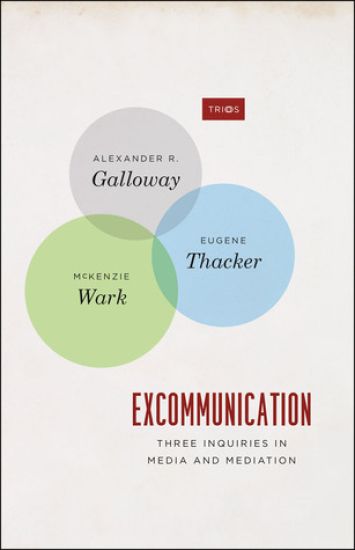
Excommunication – Three Inquiries in Media and Mediation

Excommunication – Three Inquiries in Media and Mediation

Alexander R. Galloway; Eugene Thacker; Mckenzie Wark

University of Chicago Press
2013
nidottu
Always connect - that is the imperative of today's media. But what about those moments when media cease to function properly, when messages go beyond the sender and receiver to become excluded from the world of communication itself - those messages that state: "There will be no more messages"? In this book, Alexander R. Galloway, Eugene Thacker, and McKenzie Wark turn our usual understanding of media on its head by arguing that these moments reveal the ways the impossibility of communication is integral to communication itself - instances they call excommunication. In three linked essays, Excommunication pursues this elusive topic by looking at mediation in the face of banishment, exclusion, and heresy, and by contemplating the possibilities of communication with the great beyond. First, Galloway proposes an original theory of mediation based on classical literature and philosophy, using Hermes, Iris, and the Furies to map out three of the most prevalent modes of mediation today-mediation as exchange, as illumination, and as network. Then, Thacker goes boldly beyond Galloway's classification scheme by examining the concept of excommunication through the secret link between the modern horror genre and medieval mysticism. Finally, Wark evokes the poetics of the infuriated swarm as a queer politics of heresy that deviates from both media theory and the traditional left. Reexamining commonplace definitions of media, mediation, and communication, Excommunication offers a glimpse into the realm of the nonhuman to find a theory of mediation adequate to our present condition.
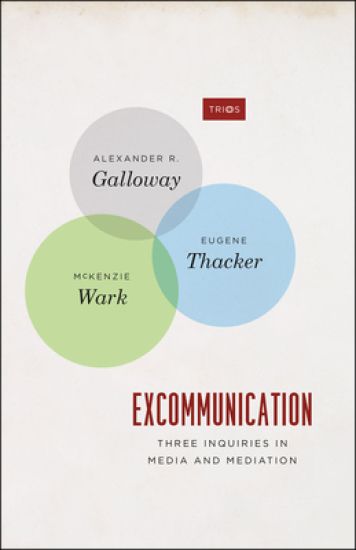
Excommunication

Excommunication

Alexander R. Galloway; Eugene Thacker; Mckenzie Wark

University of Chicago Press
2013
sidottu
Always connect - that is the imperative of today's media. But what about those moments when media cease to function properly, when messages go beyond the sender and receiver to become excluded from the world of communication itself - those messages that state: "There will be no more messages"? In this book, Alexander R. Galloway, Eugene Thacker, and McKenzie Wark turn our usual understanding of media on its head by arguing that these moments reveal the ways the impossibility of communication is integral to communication itself - instances they call excommunication. In three linked essays, Excommunication pursues this elusive topic by looking at mediation in the face of banishment, exclusion, and heresy, and by contemplating the possibilities of communication with the great beyond. First, Galloway proposes an original theory of mediation based on classical literature and philosophy, using Hermes, Iris, and the Furies to map out three of the most prevalent modes of mediation today-mediation as exchange, as illumination, and as network. Then, Thacker goes boldly beyond Galloway's classification scheme by examining the concept of excommunication through the secret link between the modern horror genre and medieval mysticism. Finally, Wark evokes the poetics of the infuriated swarm as a queer politics of heresy that deviates from both media theory and the traditional left. Reexamining commonplace definitions of media, mediation, and communication, Excommunication offers a glimpse into the realm of the nonhuman to find a theory of mediation adequate to our present condition.
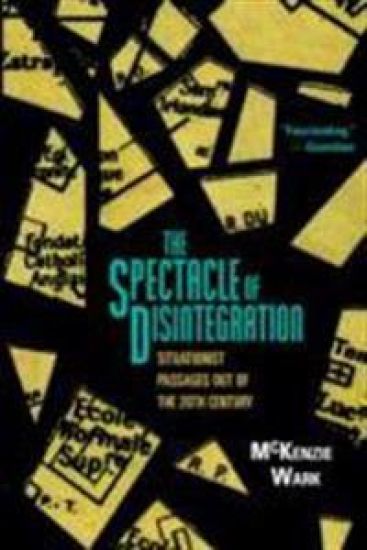
The Spectacle of Disintegration

The Spectacle of Disintegration

McKenzie Wark

Verso Books
2013
sidottu
Following her acclaimed history of the Situationist International up until the late sixties, The Beach Beneath the Street, McKenzie Wark returns with a companion volume which puts the late work of the Situationists in a broader and deeper context, charting their contemporary relevance and their deep critique of modernity. Wark builds on their work to map the historical stages of the society of the spectacle, from the diffuse to the integrated to what he calls the disintegrating spectacle. The Spectacle of Disintegration takes the reader through the critique of political aesthetics of former Situationist T.J. Clark, the Fourierist utopia of Raoul Vaneigem, René Vienet's earthy situationist cinema, Gianfranco Sangunetti's pranking of the Italian ruling class, Alice-Becker Ho's account of the anonymous language of the Romany, Guy Debord's late films and his surprising work as a game designer.At once an extraordinary counter history of radical praxis and a call to arms in the age of financial crisis and the resurgence of the streets, The Spectacle of Disintegration recalls the hidden journeys taken in the attempt to leave the twentieth century, and plots an exit from the twenty first.The dustjacket unfolds to reveal a fold-out poster of the collaborative graphic essay combining text selected by McKenzie Wark with composition and drawings by Kevin C. Pyle.
Telesthesia

Telesthesia

McKenzie Wark

Polity Press
2012
sidottu
The telegraph, telephone, and television, not to mention the Internet and mobile telephony, are all forms of communication that move information faster than the speed at which objects move. Both labor and capital and armies and commodities once moved at the same speed as the information organizing them. Over the last two centuries, social space has developed a strange folded quality, where physical space comes more and more to be doubled by a space of the movement of information. Telesthesia, or perception at a distance, comes increasingly to characterize how we see and hear and know the world. How does the evolution of different communication forms affect how we can perceive and act? How can the underlying infrastructure of communication forms be detected in the events of everyday life? These are the central questions animating this book. McKenzie Wark first explores relations between metropolitan and peripheral cultures – or postcolonial relations – with close attention to the texture of events that can happen when perception is mediated. He then examines what were once called postmodern experiences, and how relations of communication create new kinds of class relations and experiences of everyday life, from 9/11 to Occupy Wall Street.
Telesthesia

Telesthesia

McKenzie Wark

Polity Press
2012
nidottu
The telegraph, telephone, and television, not to mention the Internet and mobile telephony, are all forms of communication that move information faster than the speed at which objects move. Both labor and capital and armies and commodities once moved at the same speed as the information organizing them. Over the last two centuries, social space has developed a strange folded quality, where physical space comes more and more to be doubled by a space of the movement of information. Telesthesia, or perception at a distance, comes increasingly to characterize how we see and hear and know the world. How does the evolution of different communication forms affect how we can perceive and act? How can the underlying infrastructure of communication forms be detected in the events of everyday life? These are the central questions animating this book. McKenzie Wark first explores relations between metropolitan and peripheral cultures – or postcolonial relations – with close attention to the texture of events that can happen when perception is mediated. He then examines what were once called postmodern experiences, and how relations of communication create new kinds of class relations and experiences of everyday life, from 9/11 to Occupy Wall Street.
Gamer Theory

Gamer Theory

McKenzie Wark

Harvard University Press
2007
sidottu
Listen to a short interview with McKenzie WarkHost: Chris Gondek | Producer: Heron & CraneEver get the feeling that life's a game with changing rules and no clear sides, one you are compelled to play yet cannot win? Welcome to gamespace. Gamespace is where and how we live today. It is everywhere and nowhere: the main chance, the best shot, the big leagues, the only game in town. In a world thus configured, McKenzie Wark contends, digital computer games are the emergent cultural form of the times. Where others argue obsessively over violence in games, Wark approaches them as a utopian version of the world in which we actually live. Playing against the machine on a game console, we enjoy the only truly level playing field--where we get ahead on our strengths or not at all. Gamer Theory uncovers the significance of games in the gap between the near-perfection of actual games and the highly imperfect gamespace of everyday life in the rat race of free-market society. The book depicts a world becoming an inescapable series of less and less perfect games. This world gives rise to a new persona. In place of the subject or citizen stands the gamer. As all previous such personae had their breviaries and manuals, Gamer Theory seeks to offer guidance for thinking within this new character. Neither a strategy guide nor a cheat sheet for improving one's score or skills, the book is instead a primer in thinking about a world made over as a gamespace, recast as an imperfect copy of the game.
A Hacker Manifesto

A Hacker Manifesto

McKenzie Wark

Harvard University Press
2004
sidottu
Explains how the demands of companies for protection of their patents and copyrights and the culture of file sharing has given rise to a class conflict in which creators of the information are lined up against a possessing class who monopolize what the hackers produce.
Virtual Geography

Virtual Geography

McKenzie Wark

Indiana University Press
1994
pokkari
"The author's capacity to grasp and interpret these [world media] events is astounding, and her ability to provide insights into a world where unbounded information is circling the earth with the speed of light is startling." —Choice " . . . a wide-ranging, quirky and dextrous mix of description, theory and analysis, that documents the perils of the global telecommunications network . . . " —Times Literary Supplement " . . . this is a stimulating, even moving, book, dense with ideas and with many quotable lines." —The New Statesman "Wark is one of the most original and interesting cultural critics writing today." —Lawrence Grossberg McKenzie Wark writes about the experience of everyday life under the impact of increasingly global media vectors. We no longer have roots, we have aerials. We no longer have origins, we have terminals.