Kirjojen hintavertailu. Mukana 12 595 353 kirjaa ja 12 kauppaa.

Kirjailija

Meera Nanda

Kirjat ja teokset yhdessä paikassa: 6 kirjaa, julkaisuja vuosilta 2003-2025, suosituimpien joukossa Wrongs of the Religious Right. Vertaile teosten hintoja ja tarkista saatavuus suomalaisista kirjakaupoista.

6 kirjaa

Kirjojen julkaisuhaarukka 2003-2025.

Postcolonial Theory and the Making of Hindu Nationalism
This book tells the story of two strange bedfellows, the Postcolonial Left and the Hindu Right.It argues that the Postcolonial Left’s relentless attacks on the “epistemic violence” of Western norms of rationality and modernity are providing the conceptual vocabulary for the Hindu Right’s project of “decolonizing the Hindu mind.” The postcolonial project of “provincializing Europe” is widely shared by the Hindu Right, and harks back to the Hindu revivalist movements of the nineteenth century. This book argues that postcolonial thought in India bears a strong family resemblance, in context and content, with the “conservative revolution” that brought down the Weimar Repbulic in Germany before the Nazi takeover.Both an intellectual history of India through the last half-century and a critical engagement with postcolonial theory, this book will be of interest to scholars of South Asia and the humanities and social sciences at large.
The God Market

The God Market

Meera Nanda

Monthly Review Press,U.S.
2011
pokkari
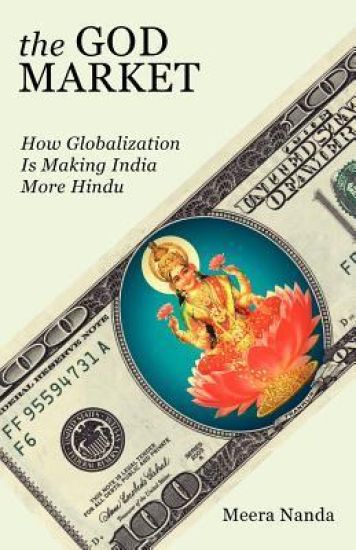
Conventional wisdom says that integration into the global marketplace tends to weaken the power of traditional faith in developing countries. But, as Meera Nanda argues in this path-breaking book, this is hardly the case in today's India. Against expectations of growing secularism, India has instead seen a remarkable intertwining of Hinduism and neoliberal ideology, spurred on by a growing capitalist class. It is this "State-Temple-Corporate Complex," she claims, that now wields decisive political and economic power, and provides ideological cover for the dismantling of the Nehru-era state-dominated economy. According to this new logic, India's rapid economic growth is attributable to a special "Hindu mind," and it is what separates the nation's Hindu population from Muslims and others deemed to be "anti-modern." As a result, Hindu institutions are replacing public ones, and the Hindu "revival" itself has become big business, a major source of capital accumulation. Nanda explores the roots of this development and its possible future, as well as the struggle for secularism and socialism in the world's second-most populous country.
The God Market

The God Market

Meera Nanda

Monthly Review Press,U.S.
2011
sidottu
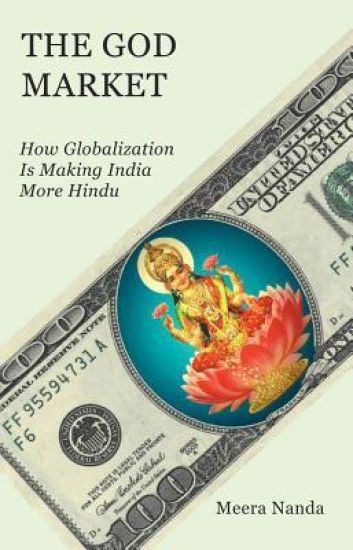
Conventional wisdom says that integration into the global marketplace tends to weaken the power of traditional faith in developing countries. But, as Meera Nanda argues in this path-breaking book, this is hardly the case in today's India. Against expectations of growing secularism, India has instead seen a remarkable intertwining of Hinduism and neoliberal ideology, spurred on by a growing capitalist class. It is this "State-Temple-Corporate Complex," she claims, that now wields decisive political and economic power, and provides ideological cover for the dismantling of the Nehru-era state-dominated economy. According to this new logic, India's rapid economic growth is attributable to a special "Hindu mind," and it is what separates the nation's Hindu population from Muslims and others deemed to be "anti-modern." As a result, Hindu institutions are replacing public ones, and the Hindu "revival" itself has become big business, a major source of capital accumulation. Nanda explores the roots of this development and its possible future, as well as the struggle for secularism and socialism in the world's second-most populous country.
Prophets Facing Backward

Prophets Facing Backward

Meera Nanda

Rutgers University Press
2003
nidottu
The leading voices in science studies have argued that modern science reflects dominant social interests of Western society. Following this logic, postmodern scholars have urged postcolonial societies to develop their own ""alternative sciences” as a step towards ""mental decolonization”. These ideas have found a warm welcome among Hindu nationalists who came to power in India in the early 1990s. In this passionate and highly original study, Indian-born author Meera Nanda reveals how these well-meaning but ultimately misguided ideas are enabling Hindu ideologues to propagate religious myths in the guise of science and secularism.At the heart of Hindu supremacist ideology, Nanda argues, lies a postmodernist assumption: that each society has its own norms of reasonableness, logic, rules of evidence, and conception of truth, and that there is no non-arbitrary, culture-independent way to choose among these alternatives. What is being celebrated as ""difference” by postmodernists, however, has more often than not been the source of mental bondage and authoritarianism in non-Western cultures. The ""Vedic sciences” currently endorsed in Indian schools, colleges, and the mass media promotes the same elements of orthodox Hinduism that have for centuries deprived the vast majority of Indian people of their full humanity.By denouncing science and secularization, the left was unwittingly contributing to what Nanda calls ""reactionary modernism.” In contrast, Nanda points to the Dalit, or untouchable, movement as a true example of an ""alternative science” that has embraced reason and modern science to challenge traditional notions of hierarchy.