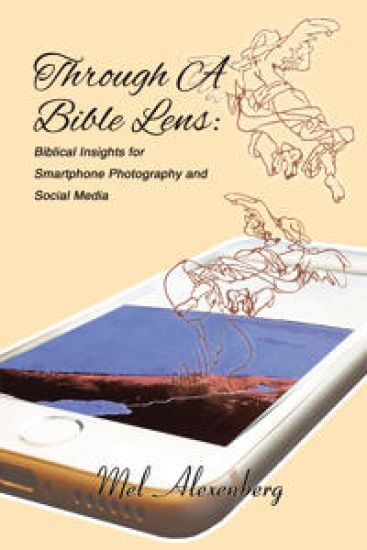
Through a Bible Lens: Biblical Insights for Smartphone Photography and Social Media by Professor Mel Alexenberg teaches people of all faiths how biblical insights can transform smartphone photography and social media into creative ways for seeing spirituality in everyday life. It develops conceptual and practical tools for observing, documenting and sharing reflections of biblical messages in all that we do. It speaks to Jews and Christians who share an abiding love of the Bible by inspiring the creation of a lively dialogue between our emerging life stories and the enduring biblical narrative. The author is an artist, educator and writer exploring the interface between biblical consciousness, creative process, and postdigital culture. His artworks are in the collections of museums worldwide. He was professor at Columbia University and research fellow at MIT Center for Advanced Visual Studies. In Israel, head of Emunah College School of the Arts and professor at Ariel and Bar-Ilan universities. He is author of The Future of Art in a Postdigital Age: From Hellenistic to Hebraic Consciousness. Through a Bible Lens speaks in the language of today's digital culture of smartphones and social media. It demonstrates to both young and old the most up-to-date thoughts on the interactions between The Bible and the impact of new technologies on contemporary life. Christians and Jews will enjoy sharing the book's spiritual messages with their children and grandchildren. Professor Alexenberg draws on six Divine attributes in the biblical verse "Yours God are the Compassion, the Strength, the Beauty, the Success, the Splendor, and the Foundation of everything in heaven and earth" (Chronicles 1:29) to demonstrate how smartphone photographers become God's partners in creation when photographing daily life through a Bible lens. He describes how the lives of biblical personalities exemplify these Divine attributes: Abraham and Ruth embody Compassion, Isaac and Sarah are models of Strength, Jacob and Rebecca represent Beauty, Success is demonstrated by Moses and Miriam, Splendor by Aaron and Deborah, and Foundation by Joseph and Tamar. There is a confluence emerging in the 21st century between biblical consciousness and a postdigital culture that addresses the humanization of digital technologies. Both share a structure of consciousness and its cultural expression that honors creative process and seeing with a different spirit, like Caleb who saw goodness in the Land of Israel while others could not (Numbers 14:24). We are fortunate to be living in age of digital technologies that gives us ways to experience invisible worlds becoming visible. These experiences give clues that help us appreciate the insightful imagination of ancient spiritual teachers who visualized invisible realms. Smartphones are gateways to the world that make invisible realms blanketing our planet become visible with a flick of a finger. Their imbedded cameras capture images, store them as invisible bits and bytes, and display them as colorful pictures. In all of human history, never has there been such a proliferation of images. A centuries-old Jewish method of Bible study called PaRDeS offers creative ways for looking beyond the surface of smartphone images by extending contemporary methods of photographic analysis to reveal spiritual significance. An exemplary blogart project, Bible Blog Your Life http: //throughabiblelens.blogspot.com, turns theory into practice. The author and his wife Miriam created it to celebrate their 52nd year of marriage. For 52 weeks, they posted photographs reflecting their life together with a text of Tweets that relate to the weekly Bible portion. Selected blog posts from each of the first five books of the Bible demonstrate how to transform the ancient biblical narrative into a mirror for people today to see themselves. Fifty photographs from these posts are reproduced in color in the book.