Kirjojen hintavertailu. Mukana 12 595 353 kirjaa ja 12 kauppaa.

Kirjailija

Melinda Moore

Kirjat ja teokset yhdessä paikassa: 16 kirjaa, julkaisuja vuosilta 1996-2021, suosituimpien joukossa Bridging the Gap. Vertaile teosten hintoja ja tarkista saatavuus suomalaisista kirjakaupoista.

16 kirjaa

Kirjojen julkaisuhaarukka 1996-2021.

Health Sector Reform in the Kurdistan Regioniraq

Health Sector Reform in the Kurdistan Regioniraq

C. Ross Anthony; Melinda Moore; Lee H. Hilborne; Andrew W. Mulcahy

RAND
2014
pokkari
This report summarizes analysis of three distinct but intertwined health policy issue areas for the Kurdistan Regional Government: health financing, primary care, and quality and patient safety. The researchers assessed policy options, developed plans to overcome barriers and achieve policy objectives, and developed and helped implement a new management information system.
Harnessing Full Value from the DOD Serum Repository and the Defense Medical Surveillance System

Harnessing Full Value from the DOD Serum Repository and the Defense Medical Surveillance System

Melinda Moore; Elisa Eiseman; Gail Fisher; Stuart S. Olmsted; Preethi R. Sama

RAND
2010
pokkari
The Army manages the Department of Defense Serum Repository (DoDSR) of over 43 million serum samples and the associated Defense Medical Surveillance System (DMSS) database, whose primary use is for military health surveillance. RAND Arroyo Center examined the current capabilities of these resources to identify gaps and suggest strategies to improve their ability to meet current and future military health needs.
Environmental Biodetection and Human Biosurveillance Research and Development for National Security

Environmental Biodetection and Human Biosurveillance Research and Development for National Security

Melinda Moore; Eric Landree; Alison K Hottes; Shoshana R Shelton

RAND
2021
nidottu
National biodefense is a critical element of national security. Environmental biodetection and human biosurveillance are part of the foundation of national biodefense. This report examines the Department of Homeland Security's chemical and biological defense research and development portfolio to identify priorities for future investments to effectively address biological threats.
Health Sector Reform in the Kurdistan Region-Iraq

Health Sector Reform in the Kurdistan Region-Iraq

C. Ross Anthony; Melinda Moore; Lee H. Hilborne

RAND
2021
nidottu
Since 2010, the RAND Corporation has worked with the Kurdistan Regional Government to develop initiatives to improve the region's health care system. The third phase of the project focused on development and use of a primary care management information system; health financing reform, with a focus on policy reform options to deal with physician dual practice; and hospital patient safety training within the context of health quality improvement.
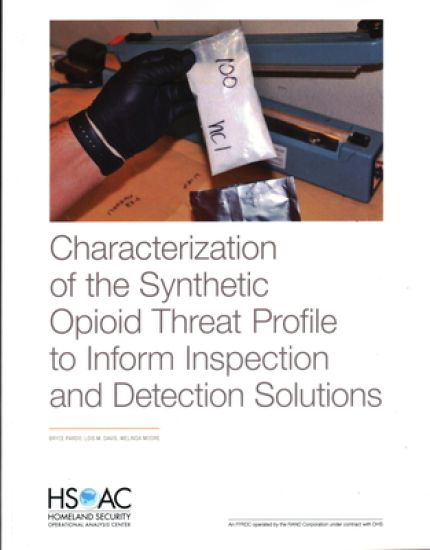
Characterization of the Synthetic Opioid Threat Profile to Inform Inspection and Detection Solutions
The majority of opioid overdoses are due to illicitly manufactured imports. Researchers from the Homeland Security Operational Analysis Center evaluated publicly available data to better understand the dimensions of the consumption and supply of these substances. They performed qualitative and quantitative analyses of these data and provide their findings and recommendations in this report.
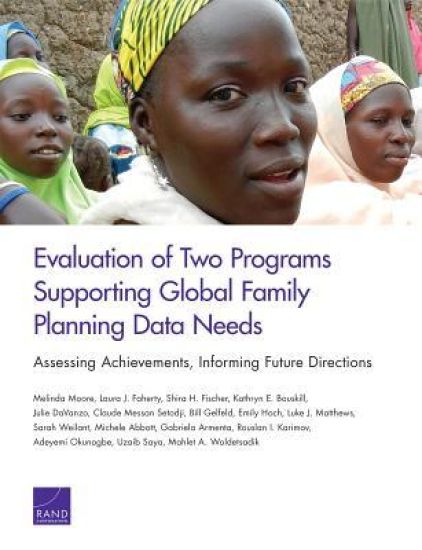
Evaluation of Two Programs Supporting Global Family Planning Data Needs

Evaluation of Two Programs Supporting Global Family Planning Data Needs

Melinda Moore; Laura J Faherty; Shira H Fischer; Kathryn E Bouskill; Julie Davanzo; Claude Messan Setodji; Bill Gelfeld; Emily Hoch; Luke J Matthews; Sarah Weilant; Michele Abbott; Gabriela Armenta; Rouslan I Karimov; Adeyemi Okunogbe; Uzaib Saya; Mahlet A Woldetsadik

RAND
2018
nidottu
In 2013, the Bill & Melinda Gates Foundation launched two programs to help monitor progress toward a new global goal to increase modern contraceptive use by 2020: Performance Monitoring and Accountability 2020 (PMA2020) and Track20. This evaluation of both programs is based on interviews with more than 260 stakeholders, statistical analysis of the PMA2020 survey, and analysis of stakeholder ratings of data maturity and sustainability.
Identifying Future Disease Hot Spots

Identifying Future Disease Hot Spots

Melinda Moore; Bill Gelfeld; Adeyemi Okunogbe; Christopher Paul

RAND
2017
pokkari
Recent high-profile outbreaks such as Ebola and Zika have illustrated the transnational nature of infectious diseases. Countries that are most vulnerable to outbreaks may be higher priorities for technical support. RAND's Infectious Disease Vulnerability Index should help U.S. government and international agencies identify these countries and inform programming to preemptively mitigate the spread and effects of potential transnational outbreaks.
Improving Decision Support for Infectious Disease Prevention and Control

Improving Decision Support for Infectious Disease Prevention and Control

David Manheim; Margaret Chamberlin; Osonde A. Osoba; Raffaele Vardavas; Melinda Moore

RAND
2016
pokkari
This report provides an overview of decision-support tools, including models and nonmodeling approaches, to inform both modelers and policymakers. It offers ways to use these tools to help address real-world policy questions related to infectious disease prevention, detection, control, and response and recommends best practices for technical experts and policymakers to collaborate in developing and using the tools.
Measuring Cooperative Biological Engagement Program (Cbep) Performance

Measuring Cooperative Biological Engagement Program (Cbep) Performance

Stephanie Young; Henry H. Willis; Melinda Moore; Jeffrey Engstrom

RAND
2014
pokkari
The Cooperative Biological Engagement Program partners with about 20 countries in different regions around the world and works with them to address diverse threats to international security. This report describes a project to develop a comprehensive evaluation framework and recommends metrics for assessing and communicating progress toward the program s goals."
The Future of Health Care in the Kurdistan Regioniraq

The Future of Health Care in the Kurdistan Regioniraq

Melinda Moore; C. Ross Anthony; Yee-Wei Lim; Spencer S. Jones; Adrian Overton; Joanne K. Yoong

RAND
2014
pokkari
Presents the results of a yearlong analysis of the health care system in the Kurdistan Region of Iraq, with a focus on primary care. The authors project future supply and demand for health services, describe the strengths of the health care system in the Kurdistan Region as well as the challenges it faces including financing issues, and discusses what strategies can be pursued to move toward a more effective and higher-quality health care system.
Toward Integrated DOD Biosurveillance

Toward Integrated DOD Biosurveillance

Melinda Moore; Gail Fisher; Clare Stevens

RAND
2013
pokkari
In the context of the 2012 National Strategy for Biosurveillance, the Office of Management and Budget asked the Department of Defense (DoD) to review its biosurveillance programs. DoD biosurveillance supports three strategic missions and four desired outcomes. More near-real-time analysis and better internal and external integration could enhance its performance and value. Improvements are needed in key enablers, including funding.
Bridging the Gap

Bridging the Gap

Melinda Moore; Michael A. Wermuth; Laura Werber Castaneda; Anita Chandra; Darcy Noricks

RAND
2010
pokkari
This report describes the current policy context for domestic all-hazards risk-informed capabilities-based planning by local military and civilian authorities and results from interviews with such planners at five selected sites. Together, these form the basis for a planning support tool, for which the framework is described in this report.
AIDS Education

AIDS Education

Martin Forst; Melinda Moore

Praeger Publishers Inc
1996
sidottu
Since the time AIDS and HIV infection were first discovered, no medical cures have been developed. It became clear early on that education would be the cornerstone in the fight against AIDS, and that assessment remains true in the 1990s. This book describes how to tailor HIV education and prevention efforts to specific communities, including how to identify those most at risk, what types of interventions are most appropriate to those communities, how to engage those most at risk, and the role of participatory evaluation in determining the effectiveness of community education efforts.