Kirjojen hintavertailu. Mukana 12 657 676 kirjaa ja 12 kauppaa.

Kirjailija

Melvin I. Urofsky

Kirjat ja teokset yhdessä paikassa: 19 kirjaa, julkaisuja vuosilta 1997-2020, suosituimpien joukossa Louis D. Brandeis: A Life. Vertaile teosten hintoja ja tarkista saatavuus suomalaisista kirjakaupoista.

19 kirjaa

Kirjojen julkaisuhaarukka 1997-2020.

The Campaign Finance Cases

The Campaign Finance Cases

Melvin I. Urofsky

University Press of Kansas
2020
nidottu
Rarely does the Supreme Court reverse itself as quickly and profoundly as it did in recent campaign finance cases, with the Citizens United decision of 2010 undoing the constraints of the McCain-Feingold Act upheld in McConnell v. Federal Election Commission (2003). And rarely have the stakes seemed so high, as billionaires vie for elected office and dark money floods political campaigns. In timely fashion, this new edition updates Melvin Urofsky's classic study of campaign finance law, bringing his cogent analysis of the relevant statutes and court cases up to date.Urofsky explains in clear and convincing language what was - and is - at stake in the twists and turns of campaign finance laws taken up by the nation's highest court in the past decades. Beginning with Buckley v. Valeo (1976) and moving through McConnell, Citizens United, and finally McCutcheon v. Federal Election Commission (2014), Urofsky discusses the two principles at issue in these cases: freedom of political speech, and the protection of the political process from undue influence. Conventional wisdom holds that in such cases liberals want greater restrictions and conservatives want corporations to have greater freedom to influence voters. But working from a rich store of primary sources, probing the motivations and ideas of all participants in the campaign finance legal story, Urofsky reveals a far more complex picture, one whose significance transcends simple political ideologies.In a time of controversies over political speech in the blogosphere, social media, and cable news, and claims of electoral fraud, The Campaign Finance Cases offers a much-needed, balanced account of how issues critical to American democracy figure in the adjudication of campaign finance law, and how a changing political and media landscape might alter the process.
The Campaign Finance Cases

The Campaign Finance Cases

Melvin I. Urofsky

University Press of Kansas
2020
sidottu
Rarely does the Supreme Court reverse itself as quickly and profoundly as it did in recent campaign finance cases, with the Citizens United decision of 2010 undoing the constraints of the McCain-Feingold Act upheld in McConnell v. Federal Election Commission (2003). And rarely have the stakes seemed so high, as billionaires vie for elected office and dark money floods political campaigns. In timely fashion, this new edition updates Melvin Urofsky's classic study of campaign finance law, bringing his cogent analysis of the relevant statutes and court cases up to date.Urofsky explains in clear and convincing language what was - and is - at stake in the twists and turns of campaign finance laws taken up by the nation's highest court in the past decades. Beginning with Buckley v. Valeo (1976) and moving through McConnell, Citizens United, and finally McCutcheon v. Federal Election Commission (2014), Urofsky discusses the two principles at issue in these cases: freedom of political speech, and the protection of the political process from undue influence. Conventional wisdom holds that in such cases liberals want greater restrictions and conservatives want corporations to have greater freedom to influence voters. But working from a rich store of primary sources, probing the motivations and ideas of all participants in the campaign finance legal story, Urofsky reveals a far more complex picture, one whose significance transcends simple political ideologies.In a time of controversies over political speech in the blogosphere, social media, and cable news, and claims of electoral fraud, The Campaign Finance Cases offers a much-needed, balanced account of how issues critical to American democracy figure in the adjudication of campaign finance law, and how a changing political and media landscape might alter the process.
The Affirmative Action Puzzle

The Affirmative Action Puzzle

Melvin I. Urofsky

Alfred A. Knopf
2020
sidottu
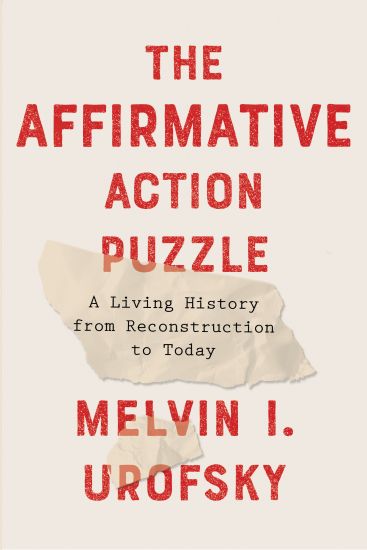
A multifaceted history of affirmative action from its inception through the past five decades. From acclaimed legal historian, author of a biography of Louis Brandeis ("Remarkable"--Anthony Lewis, NYROB; "Definitive"--Jeffrey Rosen, The New Republic) and Dissent in the Supreme Court ("Riveting"--Dahlia Lithwick, NYTBR), a history of affirmative action, from its beginning in 1961 with John F. Kennedy's Executive Order 10925, creating the President's Committee on Equal Employment Opportunity, and mandating federal contractors to take "affirmative action" to ensure that there be no discrimination by "race, creed, color, or national origin." In this important and ambitious book, Urofsky writes about the affirmative action cases decided by the Supreme Court, cases that upheld as well as struck down particular plans, and those cases that affected both governmental and private entities. He writes in detail about the societal impact of affirmative action--how it has divided society, separating not only those for and against, but also splitting traditional allies. Urofsky's book explores affirmative action in relation to education, how nearly every public university in the country has at one time or another instituted some form of affirmative action plan, some successful, others not; and looks at whether affirmative action programs have benefited minorities. Urofsky's book looks at whether shifts over time can be discerned and if those changes can be attributed to affirmative action programs. The book explores as well the issue with regards to race and women, and if the question of economic and social advancement is different for each. More than ever before, affirmative action remains an important and divisive issue in American society, a divide as large and perhaps less bridgeable than abortion; a public policy question still (alas) very much alive.
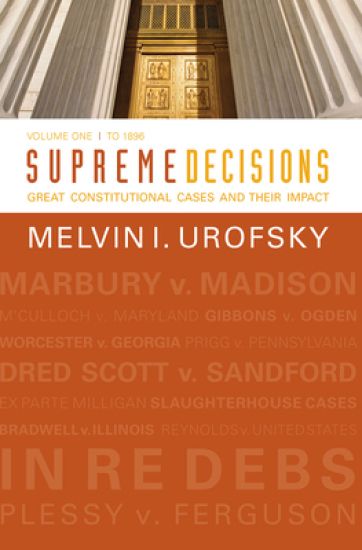
Supreme Decisions, Volume 1

Supreme Decisions, Volume 1

Melvin I. Urofsky

Routledge
2019
sidottu
Supreme Decisions: Great Constitutional Cases and Their Impact, Volumes 1, covers twenty-four Supreme Court cases that have shaped American constitutional law. Interpretive chapters shed light on the nuances of each case, the individuals involved, and the social, political, and cultural context at that particular moment in history. Discussing cases from nearly every decade in a two-hundred-year span, Melvin I. Urofsky expounds on the political climate of the United States from the country's infancy through the new millennium. Featuring Marbury v. Madison, Dred Scott v. Sandford, Miranda v. Arizona, Brown v. Board of Education, and many more, this text covers foundational rulings and more recent decisions. Written with students in mind, Melvin I. Urofsky's voice offers compelling and fascinating accounts of American legal milestones.
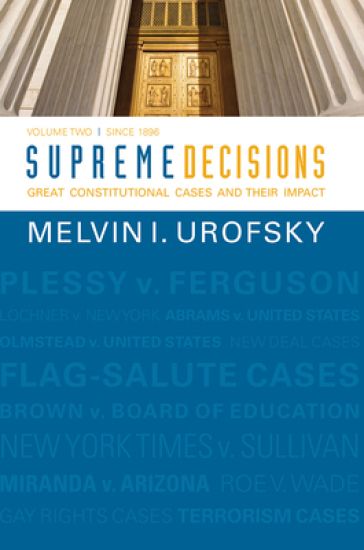
Supreme Decisions, Volume 2

Supreme Decisions, Volume 2

Melvin I. Urofsky

Routledge
2019
sidottu
Supreme Decisions: Great Constitutional Cases and Their Impact, covers twenty-four Supreme Court cases (twelve per volume) that have shaped American constitutional law. Interpretive chapters shed light on the nuances of each case, the individuals involved, and the social, political, and cultural context at that particular moment in history. Discussing cases from nearly every decade in a two-hundred-year span, Melvin I. Urofsky expounds on the political climate of the United States from the country's infancy through the new millennium. Featuring Marbury v. Madison, Dred Scott v. Sandford, Miranda v. Arizona, Brown v. Board of Education, and many more, this text covers foundational rulings and more recent decisions. Written with students in mind, Melvin I. Urofsky's voice offers compelling and fascinating accounts of American legal milestones.
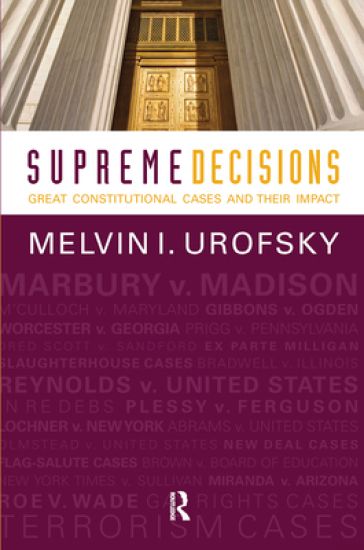
Supreme Decisions, Combined Volume

Supreme Decisions, Combined Volume

Melvin I. Urofsky

Routledge
2019
sidottu
Supreme Decisions: Great Constitutional Cases and Their Impact, Volumes 1 and 2, covers twenty-four Supreme Court cases (twelve per volume) that have shaped American constitutional law. Interpretive chapters shed light on the nuances of each case, the individuals involved, and the social, political, and cultural context at that particular moment in history. Discussing cases from nearly every decade in a two-hundred-year span, Melvin I. Urofsky expounds on the political climate of the United States from the country's infancy through the new millennium. Featuring Marbury v. Madison, Dred Scott v. Sandford, Miranda v. Arizona, Brown v. Board of Education, and many more, this text covers foundational rulings and more recent decisions. Written with students in mind, Melvin I. Urofsky's voice offers compelling and fascinating accounts of American legal milestones.
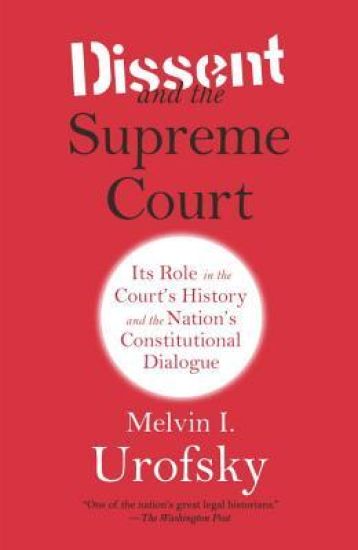
Dissent and the Supreme Court: Its Role in the Court's History and the Nation's Constitutional Dialogue
"Highly illuminating ... for anyone interested in the Constitution, the Supreme Court, and the American democracy, lawyer and layperson alike." --The Los Angeles Review of Books In his major work, acclaimed historian and judicial authority Melvin Urofsky examines the great dissents throughout the Court's long history. Constitutional dialogue is one of the ways in which we as a people reinvent and reinvigorate our democratic society. The Supreme Court has interpreted the meaning of the Constitution, acknowledged that the Court's majority opinions have not always been right, and initiated a critical discourse about what a particular decision should mean before fashioning subsequent decisions--largely through the power of dissent. Urofsky shows how the practice grew slowly but steadily, beginning with the infamous and now overturned case of Dred Scott v. Sandford (1857) during which Chief Justice Roger Taney's opinion upheld slavery and ending with the present age of incivility, in which reasoned dialogue seems less and less possible. Dissent on the court and off, Urofsky argues in this major work, has been a crucial ingredient in keeping the Constitution alive and must continue to be so.
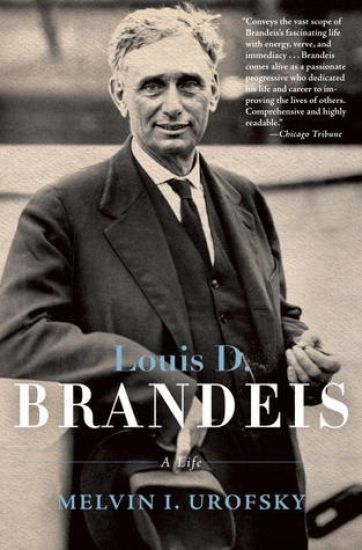
Louis D. Brandeis: A Life

Louis D. Brandeis: A Life

Melvin I. Urofsky

SCHOCKEN BOOKS INC
2012
nidottu
As a young lawyer in the late nineteenth and early twentieth centuries, Louis Brandeis, born into a family of reformers who came to the United States to escape European anti-Semitism, established the way modern law is practiced. He was an early champion of the right to privacy and pioneer the idea of pro bono work by attorneys. Brandeis invented savings bank life insurance in Massachusetts and was a driving force in the development of the Clayton Antitrust Act, the Federal Reserve Act, and the law establishing the Federal Trade Commission. Brandeis witnessed and suffered from the anti-Semitism rampant in the United States in the early twentieth century, and with the outbreak of World War I, became at age fifty-eight the head of the American Zionist movement. During the brutal six-month congressional confirmation battle that ensued when Woodrow Wilson nominated him to the Supreme Court in 1916, Brandeis was described as "a disturbing element in any gentlemen's club." But once on the Court, he became one of its most influential members, developing the modern jurisprudence of free speech and the doctrine of a constitutionally protected right to privacy and suggesting what became known as the doctrine of incorporation, by which the Bill of Rights came to apply to the states. In this award-winning biography, Melvin Urofsky gives us a panoramic view of Brandeis's unprecedented impact on American society and law.
Supreme Decisions, Volume 1

Supreme Decisions, Volume 1

Melvin I. Urofsky

Westview Press Inc
2012
nidottu
Supreme Decisions: Great Constitutional Cases and Their Impact, Volumes 1, covers twenty-four Supreme Court cases that have shaped American constitutional law. Interpretive chapters shed light on the nuances of each case, the individuals involved, and the social, political, and cultural context at that particular moment in history. Discussing cases from nearly every decade in a two-hundred-year span, Melvin I. Urofsky expounds on the political climate of the United States from the country's infancy through the new millennium. Featuring Marbury v. Madison, Dred Scott v. Sandford, Miranda v. Arizona, Brown v. Board of Education, and many more, this text covers foundational rulings and more recent decisions. Written with students in mind, Melvin I. Urofsky's voice offers compelling and fascinating accounts of American legal milestones.
Supreme Decisions, Volume 2

Supreme Decisions, Volume 2

Melvin I. Urofsky

Westview Press Inc
2012
nidottu
Supreme Decisions: Great Constitutional Cases and Their Impact, covers twenty-four Supreme Court cases (twelve per volume) that have shaped American constitutional law. Interpretive chapters shed light on the nuances of each case, the individuals involved, and the social, political, and cultural context at that particular moment in history. Discussing cases from nearly every decade in a two-hundred-year span, Melvin I. Urofsky expounds on the political climate of the United States from the country's infancy through the new millennium. Featuring Marbury v. Madison, Dred Scott v. Sandford, Miranda v. Arizona, Brown v. Board of Education, and many more, this text covers foundational rulings and more recent decisions. Written with students in mind, Melvin I. Urofsky's voice offers compelling and fascinating accounts of American legal milestones.
Supreme Decisions, Combined Volume

Supreme Decisions, Combined Volume

Melvin I. Urofsky

Westview Press Inc
2012
nidottu
Supreme Decisions: Great Constitutional Cases and Their Impact, Volumes 1 and 2, covers twenty-four Supreme Court cases (twelve per volume) that have shaped American constitutional law. Interpretive chapters shed light on the nuances of each case, the individuals involved, and the social, political, and cultural context at that particular moment in history. Discussing cases from nearly every decade in a two-hundred-year span, Melvin I. Urofsky expounds on the political climate of the United States from the country's infancy through the new millennium. Featuring Marbury v. Madison, Dred Scott v. Sandford, Miranda v. Arizona, Brown v. Board of Education, and many more, this text covers foundational rulings and more recent decisions. Written with students in mind, Melvin I. Urofsky's voice offers compelling and fascinating accounts of American legal milestones.
New York Times v. Sullivan

New York Times v. Sullivan

Kermit L. Hall; Melvin I. Urofsky

University Press of Kansas
2011
nidottu
Illuminating a classic case from the turbulent civil rights era of the 1960s, two of America’s foremost legal historians—Kermit Hall and Melvin Urofsky—provide a compact and highly readable updating of one of the most memorable decisions in the Supreme Court’s canon. When the New York Times published an advertisement that accused Alabama officials of willfully abusing civil rights activists, Montgomery police commissioner Lester Sullivan filed suit for defamation. Alabama courts, citing factual errors in the ad, ordered the Times to pay half a million dollars in damages. The Times appealed to the Supreme Court, which had previously deferred to the states on libel issues. The justices, recognising that Alabama’s application of libel law threatened both the nation’s free press and equal rights for African Americans, unanimously sided with the Times. As memorably recounted twenty years ago in Anthony Lewis’s Make No Law, the 1964 decision profoundly altered defamation law, which the Court declared must not hinder debate on public issues even if it includes “vehement, caustic, and sometimes unpleasantly sharp attacks on government and public officials.” The decision also introduced a new First Amendment test: a public official cannot recover damages for libel unless he proves that the statement was made with the knowledge that it was false or with reckless disregard of whether it was false. Hall and Urofsky, however, place a new emphasis on this iconic case. Whereas Lewis’s book championed freedom of the press, the authors here provide a stronger focus on civil rights and southern legal culture. They convey to readers the urgency of the civil rights movement and the vitriolic anger it inspired in the Deep South. Their insights place this landmark case within a new and enlightening frame.
Money and Free Speech

Money and Free Speech

Melvin I. Urofsky

University Press of Kansas
2005
sidottu
Money greases the wheels of American politics from the local level to the White House. In the 2004 presidential campaign, President George W. Bush alone raised nearly $400 million in private and public funds - nearly twenty times the combined total raised by John Kennedy and Richard Nixon in 1960 - to defeat challenger John F. Kerry, further fueling anxiety over the power of money to dictate political results. Melvin Urofsky, one of our nation's most respected legal historians, takes a fresh look at efforts to rein in campaign spending and counter efforts in the courts to preserve the status quo. He offers a thoughtful and balanced overview of campaign finance reform and the legal responses to it, from the Progressive era through the Supreme Court's landmark ruling in McConnell v. FEC (2003) and its impact on the 2004 election. Urofsky focuses especially on the 1971 Federal Election Campaign Act and 2002 McCain-Feingold or Bipartisan Campaign Reform Act (BCRA), and on challenges to both in the Supreme Court. In Buckley v. Valeo (1976), the Court upheld contribution limits but struck down expenditure caps on First Amendment grounds. In McConnell it upheld the key provisions of McCain-Feingold. In both cases, however, opponents argued that congressional control of campaign financing was an unconstitutional infringement of the free speech rights of campaign contributors. Urofsky deftly steers the reader through this contentious and complex history, revealing how both Congress and the courts have navigated uneasily between the Scylla of potential corruption and the Charybdis of suppressing political speech. Ironically, despite the Court's decision upholding McCain-Feingold, the 2004 presidential election was the most expensive in history - because, as Urofsky notes, money is the mother's milk of politics and both candidates and donors will always find ways to keep it flowing. His book provides an excellent and succinct guide to the controversies and historical debates emerging from that fact.
The Cherokee Cases

The Cherokee Cases

Jill Norgren; Kermit L. Hall; Melvin I. Urofsky

University of Oklahoma Press
2004
nidottu
This compact history is the first to explore two landmark U.S. Supreme Court cases of the early 1830s: Cherokee Nation v. Georgia and Worcester v. Georgia. Legal historian Jill Norgren details the extraordinary story behind these cases, describing how John Ross and other leaders of the Cherokee Nation, having internalized the principles of American law, tested their sovereignty rights before Chief Justice John Marshall in the highest court of the land. The Cherokees' goal was to solidify these rights and to challenge the aggressive actions that the government and people of Georgia carried out against them under the aegis of law. Written in a style accessible both to students and to general readers, The Cherokee Cases is an ideal guide to understanding the political development of the Cherokee Nation in the early nineteenth century and the tragic outcome of these cases so critical to the establishment of U.S. federal Indian law.
Religious Freedom

Religious Freedom

Melvin I. Urofsky

ABC-CLIO
2002
sidottu
This volume provides in a single source a thorough grounding in the origin, development, and current controversies surrounding the free practice of religion.The first boatloads of European settlers did not come to America advocating religious tolerance. They came seeking the freedom to practice their own religion. Other sects, they believed, were wrong at best and, at worst, not to be tolerated.The question of what constitutes "legitimate," constitutionally protected religious practice has been debated ever since. Does it include the use of peyote? Polygamy? Refusing medical care for a sick child? Freedom of Religion follows the evolving understanding of the concept of religious freedom from Great Britain to the New World, through hundreds of U.S. courtrooms, to the volatile modern-day issues of school prayer and faith-based initiatives. The thorough, responsible, and cool-headed analysis presented here offers readers a solid grounding in the constitutional issues behind the headlines.Four chapters discuss the development of religious freedom from its roots in tribal societies through key court decisions of the 1990sA chronology outlines significant events and court decisions from 1776 to 2001, and a table lists all of the pertinent cases alphabetically
The Warren Court

The Warren Court

Melvin I. Urofsky

ABC-CLIO
2001
sidottu
A survey and analysis of the historical context, key figures, and lasting legacy of the Warren Court. Earl Warren served as chief justice of the U.S. Supreme Court from 1953 until the end of the tumultuous 1960s. This book shows why conservative critics still view this court as out of control and leftist, while its liberal fans still cheer what they view as the court's progressive activism. Among this court's contributions to American life are the rights accorded to the accused in Miranda v. Arizona, the limits it placed on school prayer, and the abolition of school segregation in Brown v. Board of Education. To understand such basic American principles as equal protection, freedom of speech, freedom of the press, freedom of religion, separation of church and state, the rights of the accused, and the right to privacy, every citizen should understand the Warren Court.
Lethal Judgments

Lethal Judgments

Melvin I. Urofsky

University Press of Kansas
2000
nidottu
In two 1997 decisions, the Supreme Court ruled that there is no constitutional right to physician-assisted suicide. Yet for many people the concept strikes to the heart of notions of liberty. This text examines those cases, the law surrounding the claims and the moral debate around the issue.
Division and Discord

Division and Discord

Melvin I. Urofsky

University of South Carolina Press
1999
nidottu
A comprehensive appraisal of the Supreme Court during the fractious period that bridged the court-packing fight of the Hughes years and the rights explosion of the Warren era. During these years the Court ruled on a range of controversial cases, including the crimes of Nazi saboteurs.