Kirjojen hintavertailu. Mukana 12 657 676 kirjaa ja 12 kauppaa.

Kirjailija

Miaojie Yu

Kirjat ja teokset yhdessä paikassa: 13 kirjaa, julkaisuja vuosilta 2019-2024, suosituimpien joukossa China-US Trade War and Trade Talk. Vertaile teosten hintoja ja tarkista saatavuus suomalaisista kirjakaupoista.

13 kirjaa

Kirjojen julkaisuhaarukka 2019-2024.

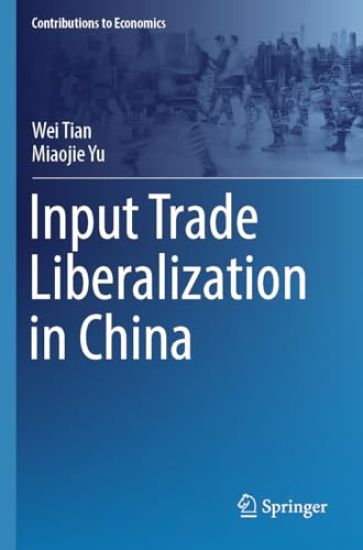
Input Trade Liberalization in China

Input Trade Liberalization in China

Wei Tian; Miaojie Yu

SPRINGER VERLAG, SINGAPORE
2024
nidottu
This book focuses on input trade liberalization in China and discusses the underlying causes and profound effects of Chinese enterprises facing import liberalization of intermediate input. The content of this book includes ten chapters. The analysis of this book mainly uses academic research, with policy study for a few chapters. Most chapters in this book apply the standard method of contemporary economic systems, integrating into the most advanced economic theories of international trade. The author uses theoretical models to obtain predictions which receive empirical support and carries out strict empirical research using data of China's manufacturing enterprises and China's customs to analyze the causes which affect Chinese enterprises facing import liberalization of intermediate input after China’s reform and opening-up. The suggested readership would be the public who are willing to understand the issues closely related to China’s input trade liberalization and opening-up policy, and basic knowledge in economics would be necessary in understanding the academic research part of the book. Meanwhile, this book is also specifically compelling to business persons and policy makers in that it enables deeper understanding on issues about outward foreign investment of enterprises and China’s opening-up policy and facilitates their decision-making process.
Input Trade Liberalization in China

Input Trade Liberalization in China

Wei Tian; Miaojie Yu

SPRINGER VERLAG, SINGAPORE
2023
sidottu
This book focuses on input trade liberalization in China and discusses the underlying causes and profound effects of Chinese enterprises facing import liberalization of intermediate input. The content of this book includes ten chapters. The analysis of this book mainly uses academic research, with policy study for a few chapters. Most chapters in this book apply the standard method of contemporary economic systems, integrating into the most advanced economic theories of international trade. The author uses theoretical models to obtain predictions which receive empirical support and carries out strict empirical research using data of China's manufacturing enterprises and China's customs to analyze the causes which affect Chinese enterprises facing import liberalization of intermediate input after China’s reform and opening-up. The suggested readership would be the public who are willing to understand the issues closely related to China’s input trade liberalization and opening-up policy, and basic knowledge in economics would be necessary in understanding the academic research part of the book. Meanwhile, this book is also specifically compelling to business persons and policy makers in that it enables deeper understanding on issues about outward foreign investment of enterprises and China’s opening-up policy and facilitates their decision-making process.
Outward Foreign Direct Investment of Chinese Enterprises

Outward Foreign Direct Investment of Chinese Enterprises

Wei Tian; Miaojie Yu

SPRINGER VERLAG, SINGAPORE
2023
nidottu
This book focuses on China's fast-growing outward foreign direct investment (ODI) and discusses the underlying causes and profound effects of Chinese enterprises’ “going global.” The book includes eight chapters to analyze the basic characteristics of China's ODI manufacturing enterprises, examine the relationship between enterprise productivity and ODI, investigate the differences between state-owned enterprises and private enterprises in factor market, enterprise ownership and investment, analyze the overall effect of the foreign direct investment (FDI) and thereby the China–US bilateral investment treaties (BIT) on Chinese manufacturing sector in terms of productivity and profitability of the firms. The last chapter provides an overview of China’s three stages of economic reform and opening-up policy in the past four decades, and analyzes the reasons for China’s realization of the splendid economic achievements within such a short time and the main driving forces of China’s incremental international trade in different stages, and discusses the future tasks that would promote the country into a new stage of all-round opening-up. The book aims to illustrate the evolution of China’s opening-up design during the past decades and discuss several most important measures to build an all-around opening-up strategy. Based on these profound analyses, the book provides further policy implication for the sustainable development of China’s opening-up.
Handelskrieg und Handelsgespräche zwischen China und den USA

Handelskrieg und Handelsgespräche zwischen China und den USA

Miaojie Yu

Springer-Verlag Berlin and Heidelberg GmbH Co. KG
2023
sidottu
Dieses Buch konzentriert sich auf die aktuellen Spannungen zwischen China und den USA im Zusammenhang mit dem Handelsungleichgewicht und erörtert Chinas Öffnungsstrategie im Kontext dieses Handelskonflikts. Das Buch gliedert sich in zwei Teile. Im ersten Teil legt der Autor eine detaillierte Analyse des aktuellen Stands der Handelsbeziehungen zwischen China und den USA vor und beschreibt die möglichen Auswirkungen von Handelskonflikten zwischen China und den USA. Zu den in diesem Teil behandelten Themen gehören die Neuschätzung des US-Handelsdefizits mit China, Chinas Status als Nicht-Marktwirtschaft, die Auswirkungen der bilateralen Investitionsabkommen zwischen China und den USA auf Chinas verarbeitende Industrie sowie die geschätzten Wohlfahrtsverluste und -gewinne, die sich aus dem Handelskrieg zwischen China und den USA ergeben. Teil II untersucht Chinas mögliche Reaktion und Entwicklungsstrategie im Kontext der De-Globalisierung. Ausgehend von einem Überblick über die drei Phasen der chinesischen Wirtschaftsreform und Öffnungspolitik in den vergangenen vier Jahrzehnten erörtert der Autor die künftigen Aufgaben, die das Land in eine neue Phase der umfassenden Öffnung führen würden. Schließlich wird in dem Buch die Rolle der Handelsabwicklung, der Handelsliberalisierung und der Unternehmensleistung bei der Förderung von Chinas wundersamem Wirtschaftswachstum umfassend untersucht, um ein besseres Verständnis von Chinas Erfahrungen mit der Öffnung in den letzten vier Jahrzehnten zu fördern.
China’s Miracle in Foreign Trade

China’s Miracle in Foreign Trade

Miaojie Yu

SPRINGER VERLAG, SINGAPORE
2023
nidottu
This book mainly focuses on the miracle of China’s foreign trade in the past 40 years from five perspectives: first, it briefly reviews the import substitution strategy China adopted before its opening-up; second, it analyzes the export-oriented strategy that contributes a lot to China’s economic growth since 1980s; third, it discusses the impacts of trade liberalization and China’s participation in WTO on Chinese firms; forth, it addresses the deepening opening-up in the context of global financial crisis; last, it provides policy advice on China’s newly conducted all-around opening-up strategy. By dividing China’s opening-up into five stages, this book offers a comprehensive discussion to understand and analyze the reason, performance and challenge of China’s economic growth from the perspective of foreign trade.
Outward Foreign Direct Investment of Chinese Enterprises

Outward Foreign Direct Investment of Chinese Enterprises

Wei Tian; Miaojie Yu

SPRINGER VERLAG, SINGAPORE
2022
sidottu
This book focuses on China's fast-growing outward foreign direct investment (ODI) and discusses the underlying causes and profound effects of Chinese enterprises’ “going global.” The book includes eight chapters to analyze the basic characteristics of China's ODI manufacturing enterprises, examine the relationship between enterprise productivity and ODI, investigate the differences between state-owned enterprises and private enterprises in factor market, enterprise ownership and investment, analyze the overall effect of the foreign direct investment (FDI) and thereby the China–US bilateral investment treaties (BIT) on Chinese manufacturing sector in terms of productivity and profitability of the firms. The last chapter provides an overview of China’s three stages of economic reform and opening-up policy in the past four decades, and analyzes the reasons for China’s realization of the splendid economic achievements within such a short time and the main driving forces of China’s incremental international trade in different stages, and discusses the future tasks that would promote the country into a new stage of all-round opening-up. The book aims to illustrate the evolution of China’s opening-up design during the past decades and discuss several most important measures to build an all-around opening-up strategy. Based on these profound analyses, the book provides further policy implication for the sustainable development of China’s opening-up.
China’s Miracle in Foreign Trade

China’s Miracle in Foreign Trade

Miaojie Yu

SPRINGER VERLAG, SINGAPORE
2022
sidottu
This book mainly focuses on the miracle of China’s foreign trade in the past 40 years from five perspectives: first, it briefly reviews the import substitution strategy China adopted before its opening-up; second, it analyzes the export-oriented strategy that contributes a lot to China’s economic growth since 1980s; third, it discusses the impacts of trade liberalization and China’s participation in WTO on Chinese firms; forth, it addresses the deepening opening-up in the context of global financial crisis; last, it provides policy advice on China’s newly conducted all-around opening-up strategy. By dividing China’s opening-up into five stages, this book offers a comprehensive discussion to understand and analyze the reason, performance and challenge of China’s economic growth from the perspective of foreign trade.
Exchange Rate, Credit Constraints and China’s International Trade
This book, by one of China's leading economists, explores the past and present of the RMB—the people's currency—as it is poised to compete with the dollar as the international reserve currency. Exchange rate movement and its pass-through to changes in domestic prices have been topics of wide concern among economists. However, relatively few studies have empirically investigated the relationship between exchange rate movements and China's international trade.This book fills this gap, using the general equilibrium theory of the western economic science norm systems, integrating the leading heterogeneous firm theory of international trade, attempting to set up a theoretical structural model for further prediction, and applying the data from sample cases to examine the structural model. This book will be of interest to economists, financiers, and China watchers.
Trade Openness and China's Economic Development
With the expansion of globalization, international trade has played an increasingly significant role, especially for developing countries. As the largest developing country, China has made a lot of efforts to integrate to the global market since its Open and Reform Policy in 1978 and has become the second largest economy in world. So what is the effect of China’s trade-oriented strategy for the country and the world? How did it improve the country’s economic development? These are some critical questions this book discusses.This book utilizes classic Western economic models to examine how China’s openness policies have affected the manufacturing upgrading and economic development of the country. A large amount of micro-level empirical evidence is added to support the conclusion. Scholars and students in economics and business will benefit from this book. Also, it will appeal to readers interested in policy making and Chinese studies.
China-US Trade War and Trade Talk

China-US Trade War and Trade Talk

Miaojie Yu

Springer Verlag, Singapore
2021
nidottu
This book focuses on the current tension between China and the US on trade imbalance and discusses China’s opening-up strategy in the context of this trade conflict. The book is divided into two parts. In the first part, the author presents a detailed analysis of the current state of the China-US trade relationship and describes the potential impacts of China-US trade conflicts. The topics covered in this section include the re-estimate of US trade deficit with China, China’s non-market economy status, the impact of China-US bilateral investment treaties on China’s manufacturing sectors, and the estimated welfare losses and gains resulting from the China-US trade war. Part II explores China’s possible response and development strategy in the context of de-globalization. Based on an overview of China’s three stages of economic reform and opening-up policy in the past four decades, the author discusses the future tasks that would move the country into a new stage of all-round opening up. Lastly, the book comprehensively reviews the role of processing trade, trade liberalization, and firm performance in promoting China’s miraculous economic growth so as to foster a better understanding of China’s experience of opening up over the past 4 decades.
Exchange Rate, Credit Constraints and China’s International Trade
This book, by one of China's leading economists, explores the past and present of the RMB—the people's currency—as it is poised to compete with the dollar as the international reserve currency. Exchange rate movement and its pass-through to changes in domestic prices have been topics of wide concern among economists. However, relatively few studies have empirically investigated the relationship between exchange rate movements and China's international trade.This book fills this gap, using the general equilibrium theory of the western economic science norm systems, integrating the leading heterogeneous firm theory of international trade, attempting to set up a theoretical structural model for further prediction, and applying the data from sample cases to examine the structural model. This book will be of interest to economists, financiers, and China watchers.
China-US Trade War and Trade Talk

China-US Trade War and Trade Talk

Miaojie Yu

Springer Verlag, Singapore
2020
sidottu
This book focuses on the current tension between China and the US on trade imbalance and discusses China’s opening-up strategy in the context of this trade conflict. The book is divided into two parts. In the first part, the author presents a detailed analysis of the current state of the China-US trade relationship and describes the potential impacts of China-US trade conflicts. The topics covered in this section include the re-estimate of US trade deficit with China, China’s non-market economy status, the impact of China-US bilateral investment treaties on China’s manufacturing sectors, and the estimated welfare losses and gains resulting from the China-US trade war. Part II explores China’s possible response and development strategy in the context of de-globalization. Based on an overview of China’s three stages of economic reform and opening-up policy in the past four decades, the author discusses the future tasks that would move the country into a new stage of all-round opening up. Lastly, the book comprehensively reviews the role of processing trade, trade liberalization, and firm performance in promoting China’s miraculous economic growth so as to foster a better understanding of China’s experience of opening up over the past 4 decades.
Trade Openness and China's Economic Development
With the expansion of globalization, international trade has played an increasingly significant role, especially for developing countries. As the largest developing country, China has made a lot of efforts to integrate to the global market since its Open and Reform Policy in 1978 and has become the second largest economy in world. So what is the effect of China’s trade-oriented strategy for the country and the world? How did it improve the country’s economic development? These are some critical questions this book discusses.This book utilizes classic Western economic models to examine how China’s openness policies have affected the manufacturing upgrading and economic development of the country. A large amount of micro-level empirical evidence is added to support the conclusion. Scholars and students in economics and business will benefit from this book. Also, it will appeal to readers interested in policy making and Chinese studies.