Kirjojen hintavertailu. Mukana 12 595 353 kirjaa ja 12 kauppaa.

Kirjailija

Michael A. Cusumano

Kirjat ja teokset yhdessä paikassa: 10 kirjaa, julkaisuja vuosilta 1991-2020, suosituimpien joukossa The Business of Platforms. Vertaile teosten hintoja ja tarkista saatavuus suomalaisista kirjakaupoista.

10 kirjaa

Kirjojen julkaisuhaarukka 1991-2020.

Strategy Rules: Five Timeless Lessons from Bill Gates, Andy Grove, and Steve Jobs
The authors of the bestselling Competing on Internet Time (a Business Week top 10 book) analyze the strategies, principles, and skills of three of the most successful and influential figures in business--Bill Gates, Andy Grove, and Steve Jobs--offering lessons for all managers and entrepreneurs on leadership, strategy and execution.In less than a decade, Bill Gates, Steve Jobs, and Andy Grove founded three companies that would define the world of technology and transform our lives. At their peaks, Microsoft, Apple, and Intel were collectively worth some $1.5 trillion. Strategy Rules examines these three individuals collectively for the first time--their successes and failures, commonalities and differences--revealing the business strategies and practices they pioneered while building their firms.David B. Yoffie and Michael A. Cusumano have studied these three leaders and their companies for more than thirty years, while teaching business strategy, innovation and entrepreneurship at Harvard and MIT. In this enlightening guide, they show how Gates, Grove, and Jobs approached strategy and execution in remarkably similar ways--yet markedly differently from their erstwhile competitors--keeping their focus on five strategic rules.Strategy Rules brings together the best practices in strategic management and high-tech entrepreneurship from three path-breaking entrepreneurs who emerged as CEOs of huge global companies. Their approaches to formulating strategy and building organizations offer unique insights for start-up executives as well as the heads of modern multinationals.

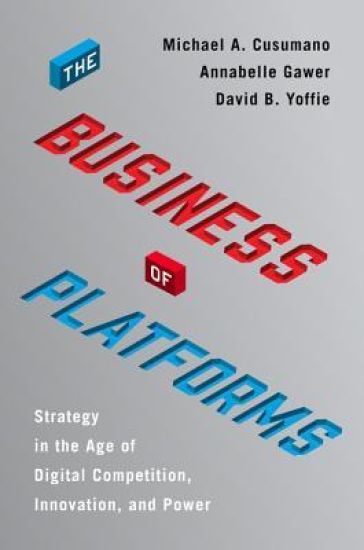
The Business of Platforms

The Business of Platforms

Michael A. Cusumano; Annabelle Gawer; David B. Yoffie

HarperCollins Publishers
2019
sidottu
A trio of experts on high-tech business strategy and innovation reveal the principles that have made platform businesses the most valuable firms in the world and the first trillion-dollar companies. Managers and entrepreneurs in the digital era must learn to live in two worlds—the conventional economy and the platform economy. Platforms that operate for business purposes usually exist at the level of an industry or ecosystem, bringing together individuals and organizations so they can innovate and interact in ways not otherwise possible. Platforms create economic value far beyond what we see in conventional companies.The Business of Platforms is an invaluable, in-depth look at platform strategy and digital innovation. Cusumano, Gawer, and Yoffie address how a small number of companies have come to exert extraordinary influence over every dimension of our personal, professional, and political lives. They explain how these new entities differ from the powerful corporations of the past. They also question whether there are limits to the market dominance and expansion of these digital juggernauts. Finally, they discuss the role governments should play in rethinking data privacy laws, antitrust, and other regulations that could reign in abuses from these powerful businesses. Their goal is to help managers and entrepreneurs build platform businesses that can stand the test of time and win their share of battles with both digital and conventional competitors. As experts who have studied and worked with these firms for some thirty years, this book is the most authoritative and timely investigation yet of the powerful economic and technological forces that make platform businesses, from Amazon and Apple to Microsoft, Facebook, and Google—all dominant players in shaping the global economy, the future of work, and the political world we now face.
Strategy Rules

Strategy Rules

David B. Yoffie; Michael A. Cusumano

HarperBusiness
2015
sidottu
In less than a decade, Bill Gates, Steve Jobs, and Andy Grove founded three companies that would define the world of technology and transform our lives. At their peaks, Microsoft, Apple, and Intel were collectively worth some $1.5 trillion. Strategy Rules examines these three individuals collectively for the first time - their successes and failures, commonalities and differences - revealing the business strategies and practices they pioneered while building their firms. David B. Yoffie and Michael A. Cusumano have studied these three leaders and their companies for more than thirty years, while teaching business strategy, innovation and entrepreneurship at Harvard and MIT. In this enlightening guide, they show how Gates, Grove, and Jobs approached strategy and execution in remarkably similar ways - yet markedly differently from their erstwhile competitors - keeping their focus on five strategic rules. Strategy Rules brings together the best practices in strategic management and high-tech entrepreneurship from three path-breaking entrepreneurs who emerged as CEOs of huge global companies. Their approaches to formulating strategy and building organizations offer unique insights for start-up executives as well as the heads of modern multinationals.
Staying Power

Staying Power

Michael A. Cusumano

Oxford University Press
2012
nidottu
As we continue in an era of simultaneous innovation and commoditization, enabled by digital technologies, managers around the world are asking themselves "how can we both adapt to rapid changes in technology and markets, and still make enough money to survive - and thrive?" To provide answers to these important and urgent questions, MIT Sloan School of Management Professor Michael Cusumano draws on nearly 30 years of research into the practices of global corporations that have been acknowledged leaders and benchmark setters - including Apple, Intel, Google, Microsoft, Toyota, Sony, Panasonic, and others in a range of high-technology, services, and manufacturing industries. These companies have also encountered major challenges in their businesses or disruptions to their core technologies. If we look deeply enough, he contends, we can see the ideas that underpin the management practices that make for great companies, and drive their strategic evolution and innovation capabilities. From his deep knowledge of these organizations, Cusumano distils six enduring principles that he believes have been - in various combinations - crucial to their strategy, innovation management practices, and ability to deal with change and uncertainty. The first two principles - platforms (not just products), and services (especially for product firms) - are relatively new and broader ways of thinking about strategy and business models, based on Cusumano's latest research. The other four - capabilities (not just strategy or positioning), the "pull" concept (not just push), economies of scope (not just scale), and flexibility (not just efficiency) - all contribute to agility, which is a mix of flexibility and speed. Many practices associated with these ideas, such as dynamic capabilities, just-in-time production, iterative or prototype-driven product development, flexible design and manufacturing, modular architectures, and component reuse, are now commonly regarded as standard best practices. These six enduring principles are essential in a new world dominated by platforms and technology-enabled services.
Staying Power

Staying Power

Michael A. Cusumano

Oxford University Press
2010
sidottu
As we move into an era of simultaneous innovation and commoditization, enabled by digital technologies, managers around the world are asking themselves "how can we both adapt to rapid changes in technology and markets, and still make enough money to survive - and thrive?" To provide answers to these important and urgent questions, MIT Sloan School of Management Professor Michael Cusumano draws on nearly 30 years of research into the practices of global corporations that have been acknowledged leaders and benchmark setters - and Microsoft, Apple, Intel, Google, and others in software, internet services, and consumer electronics, and Toyota in manufacturing. If we look deeply enough, he contends, we can see the ideas that underpin the management practices that make for great companies, and drive their strategic evolution and innovation capabilities. From his deep knowledge of these organizations, Cusumano distils six enduring principles that he believes have been - in various combinations - crucial to their strategy, innovation management practices, and ability to deal with change and uncertainty. The first two principles - platforms (not just products), and services, for product firms - are relatively new and broader ways of thinking about strategy and business models, based on Cusumano's latest research. The other four - capabilities (not just strategy), the "pull" concept, economies of scope, and flexibility (not just efficiency) - all contribute to agility, which is a mix of flexibility and speed. Some practices associated with these ideas, such as dynamic capabilities, just-in-time production, iterative or prototype-driven product development, flexible design and manufacturing, modular architectures, and component reuse, are now commonly regarded as standard best practices. They are also essential to a new world dominated by platforms and technology-enabled services.
Thinking Beyond Lean

Thinking Beyond Lean

Michael A. Cusumano; Kentaro Nobeoka

The Free Press
2008
pokkari
"Lean Thinking" has dominated product development and project management for over a decade. Now, however, a six-year study by MIT's International Motor Vehicle Program led by Michael Cusumano and Kentaro Nobeoka finds that, in order to dramatically improve product portfolios, Toyota and other leading companies are moving beyond single-project management on which lean thinking is based. In "Thinking Beyond Lean, " Cusumano and Nobeoka show that single-project management can produce isolated hit products and "fat" designs that contain few common components and many unnecessary parts and features. As a result, in this era of slowing growth and falling profits, leading companies are maximizing their investment by utilizing a groundbreaking concept the authors call "multi-project management." Drawing on a data base of 210 automobile products and detailed case studies from Toyota, Ford, GM, Chrysler, Nissan, Honda, Mazda, Renault, and Fiat, the authors demonstrate how product development teams can share engineers and key common components but retain separate designers to maintain distinctive product features. The result: multi-project management has brought these companies huge savings in development and production costs. Cusumano and Nobeoka's findings will be required reading for every company that makes more than one product. Taking up where "The Machine That Changed the World" left off, "Thinking Beyond Lean" will change the way leaders do business now and in the future.
Platform Leadership

Platform Leadership

Annabelle Gawer; Michael A. Cusumano

Harvard Business Review Press
2002
sidottu
It is the fundamental challenge of the high-tech sector: A firm must innovate internally to succeed - yet its success may equally depend on corresponding innovations by external firms. Whether a company develops a ubiquitous operating system or the software that runs on it, a VCR or the movies we play on it, every participant in a high-tech network is vulnerable to the innovative moves of its partners and competitors. Yet, in spite of this perilous situation, some firms have developed strategies that have made them industry powerhouses and world-class innovators. How? By becoming platform leaders - companies that provide the technological foundation on which other products, services, and systems are built.Platform leadership is the Holy Grail of high-tech industries, but it is difficult to achieve. In "Platform Leadership", high-tech strategy experts Annabelle Gawer and Michael A. Cusumano reveal how Intel, Microsoft, and Cisco, as well as companies including Palm and NTT DoCoMo, have orchestrated industry innovations to support their products - and, in the process, established dominant market positions.Based on these in-depth case studies and on incisive analysis, the authors present their Four Levers Framework for designing and implementing a successful platform strategy-or for improving an existing strategy: Determine the scope of the firm - Is it preferable to create product complements internally or let the "market" produce them?; Design product technology strategically - What degree of modularity is appropriate? Should product interfaces be open or closed? What information should leaders disclose to outside firms?; Shape relationships with external complementors - How can the company balance competition and collaboration with outside players?; Optimize internal organizational structures - What processes and systems will allow the company to manage internal and external conflicts of interest most effectively?For executives, strategists, and entrepreneurs in many high-tech arenas, this book shows how firms can orchestrate innovation to ensure their own competitive futures - and drive the evolution of their industry. Annabelle Gawer is Assistant Professor of Strategy and Management at INSEAD. Michael A. Cusumano is the Sloan Management Review Professor of Management at the MIT Sloan School, editor-in-chief and chairman of the board of the Sloan Management Review, and coauthor of the bestseller "Microsoft Secrets".
Competing On Internet Time

Competing On Internet Time

Michael A. Cusumano; David B. Yoffie

The Free Press
2000
pokkari
When Marc Andreessen and Jim Clark founded Netscape in 1994, they were the first to envision how the Internet could revolutionise conventional ways of using computers, distributing software, communicating with other people, and conducting business. In this penetrating analysis of strategy-making and product innovation in the dynamic markets of commercial cyberspace, bestselling authors Cusumano and Yoffie draw vital lessons from Netscape and how it has employed the techniques of 'judo strategy' in its pitched battle against Microsoft. Through on-site observation and in-depth interviews, the authors construct a blueprint detailing how this hugely successful software company has competed on Internet time. They suggest that by designing products that run on multiple operating systems and staying flexible, they have forced Microsoft into an immovable and therefore less competitive position. Managers everywhere will want to absorb these valuable lessons from the fastest growing software company in history and put them to work in their organisations now - before the competition does!
Japan's Software Factories

Japan's Software Factories

Michael A. Cusumano

Oxford University Press Inc
1991
sidottu
Though Japan has successfully competed with US computer makers in manufacturing and marketing hardware, it has been less successful in developing software that competes with US software companies. This book analyses how a number of Japanese firms, in an effort to catch up, have created what are called `software factories' in which large numbers of people are engaged in developing software in co-operative ways.