
Kirjojen hintavertailu. Mukana 12 390 323 kirjaa ja 12 kauppaa.

Kirjailija

Michael A. Forrester

Kirjat ja teokset yhdessä paikassa: 3 kirjaa, julkaisuja vuosilta 1995-2016, suosituimpien joukossa The Development of Young Children's Social-Cognitive Skills. Vertaile teosten hintoja ja tarkista saatavuus suomalaisista kirjakaupoista.

3 kirjaa

Kirjojen julkaisuhaarukka 1995-2016.

Early Social Interaction

Early Social Interaction

Michael A. Forrester

Cambridge University Press
2016
pokkari
When a young child begins to engage in everyday interaction, she has to acquire competencies that allow her to be oriented to the conventions that inform talk-in-interaction and, at the same time, deal with emotional or affective dimensions of experience. The theoretical positions associated with these domains - social-action and emotion - provide very different accounts of human development and this book examines why this is the case. Through a longitudinal video-recorded study of one child learning how to talk, Michael A. Forrester develops proposals that rest upon a comparison of two perspectives on everyday parent-child interaction taken from the same data corpus - one informed by conversation analysis and ethnomethodology, the other by psychoanalytic developmental psychology. Ultimately, what is significant for attaining membership within any culture is gradually being able to display an orientation towards both domains - doing and feeling, or social-action and affect.
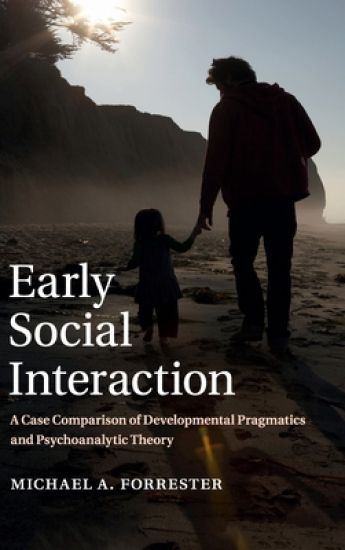
Early Social Interaction

Early Social Interaction

Michael A. Forrester

Cambridge University Press
2014
sidottu
When a young child begins to engage in everyday interaction, she has to acquire competencies that allow her to be oriented to the conventions that inform talk-in-interaction and, at the same time, deal with emotional or affective dimensions of experience. The theoretical positions associated with these domains - social-action and emotion - provide very different accounts of human development and this book examines why this is the case. Through a longitudinal video-recorded study of one child learning how to talk, Michael A. Forrester develops proposals that rest upon a comparison of two perspectives on everyday parent-child interaction taken from the same data corpus - one informed by conversation analysis and ethnomethodology, the other by psychoanalytic developmental psychology. Ultimately, what is significant for attaining membership within any culture is gradually being able to display an orientation towards both domains - doing and feeling, or social-action and affect.
The Development of Young Children's Social-Cognitive Skills

The Development of Young Children's Social-Cognitive Skills

Michael A. Forrester

Psychology Press Ltd
1995
nidottu
Understanding how young children begin to make sense out of the social world has become a major concern within developmental psychology. Over the last 25 years research in this area has raised a number of questions which mirror the confluence of interests from cognitive-developmental and social-developmental psychology. The aims of this book are to consider critically the major themes and findings within this growing social-cognitive developmental research, and to present a new theoretical framework for investigating children's social cognitive skills. Beyond being the first major review of the literature in this area, this synopsis articulates why contemporary theoretical ideas (e.g. information processing, Piagetian and social interactionist) are unlikely ever to provide the conceptual basis for understanding children's participative skills. Building upon ideas both within and beyond mainstream developmental psychology, the "eco-structural" approach advocated seeks to draw together the advantages of the ecological approach in perceptual psychology with the considerable insights of the conversational analysts, child language researchers and Goffman's analysis of social interaction. This convergence is centred around the dynamic and participatory realities of engaging in conversational contexts, the locus for acquiring social cognitive skills. The framework provides the building blocks for models of developmental social cognition which can accommodate dynamic aspects of children's conversational skills. This book then is a review of an important area of developmental psychology, a new perspective on how we can study children's participatory social-cognitive skills and a summary of supporting research for the framework advocated.