Kirjojen hintavertailu. Mukana 12 156 531 kirjaa ja 12 kauppaa.
Kirjailija
Michael A. Hitt
Kirjat ja teokset yhdessä paikassa: 7 kirjaa, julkaisuja vuosilta 1995-2021, suosituimpien joukossa Mergers and Acquisitions. Vertaile teosten hintoja ja tarkista saatavuus suomalaisista kirjakaupoista.
People, processes, and technology. These are the three major drivers of business achievement. The best leaders inherently understand that great companies start with great people. This is as true now as it was during the beginning of the industrial revolution, and understanding and staying current on the latest organizational behavior research and best practices paves the way for managerial success. In this updated edition of Organizational Behavior, theory, new research and real-world case studies are combined in an engaging manner to blend together the critical concepts and skills needed to successfully manage others and build a strong organization across all levels of a company. Featuring an in-depth view of the process and practice of managing individuals, teams, and entire organizations, the text provides a solid foundation for students and future managers.
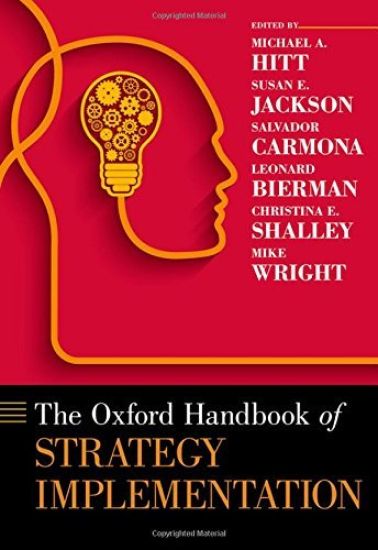
Good strategies can fail because they are poorly implemented. Behind this straightforward statement is a complex reality. This innovative volume explores various aspects of strategy implementation, a process that is as challenging as it is important. For strategies to be implemented effectively, firms must have the right resources and capabilities available. Available resources must be integrated in ways that create the capabilities needed and then those capabilities must be leveraged to effectively implement the strategy in order to create and sustain a competitive advantage. This handbook focuses on how strategy implementation is influenced by resources and governance, human capital and management of it, and accounting-based control systems. It examines how the dynamic, competitive, and international environment increases the importance of knowledge and its acquisition, effective governance as a signal of proper incentives, the interaction of legality and legitimacy, and the connections between compliance and enforcement. Because people implement the strategies through the completion of their job tasks and achievement of their job-related goals, the second section explores how changes in workforce demographics have influenced and may influence strategy. Major factors include the greater proportion of older workers and the increasing role women play in leadership. Acquiring, developing, and having a motivated work force is critical to implementation, whether and how best practices spread is explored, as is the effectiveness of setting goals. Controlling managerial behavior plays a critical role in the implementation of strategies, and is the focus of the third section on accounting-based control systems. These can be helpful both in identifying inappropriate behaviors and in promoting positive managerial actions to achieve desired financial outcomes. They can also encourage experimentation and creativity. The effectiveness of accounting and accountability systems is influenced by four dimensions, including the intended users, standards of compliance, enforcement criteria, and the assurance process.
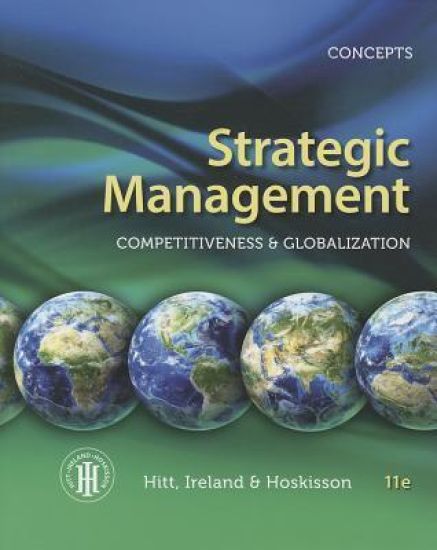
Examine strategic management with the market-leading text that sets the standard for the most intellectually rich, yet thoroughly practical, analysis of strategic management today. Written by highly respected experts Hitt, Ireland, and Hoskisson, STRATEGIC MANAGEMENT: COMPETITIVENESS AND GLOBALIZATION, CONCEPTS AND CASES, Eleventh Edition, combines the latest cutting-edge research and strategic management trends with ideas from some of today's most prominent scholars. This is the only text that integrates the classic industrial organization model with a resource-based view of the firm to give you a complete understanding of how today's businesses use strategic management to establish a sustained competitive advantage.A strong global focus and examples from more than 600 emerging and leading companies place ideas into context within an inviting, practical presentation. A wealth of learning features and more than 30 all-new compelling cases examine a broad range of critical issues confronting managers today. Engaging video cases, CengageNOW (TM) online learning tools, and a complete electronic business library help keep your study current and relevant. STRATEGIC MANAGEMENT: COMPETITIVENESS AND GLOBALIZATION provides the solid understanding you need to effectively apply strategic management tools and techniques for increased performance and tomorrow's competitive advantage.
Michael Hitt is one of the leading names in strategic management in the US. He is former president of the Academy of Management and is on the Board of the Strategic Management Society. He has sent us the attached proposal, which is also being considered and bid for by three other publishers (including Wiley and Oxfprd). We will do extremely well to get it. In the meantime I have received some critical comments (below) and suggestions from Rita McGrath, whose book on "The Entrepreneurial Mindset" is one of the key competitors to this. Mikle Hitt will take these on board. His name alone will be sufficient to secure big sales, as Rita McGrath indicates. I have also consulted Howard Thomas (ex-Illinois) now Warwick; Rob Grant and John Child. All have promised a short review but confirmed that a new text by these authors will be a winner (even a hit). I list the competition in this proposal section as have not mastered the BPS form for this. There is a lot out there, but the closest is the McGrath-Mcmillan book with Harvard. This is a really important area of management study and teaching - I would expect this book to sell to advanced undergrads as well as the MBAs. The unique value creating features of "Strategic Entrepreneurship" include: integration of opportunity seeking and advantage seeking behaviors; explanation of resources and their importance for entrepreneurial success; examination of managing resources (acquiring, changing, bundling, and leveraging) to create value; discussion of the importance and facilitation of creativity for entrepreneurial activity; explaining the linkage between radical or disruptive innovation and entrepreneurship; exploration of entry into international markets as a facilitator of entrepreneurial activity; explanation of the effects of participation in external networks on entrepreneurial activity and value creation; examination of the role and effect of strategic leadership on the success of entrepreneurial activity; and, discussion of how strategic entrepreneurship is important for established firms and start-up ventures. "Strategic Entrepreneurship: Seeking Opportunities and Developing Competitive Advantages to Create Value" is written by Michael A. Hitt and R. Duane Ireland. Firms create value by identifying opportunities in their external environments and then developing competitive advantages to exploit them. Successful value creation requires continuous identification of opportunities and subsequent exploitation of those opportunities in the marketplace by building a sustainable competitive advantage. Therefore, strategic entrepreneurship involves simultaneous opportunity seeking and advantage seeking behaviors. Balance is critical for organizational success. Firms able to spot multiple opportunities but incapable of using appropriate and unique competitive advantages to exploit them become bundles of unfilled promise. Similarly, firms with value-creating competitive advantages lacking opportunities to apply them in the marketplace become pockets of unused capabilities. Only when firms combine effective opportunity seeking behavior with effective advantage seeking behavior can they create significant value for stakeholders, including shareholders. On the other hand, firms seeking opportunities without a strategic perspective as well as firms with strong competitive advantages but lacking an entrepreneurial perspective fail. We believe that many firm failures are attributable to these two conditions. Achieving balance through strategic entrepreneurship - Because it is a product of an appropriate balance between opportunity and advantage seeking behaviors, strategic entrepreneurship is the path to sustainable, value creation. Resources, entrepreneurial networks, creativity and innovation, international entrepreneurship, and strategic leadership are the interrelated components of effective strategic entrepreneurship. Mentioned briefly here, we further define each component in the descriptions of the book's individual chapters. The appendix will include several tools useful for analysis and planning (i.e., "Guide for the Development of a Business Plan"); Competition Bygrave, William D. 1997. "The Portable MBA in Entrepreneurship", New York: John Wiley & Sons. This is an edited volume. Professor Bygrave wrote the book's introductory chapter. Scholars known for their work in areas involved with the practice of entrepreneurship (e.g., Financial Projects, Legal and Tax Issues, and Entrepreneurship Economics) wrote the remaining chapters. Oriented to the MBA, Executive MBA, and business practitioner markets (as is our book), this edited volume is concerned only with entrepreneurship. Small businesses are the focus with the objective being to describe what should be done to successfully start, grow, and harvest a small firm. How does our book differ - An obvious difference is that the Bygrave work is an edited volume with contributions from multiple individuals. Edited volumes often lack consistency in terms of writing style and cohesion in terms of explaining the interrelationships associated with a particular phenomenon. This edited volume also lacks sufficient treatment of the strategic management literature (both the academic and practitioner literatures). As such, there is no effort to integrate opportunity seeking with advantage seeking behavior. Lastly, the value of some of the chapter topics (e.g., Entrepreneurs and the Internet) to value creation (the focus of our book) isn't obvious. In "Beyond Entrepreneurship: Turning Your Business into an Enduring Great Company" (Collins, James C., and Lazier, William C. 1995.), New York: Simon & Schuster, the authors rely on many company-specific examples. They discuss actions taken by firms in efforts to remain healthy and achieve long-term success. Healthy firms are successful in the long term and achieve what the authors call corporate greatness. Leadership is seen as a vital to achieving corporate greatness. In particular, the importance of the firm's leaders to establishment of a compelling vision is emphasized in the discussion of effective leadership. The authors argue that the foundation for corporate greatness should be set while the firm is small and flexible enough to adapt to the leaders' values. How does our book differ? Collins and Lazier draw primarily from their work as consultants as the foundation for this book. The large number of examples from a diverse set of companies highlights the source of their arguments and guidelines. Our book will include company-specific examples to demonstrate key points. However, the entrepreneurship and strategic management academic and practitioner literatures are the primary source of our materials. Our contribution is the integration of two streams of thoughts to show how the firm creates value by successfully combining opportunity seeking with advantage seeking behavior. The scope of the two books also differs, in that Collins and Lazier are only concerned with established firms while our arguments show how the use of strategic entrepreneurship creates an entrepreneurial firm for established companies as well as start-up ventures. Moreover, increased value for stakeholders is the outcome of strategic entrepreneurship instead of the less-carefully defined corporate greatness. "Harvard Business Review on Entrepreneurship", (Harvard Business School Staff. 1999), Boston: Harvard Business School Press. This is a compilation of articles from HBR. The focus of this volume is on starting entrepreneurial ventures. Topics considered include those associated with developing a business plan, using it to gain capitalization for the venture, and what companies do to successfully commercialize technologies. The articles chosen for this collection of readings have a bent toward technology-intensive start-ups. How does our book differ? Because of the two authors' long and successful working relationship, the book will have the consistency and cohesiveness that is absent a volume of works by multiple authors. Beyond this, the HBR volume doesn't include articles oriented to advantage seeking behavior. Finally, the collection of articles isn't focused on value creation as the product of integrating opportunity seeking and advantage seeking behaviors. "The Entrepreneurial Mindset: Strategies for Continuously Creating Opportunity in an Age of Uncertainty" (McGrath, Rita G., and MacMillan, Ian. 2000), Boston: Harvard Business Press. In this book, McGrath and MacMillan's core argument is that businesses fail in rapidly changing competitive environments if they don't adopt an entrepreneurial mindset and use the tools associated with it. Uncertainty characterizes the environments firms of all types now face. The book is filled with tools and techniques firms are advised to use in managing entrepreneurially in uncertain business conditions. This book is the closest competitor to the product that we propose. How does our book differ? McGrath and MacMillan have written a successful book that targets our market. As is the case for us, their focus is on integrating entrepreneurship and strategic management activities. However, our focus on integrating the fields is far more direct and explicit. In addition, we discuss provide a more comprehensive treatment of opportunity seeking and advantage seeking behaviors. Our detailed analysis of resources in terms of acquisition, change, bundling, and leveraging offers insights that McGrath and MacMillan do not provide. Moreover, we examine international entrepreneurship and entrepreneurial networks that are largely ignored in their book. "Entrepreneurial Management: Productivity Through Innovation, Raising Capital, Structuring Deals, Successful Strategic Plans", (Calvin, Robert J., 2002), New York: McGraw-Hill. In this book, Calvin has produced a good 'nuts and bolts' book about developing an entrepreneurial firm. He explains the finance and control processes, marketing and sales and business development. The book is filled with tools entrepreneurs can use for analysis. The framework is similar to and built on his other books on marketing and sales. These books are designed for lower level thinking with the primary objective being to train analysts instead of leaders. "How does our book differ? Rather than a 'nuts and bolts' approach, we seek to provide insights for the thinking executive and MBA students. Our book will challenge and satisfy their intellectual curiosity. We encourage entrepreneurs and managers to integrate entrepreneurial and strategic activities and thereby create value for the firm's stakeholders. The level of analysis and content will be higher in our book. Our book is designed to make executives and graduate students Think and then Act in effective ways as opposed to conduct analyses. Our book contributes to the development of strategic and entrepreneurial leadership.
In 1999, MCI WorldComm and Sprint agreed to merge. Valued at $129 billion, this expected transaction was the largest in history. However, it fell victim to regulators in Europe concerned with the potential monopoly power of the merged firm. This M&A action was merely the latest in a growing trend of "blockbuster" mergers over the past several years. Once a phenomenon seen primarily in the United States, mergers and acquisitions are increasingly being pursued across national boundaries. In short, acquisition strategies are among the most important corporate-level strategies in the new millennium. The need for clear, complete, and up-to-date guide to successful mergers and acquisitions had never been greater. This book more than fills that need. Looking at successful--and unsuccessful--mergers and acquisitions in a number of different industries, Mergers and Acquisitions: A Guide to Creating Value explains how to conduct an acquisition and how to avoid pitfalls that have doomed many such ventures. The authors take the reader step-by-step through the process, starting with the elements of a successful merger, due diligence to ensure that the target firm is sound and fits well with the acquiring firm, and how mergers and acquisitions are financed. They move on to explore how firms find partners/targets for acquisitions that have complementary resources and how to find partners with which integration and synergy can be achieved. Finally, they discuss the potential hazards found in M&A's and how to avoid them, how to conduct successful cross-border acquisitions, and how to ensure that ethical principles aren't breached during the process. Based on 15 years of research, this essential guide goes beyond specific case studies to cover all aspects of these ventures, making it required reading for all managers seeking to build a successful strategy.
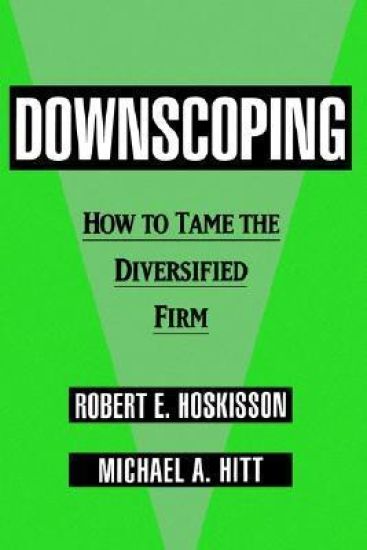
Large, diversified firms face unique challenges as they compete worldwide, and corporate restructuring is one way multinationals strive for competitive advantage. Weighing the pros and cons of a variety of approaches to restructuring, Downscoping offers executives a clear, strategic path through the maze. The authors show that when a multinational conglomerate fails to compete effectively, too much diversification may be the culprit. Whether the result of weak corporate governance or poor corporate strategy, over-diversification can make managers, unfamiliar with some of the markets in which they compete, opt for safety over innovation. This risk-aversion and lack of long-range commitment to innovation lead inevitably to stagnation over the longer term. The answer is not downsizing--closing offices and laying off personnel--but downscoping: a strategic approach to restructuring. The options include incentive and compensation adjustments for executives, leveraged buy-outs and capital structure changes, focusing on core skills, diversifying internationally while focusing on businesses in which a firm has strong competencies, and buying and selling mature businesses where product development is not a great concern. Regardless of the approach, executives must exercise strategic leadership during and after restructuring, including providing strategic direction, exploiting core competencies, deeloping human capital and sustaining the corporate culture. Based on systematic research rather than casual observation, Downscoping provides a strong description of restructuring alternatives and their resulting tradeoffs. Its specific guidelines for maintaining competitiveness will be essential reading for managers involved in corporate restructuring.