Kirjailija
Michael A. Lofaro
Kirjat ja teokset yhdessä paikassa: 10 kirjaa, julkaisuja vuosilta 1986-2021, suosituimpien joukossa James Agee. Vertaile teosten hintoja ja tarkista saatavuus suomalaisista kirjakaupoista.
10 kirjaa
Kirjojen julkaisuhaarukka 1986-2021.
Life of Ma-ka-tai-me-she-kia-kiak, or Black Hawk
Michael A. Lofaro
University of Tennessee Press
2021
nidottu
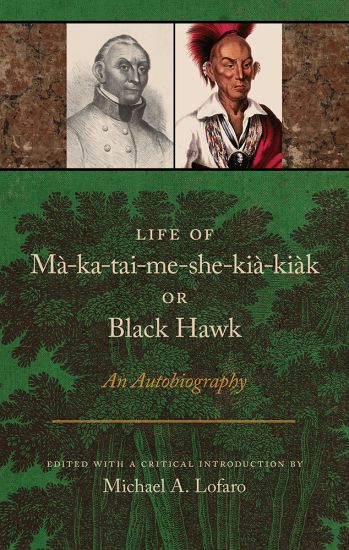
Originally published in 1833, the autobiography of the Sauk war chief Black Hawk was the first memoir written by a Native American who was actively resisting US Indian removal policy. Donald Jackson edited the first scholarly version of this work-Black Hawk: An Autobiography-in 1955. Since then, the Life has become a classic and seminal text in the fields of Native American literature and studies, American history, literature, autobiography, and cultural studies.This edition of Black Hawk's 1833 autobiography includes explanatory, historical, and textual notes that significantly enrich the understanding of Black Hawk's memoir, his life, and the Black Hawk War of 1832. The notes and a chronology make this key Native American text available to scholars in several new ways. Likewise, in its preface and critical essay, this edition moves beyond Jackson's historical work to incorporate insights from numerous other disciplines that have since engaged the text. These investigations reflect the new developments in scholarship since 1955, suggest future possibilities for the crosscultural study of Black Hawk's Life, and examine the continuity of his autobiography within Native American and other life-story traditions. This volume also includes the biographical continuation of Black Hawk's Life-recounting subsequent events in his life until his death in 1838-written by J. B. Patterson for his 1882 reissued and expanded edition of the original autobiography.Scholars of Native American literature and history and settler colonialism will find much to engage them in this remarkable new edition.
The Life and Adventures of Colonel David Crockett of West Tennessee
Michael A. Lofaro
University of Tennessee Press
2020
nidottu
The legendary Davy Crockett arose simultaneously with the emergence of the historical Crockett as a public figure, and once established, the man and the myth were forevermore entangled. The present work, his Life and Adventures (1833), ushered in a series of biographical and autobiographical books that thrust Crockett fully onto the national and international scene. This work, quickly retitled Sketches and Eccentricities, was the most outlandish. Its purported author, J. S. French, mixed two nineteenth-century genres of storytelling - the Humor of the Old Southwest and the sketch - all presented within a historical framework to create an early version of the King of the Wild Frontier. The Crockett encountered here is the marksman who can shoot an elk from 140 yards with his beloved rifle, Betsy, grin the bark off a tree knot, and choose bows and arrows as weapons when challenged to a duel by a fellow congressman. Within a year, Crockett disavowed this book, preferring his autobiography - Narrative of the Life of David Crockett, of the State of Tennessee - but this rollicking story, often bouncing along from tall tale, hunting anecdote, faux moral tale, to humorous pratfall, became a major source for the later biographical writings and a later cultural industry that swept up newspapers, books, political propaganda, plays, and films - and almost every way in which a frontier figure could appear in popular culture. And, while Crockett's image was a source of entertainment and humor, it also pointed toward something far more serious: after his death at the Alamo it presented Americans with a fictional Frontier hero who progressively embodied their views on topics as varied as manliness, manifest destiny, and even white supremacy. However, the Crockett of Sketches - canny, adaptable, intelligent but not educated, hilarious - was above all a perfect reflection of the aspirations, interests, and beliefs of Jacksonian-era Americans.
Boone, Black Hawk, and Crockett in 1833
Michael A. Lofaro
University of Tennessee Press
2019
sidottu
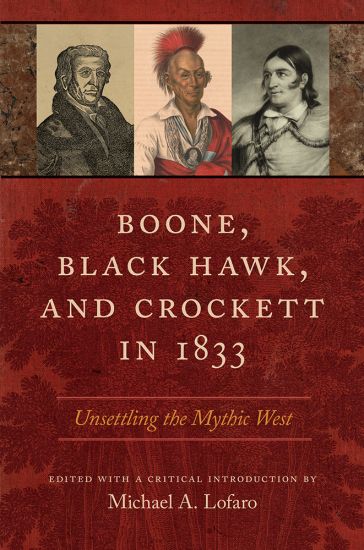
Although name such as Daniel Boone, Black Hawk, and “Davy” Crockett are familiar to most Americans, the historical, political, and literary contexts that produced the mythical images of these figures are unfamiliar to most outside academia. In Boone, Black Hawk, and Crockett in 1833,Michael A. Lofaro compiles, annotates, and analyzes three (auto)biographical writings published in Cincinnati, Ohio, in 1833-The Biographical Memoir of Daniel Boone; Life of Ma-ka-tai-me-she-kia-kiak, or Black Hawk; and The Life and Col. David Crockett of West Tennessee-to reveal how the portrayals of Boone, Black Hawk, and Crockett revised the idea of the “frontier hero.” By placing them together in dialogue through the scholarly reediting of their texts, Lofaro demonstrates that these works exemplify, typify, and epitomize masculinity, burgeoning capitalism, and Jacksonian democracy, probe beliefs in race and class, and provide nothing short of a deep dissection of the frontier mentality of the antebellum period. Additionally, the reception of these works influenced the ways in which nineteenth-century Americans understood and perceived manifest destiny, the removal of Native Americans from their homelands, to the west of the Mississippi River, and the waning concept of “American frontier.” With its great scope and insight, this publication creates connections among many academic disciplines, including colonial America, Jacksonian America, Native American studies, as well as literary and folklore studies.
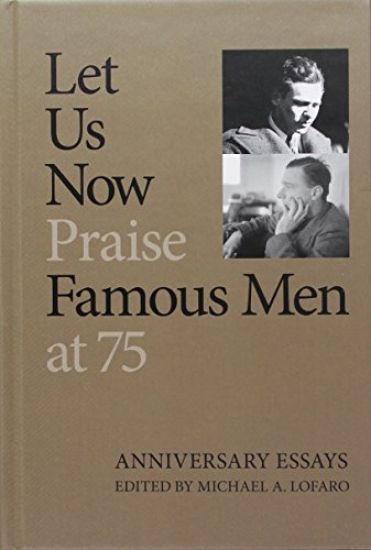
Barely noticed upon publication in 1941, writer James Agee and photographer Walker Evans’s unique chronicle of Alabama sharecroppers, Let Us Now Praise Famous Men, would enjoy a remarkable revival during the 1960s. Remembering it as a “bible of sorts” for civil rights activists like himself, psychiatrist Robert Coles called it “an eloquent testimony that others had cared, had gone forth to look and hear, and had come back to stand up and address their friends and neighbors and those beyond personal knowing.” The book has remained in print ever since, profoundly affecting subsequent generations of readers. In this collection, seventeen gifted essayists offer provocative new perspectives on the Agee-Evans classic, ranging from personal appreciations to computational analysis, with forays into literary, film, historical, social, and cultural criticism, among other approaches. David Moltke-Hansen examines the political context in which the book was produced, comparing it in particular to the works of Erskine Caldwell and others with more explicit agendas than Agee, while Sarah E. Gardner explores Agee’s position as a southerner in the literary culture of 1930s Manhattan. Contrasting Agee’s text to the uncaptioned Evans photographs that open the book, Jeffrey Couchman discusses how the writer applied a “cinematic eye” to his descriptions of the sharecroppers’ homes and their possessions. In their essays, Hugh Davis, Brent Walker Cline, and David Madden link Agee with earlier writers such as Wordsworth, Schopenhauer, Dostoevsky, and Melville, while Michael Jacobs considers Agee as a forefather of the “New Journalism” championed by Tom Wolfe. Other contributors explore such disparate topics as Agee’s conception of irony, the conflict of art and nature in the book, and the author’s portrayal of space. Taken together, these artful elucidations of a notoriously difficult but brilliant work provide the most comprehensive and wide-ranging view of Let Us Now Praise Famous Men to date.
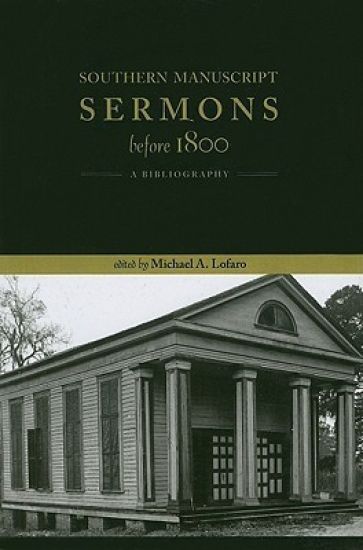
Southern Manuscript Sermons before 1800: A Bibliography
Michael A. Lofaro
Newfound Press
2010
nidottu
Southern Manuscript Sermons before 1800 is the first guide to the study of the manuscript sermon literature of the Southern colonies/states of Maryland, Virginia, North Carolina, South Carolina, and Georgia. The bibliography contains entries for over 1,600 sermons by over a hundred ministers affiliated with eight denominations. The compilation provides a previously unavailable major tool for research into the early South. Richard Beale Davis began the bibliography in 1946 as part of his research for Intellectual Life in the Colonial South, 1585-1763, which won the National Book Award in history. Michael A. Lofaro took over the project in 1976, expanded the colonial entries (pre-1764), and added the period of 1764-1799. George M. Barringer contributed entries for Jesuit sermons. Sandra G. Hancock contributed those for Thomas Cradock. The bibliography is also available online (dlc.lib.utk.edu/sermons). This database contains the same in-depth descriptions of these sermons, over 90 percent of which are unknown. It provides multiple avenues of access. Searches can be constructed and limited by single or combined criteria of author, repository, book of the Bible, date, state, denomination, keyword, and short title. Scholars can employ both versions of this tool to construct a more complete picture of the southern mind before 1800 and to reveal how that mind contributes to a national ethos. The bibliography will aid many disciplines--religion, cultural and American studies, history, literature, political science, sociology, psychology, and more--and all those who wish to interpret the past and its effect upon the present. It will lead to a more balanced appraisal of American intellectual history by encouraging access to a large body of southern sermons to place alongside those of the northern and middle states for critical assessment.