Kirjojen hintavertailu. Mukana 12 390 323 kirjaa ja 12 kauppaa.

Kirjailija

Michael B. Smith

Kirjat ja teokset yhdessä paikassa: 25 kirjaa, julkaisuja vuosilta 1988-2025, suosituimpien joukossa Biochemistry. Vertaile teosten hintoja ja tarkista saatavuus suomalaisista kirjakaupoista.

Mukana myös kirjoitusasut: Michael B Smith

25 kirjaa

Kirjojen julkaisuhaarukka 1988-2025.

Biochemistry

Biochemistry

Michael B. Smith

CRC Press Inc
2020
nidottu
“There is a continuing demand for up to date organic & bio-organic chemistry undergraduate textbooks. This well planned text builds upon a successful existing work and adds content relevant to biomolecules and biological activity”.-Professor Philip Page, Emeritus Professor, School of Chemistry University of East Anglia, UK“Introduces the key concepts of organic chemistry in a succinct and clear way”.-Andre Cobb, KCL, UKReactions in biochemistry can be explained by an understanding of fundamental organic chemistry principles and reactions. This paradigm is extended to biochemical principles and to myriad biomolecules.Biochemistry: An Organic Chemistry Approach provides a framework for understanding various topics of biochemistry, including the chemical behavior of biomolecules, enzyme activity, and more. It goes beyond mere memorization. Using several techniques to develop a relational understanding, including homework, this text helps students fully grasp and better correlate the essential organic chemistry concepts with those concepts at the root of biochemistry. The goal is to better understand the fundamental principles of biochemistry.Features:Presents a review chapter of fundamental organic chemistry principles and reactions.Presents and explains the fundamental principles of biochemistry using principles and common reactions of organic chemistry.Discusses enzymes, proteins, fatty acids, lipids, vitamins, hormones, nucleic acids and other biomolecules by comparing and contrasting them with the organic chemistry reactions that constitute the foundation of these classes of biomolecules.Discusses the organic synthesis and reactions of amino acids, carbohydrates, nucleic acids and other biomolecules.
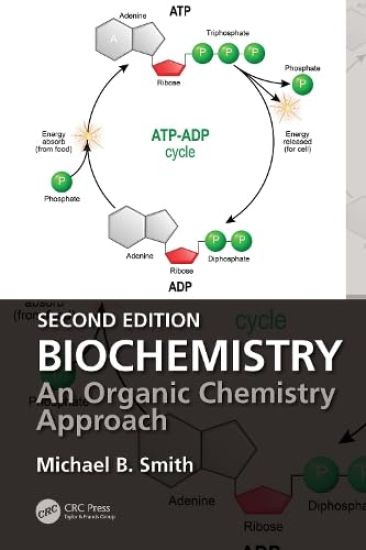
Biochemistry An Organic Chemistry Approach Second Edition
Reactions in biochemistry can be explained by an understanding of fundamental organic chemistry principles and reactions. This paradigm is extended to biochemical principles and to a myriad of biomolecules.The text provides a framework for understanding various topics of biochemistry including the chemical behavior of biomolecules, enzyme activity and more. It goes beyond mere memorization. Using several techniques to develop a relational understanding, including homework, this text helps students fully grasp and better correlate the essential organic chemistry concepts with those concepts at the root of biochemistry.The goal is to better understand the fundamental principles of biochemistry.
Organic Chemistry

Organic Chemistry

Michael B. Smith

TAYLOR FRANCIS LTD
2024
nidottu
Based on the premise that many, if not most, reactions in organic chemistry can be explained by variations of fundamental acid–base concepts, Organic Chemistry: An Acid–Base Approach provides a framework for understanding the subject that goes beyond mere memorization. Using several techniques to develop a relational understanding, it helps students fully grasp the essential concepts at the root of organic chemistry.This new edition was rewritten largely with the feedback of students in mind and is also based on the author’s classroom experiences using the previous editions.Highlights of the Third Edition Include:Extensively revised chapters that improve the presentation of material. Features the contributions of more than 65 scientists, highlighting the diversity in organic chemistry. Features the current work of over 30 organic chemists, highlighting the diversity in organic chemistry. Many new reactions are featured that are important in modern organic chemistry. Video lectures are provided in a .mov format, accessible online as a ‘built-in’ ancillary for the book. Instructor and Student Resources —includes scientist images and solutions manual for instructors. The third edition of Organic Chemistry: An Acid–Base Approach constitutes a significant improvement upon a unique introductory technique to organic chemistry. The reactions and mechanisms it covers are the most fundamental concepts in organic chemistry that are applied to industry, biological chemistry, biochemistry, molecular biology, and pharmacy. Using an illustrated conceptual approach rather than presenting sets of principles and theories to memorize, it gives students a more concrete understanding of the material.
Organic Chemistry

Organic Chemistry

Michael B. Smith

TAYLOR FRANCIS LTD
2022
sidottu
Based on the premise that many, if not most, reactions in organic chemistry can be explained by variations of fundamental acid–base concepts, Organic Chemistry: An Acid–Base Approach provides a framework for understanding the subject that goes beyond mere memorization. Using several techniques to develop a relational understanding, it helps students fully grasp the essential concepts at the root of organic chemistry.This new edition was rewritten largely with the feedback of students in mind and is also based on the author’s classroom experiences using the previous editions.Highlights of the Third Edition Include:Extensively revised chapters that improve the presentation of material. Features the contributions of more than 65 scientists, highlighting the diversity in organic chemistry. Features the current work of over 30 organic chemists, highlighting the diversity in organic chemistry. Many new reactions are featured that are important in modern organic chemistry. Video lectures are provided in a .mov format, accessible online as a ‘built-in’ ancillary for the book. Instructor and Student Resources —includes scientist images and solutions manual for instructors. The third edition of Organic Chemistry: An Acid–Base Approach constitutes a significant improvement upon a unique introductory technique to organic chemistry. The reactions and mechanisms it covers are the most fundamental concepts in organic chemistry that are applied to industry, biological chemistry, biochemistry, molecular biology, and pharmacy. Using an illustrated conceptual approach rather than presenting sets of principles and theories to memorize, it gives students a more concrete understanding of the material.
A Q&A Approach to Organic Chemistry

A Q&A Approach to Organic Chemistry

Michael B. Smith

TAYLOR FRANCIS LTD
2022
nidottu
A Q&A Approach to Organic Chemistry is a book of leading questions that begins with atomic orbitals and bonding. All critical topics are covered, including bonding, nomenclature, stereochemistry, conformations, acids and bases, oxidations, reductions, substitution, elimination, acyl addition, acyl substitution, enolate anion reactions, the Diels–Alder reaction and sigmatropic rearrangements, aromatic chemistry, spectroscopy, amino acids and proteins, and carbohydrates and nucleosides. All major reactions are covered. In all chapters, there are leading questions to focus attention on a principle or reaction and the answer is immediately provided. Each chapter includes end-of-chapter homework questions with the answer keys in an Appendix at the end of the book. This book is envisioned to be a supplementary guide to be used with virtually any available undergraduate organic chemistry textbook. This book allows for a "self-guided" approach that is useful as one studies for a coursework exam or as one reviews organic chemistry for postgraduate exams.Key Features: Allows a "self-guided tour" of organic chemistry Discusses all important areas and fundamental reactions of organic chemistry Classroom tested Useful as a study guide that will supplement most organic chemistry textbooks Assists one in study for coursework exams or allows one to review organic chemistry for postgraduate exams Includes 21 chapters of leading questions that covers all major topics and major reactions of organic chemistry, with the answers immediately after
A Q&A Approach to Organic Chemistry

A Q&A Approach to Organic Chemistry

Michael B. Smith

CRC Press
2020
sidottu
A Q&A Approach to Organic Chemistry is a book of leading questions that begins with atomic orbitals and bonding. All critical topics are covered, including bonding, nomenclature, stereochemistry, conformations, acids and bases, oxidations, reductions, substitution, elimination, acyl addition, acyl substitution, enolate anion reactions, the Diels–Alder reaction and sigmatropic rearrangements, aromatic chemistry, spectroscopy, amino acids and proteins, and carbohydrates and nucleosides. All major reactions are covered. Each chapter includes end-of-chapter homework questions with the answer keys in an Appendix at the end of the book. This book is envisioned to be a supplementary guide to be used with virtually any available undergraduate organic chemistry textbook. This book allows for a "self-guided" approach that is useful as one studies for a coursework exam or as one reviews organic chemistry for postgraduate exams.Key Features: Allows a "self-guided tour" of organic chemistry Discusses all important areas and fundamental reactions of organic chemistry Classroom tested Useful as a study guide that will supplement most organic chemistry textbooks Assists one in study for coursework exams or allows one to review organic chemistry for postgraduate exams Includes 21 chapters of leading questions that covers all major topics and major reactions of organic chemistry
Biochemistry

Biochemistry

Michael B. Smith

CRC Press Inc
2020
sidottu
“There is a continuing demand for up to date organic & bio-organic chemistry undergraduate textbooks. This well planned text builds upon a successful existing work and adds content relevant to biomolecules and biological activity”.-Professor Philip Page, Emeritus Professor, School of Chemistry University of East Anglia, UK“Introduces the key concepts of organic chemistry in a succinct and clear way”.-Andre Cobb, KCL, UKReactions in biochemistry can be explained by an understanding of fundamental organic chemistry principles and reactions. This paradigm is extended to biochemical principles and to myriad biomolecules.Biochemistry: An Organic Chemistry Approach provides a framework for understanding various topics of biochemistry, including the chemical behavior of biomolecules, enzyme activity, and more. It goes beyond mere memorization. Using several techniques to develop a relational understanding, including homework, this text helps students fully grasp and better correlate the essential organic chemistry concepts with those concepts at the root of biochemistry. The goal is to better understand the fundamental principles of biochemistry.Features:Presents a review chapter of fundamental organic chemistry principles and reactions.Presents and explains the fundamental principles of biochemistry using principles and common reactions of organic chemistry.Discusses enzymes, proteins, fatty acids, lipids, vitamins, hormones, nucleic acids and other biomolecules by comparing and contrasting them with the organic chemistry reactions that constitute the foundation of these classes of biomolecules.Discusses the organic synthesis and reactions of amino acids, carbohydrates, nucleic acids and other biomolecules.
March's Advanced Organic Chemistry

March's Advanced Organic Chemistry

Michael B. Smith

Wiley-Blackwell
2020
sidottu
The completely revised and updated, definitive resource for students and professionals in organic chemistry The revised and updated 8th edition of March's Advanced Organic Chemistry: Reactions, Mechanisms, and Structure explains the theories of organic chemistry with examples and reactions. This book is the most comprehensive resource about organic chemistry available. Readers are guided on the planning and execution of multi-step synthetic reactions, with detailed descriptions of all the reactions The opening chapters of March's Advanced Organic Chemistry, 8th Edition deal with the structure of organic compounds and discuss important organic chemistry bonds, fundamental principles of conformation, and stereochemistry of organic molecules, and reactive intermediates in organic chemistry. Further coverage concerns general principles of mechanism in organic chemistry, including acids and bases, photochemistry, sonochemistry and microwave irradiation. The relationship between structure and reactivity is also covered. The final chapters cover the nature and scope of organic reactions and their mechanisms. This edition: Provides revised examples and citations that reflect advances in areas of organic chemistry published between 2011 and 2017Includes appendices on the literature of organic chemistry and the classification of reactions according to the compounds preparedInstructs the reader on preparing and conducting multi-step synthetic reactions, and provides complete descriptions of each reaction The 8th edition of March's Advanced Organic Chemistry proves once again that it is a must-have desktop reference and textbook for every student and professional working in organic chemistry or related fields.Winner of the Textbook & Acadmic Authors Association 2021 McGuffey Longevity Award.
Hybrid Retrosynthesis

Hybrid Retrosynthesis

Michael B. Smith; John D'Angelo

Elsevier Science Publishing Co Inc
2015
nidottu
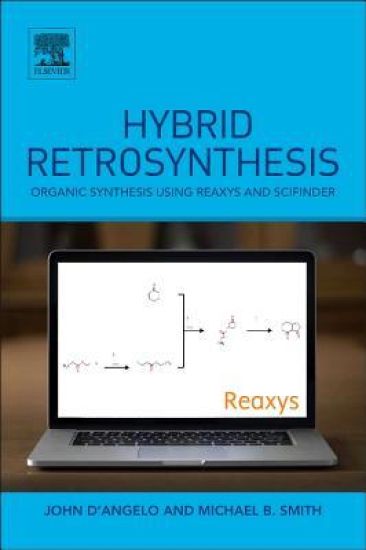
Designed to supplement existing organic textbooks, Hybrid Retrosynthesis presents a relatively simple approach to solving synthesis problems, using a small library of basic reactions along with the computer searching capabilities of Reaxys and SciFinder. This clear, concise guide reviews the essential skills needed for organic synthesis and retrosynthesis, expanding reader knowledge of the foundational principles of these techniques, whilst supporting their use via practical methodologies. Perfect for both graduate and post-graduate students, Hybrid Retrosynthesis provides new applied skills and tools to help during their organic synthesis courses and future careers, whilst simultaneously acting as useful resource for those setting tutorial and group problems, and as a helpful go-to guide for organic chemists involved in either industry or academia.
Compendium of Organic Synthetic Methods, Volume 13

Compendium of Organic Synthetic Methods, Volume 13

Michael B. Smith

John Wiley Sons Inc
2014
sidottu
The Compendium of Organic Synthetic Methods serves as a handy desktop reference for organic chemists to browse new reactions and transformations of interest, facilitating the search for functional group transformations in the original literature of organic chemistry. Volume 13 contains both functional group transformations and carbon-carbon bond forming reactions from the literature in the years 2005-8. It presents examples of published reactions for the preparation of monofunctional compounds.The Compendium of Organic Synthetic Methods series facilitates the search for quality, selected functional group transformations, organized by reacting functional group of starting material and functional group formed, with full references to each reactionPresents examples of published reactions for the preparation of monofunctional compounds from the literature of 2005-8Provides a handy reference and a valuable tool to the working organic chemist, allowing a quick check of known organic transformationsStringent criteria for inclusion of reactions, including real synthetic utility of reactions, reagents readily available or easily prepared and handled in the laboratory
Compendium of Organic Synthetic Methods, Volume 12

Compendium of Organic Synthetic Methods, Volume 12

Michael B. Smith

John Wiley Sons Inc
2009
sidottu
The Compendium of Organic Synthetic Methods series facilitates the working chemist's search for the most useful functional group transformations in organic chemistry. Drawn from an exhaustive survey of the literature, Compendium of Organic Synthetic Methods, Volume 12 contains both functional group transformations and carbon-carbon bond-forming reactions. Author Michael Smith adheres to stringent criteria for listing reactions, including real synthetic utility and reagents that are either readily available or easily prepared and handled in the laboratory. A clear organizational scheme-chemical transformations classified first by reacting functional group of starting material, then by functional group formed-allows for quick reference and information retrieval. Compendium of Organic Synthetic Methods, Volume 12 provides an unparalleled source of information on the methods, reactions, and transformations in contemporary organic chemistry for the working chemist and student alike.
Dis-Enclosure

Dis-Enclosure

Jean-Luc Nancy; Gabriel Malenfant; Michael B. Smith

Fordham University Press
2008
pokkari
This book is a profound and eagerly anticipated investigation into what is left of a monotheistic religious spirit—notably, a minimalist faith that is neither confessional nor credulous. Articulating this faith as works and as an objectless hope, Nancy deconstructs Christianity in search of the historical and reflective conditions that provided its initial energy. Working through Blanchot and Nietzsche, re-reading Heidegger and Derrida, Nancy turns to the Epistle of Saint James rather than those of Saint Paul, discerning in it the primitive essence of Christianity as hope. The "religion that provided the exit from religion," as he terms Christianity, consists in the announcement of an end. It is the announcement that counts, however, rather than any finality. In this announcement there is a proximity to others and to what was once called parousia. But parousia is no longer presence; it is no longer the return of the Messiah. Rather, it is what is near us and does not cease to open and to close, a presence deferred yet imminent. In a demystified age where we are left with a vision of a self-enclosed world—in which humans are no longer mortals facing an immortal being, but entities whose lives are accompanied by the time of their own decline—parousia stands as a question. Can we venture the risk of a decentered perspective, such that the meaning of the world can be found both inside and outside, within and without our so-immanent world? The deconstruction of Christianity that Nancy proposes is neither a game nor a strategy. It is an invitation to imagine a strange faith that enacts the inadequation of life to itself. Our lives overflow the self-contained boundaries of their biological and sociological interpretations. Out of this excess, wells up a fragile, overlooked meaning that is beyond both confessionalism and humanism.
Dis-Enclosure

Dis-Enclosure

Jean-Luc Nancy; Gabriel Malenfant; Michael B. Smith

Fordham University Press
2008
sidottu
This book is a profound and eagerly anticipated investigation into what is left of a monotheistic religious spirit—notably, a minimalist faith that is neither confessional nor credulous. Articulating this faith as works and as an objectless hope, Nancy deconstructs Christianity in search of the historical and reflective conditions that provided its initial energy. Working through Blanchot and Nietzsche, re-reading Heidegger and Derrida, Nancy turns to the Epistle of Saint James rather than those of Saint Paul, discerning in it the primitive essence of Christianity as hope. The “religion that provided the exit from religion,” as he terms Christianity, consists in the announcement of an end. It is the announcement that counts, however, rather than any finality. In this announcement there is a proximity to others and to what was once called parousia. But parousia is no longer presence; it is no longer the return of the Messiah. Rather, it is what is near us and does not cease to open and to close, a presence deferred yet imminent. In a demystified age where we are left with a vision of a self-enclosed world—in which humans are no longer mortals facing an immortal being, but entities whose lives are accompanied by the time of their own decline—parousia stands as a question. Can we venture the risk of a decentered perspective, such that the meaning of the world can be found both inside and outside, within and without our so-immanent world? The deconstruction of Christianity that Nancy proposes is neither a game nor a strategy. It is an invitation to imagine a strange faith that enacts the inadequation of life to itself. Our lives overflow the self-contained boundaries of their biological and sociological interpretations. Out of this excess, wells up a fragile, overlooked meaning that is beyond both confessionalism and humanism.
Semantics

Semantics

James R. Hurford; Brendan Heasley; Michael B. Smith

Cambridge University Press
2007
pokkari
This practical coursebook introduces all the basics of semantics in a simple, step-by-step fashion. Each unit includes short sections of explanation with examples, followed by stimulating practice exercises to complete in the book. Feedback and comment sections follow each exercise to enable students to monitor their progress. No previous background in semantics is assumed, as students begin by discovering the value and fascination of the subject and then move through all key topics in the field, including sense and reference, simple logic, word meaning and interpersonal meaning. New study guides and exercises have been added to the end of each unit to help reinforce and test learning. A completely new unit on non-literal language and metaphor, plus updates throughout the text significantly expand the scope of the original edition to bring it up-to-date with modern teaching of semantics for introductory courses in linguistics as well as intermediate students.
Fiesers' Reagents for Organic Synthesis, Collective Index for Volumes 1 - 22
From reviews of previous volumes: "Essential for chemistry collections at the university and research levels." --The New York Public Library "Highly recommended...lots of succinct, practical information on recent developments...in a format that is easy to use. The reagents are taken up in alphabetical order (common usage names, not CAS indexing code names), sometimes several to a page, sometimes several pages to a reagent. One can expect to find how to make the reagent (in loose terms), or where it can be bought, what it is good for, and where to seek complete details. As with previous volumes, one can profit from just browsing, even if one does not feel a need to look up any particular subject. It is thus a secondary function of the book to help one keep abreast of the field, and it would be a rare chemist who would not learn something new and useful from a casual perusal of the pages." --Journal of the American Chemical Society REAGENTS FOR ORGANIC SYNTHESIS Volume 1 1967 (0-471-25875-X) 1,475 pp. Volume 2 1969 (0-471-25876-8) 538 pp. Volume 3 1972 (0-471-25879-2) 401 pp. Volume 4 1974 (0-471-25881-4) 660 pp. Volume 5 1975 (0-471-25882-2) 864 pp. Volume 6 1977 (0-471-25873-3) 765 pp. Volume 7 1979 (0-471-02918-1) 487 pp. Volume 8 1980 (0-471-04834-8) 602 pp. Volume 9 1981 (0-471-05631-6) 596 pp. Volume 10 1982 (0-471-86636-9) 528 pp. Volume 11 1984 (0-471-88628-9) 669 pp. Volume 12 1986 (0-471-83469-6) 643 pp. Volume 13 1988 (0-471-63007-1) 472 pp. Volume 14 1989 (0-471-50400-9) 386 pp. Volume 15 1990 (0-471-52113-2) 432 pp. Volume 16 1992 (0-471-52721-1) 435 pp. Volume 17 1994 (0-471-00074-4) 464 pp. Volume 18 1999 (0-471-24477-5) 518 pp. Volume 19 1999 (0-471-32709-3) 504 pp. Volume 20 2000 (0-471-36999-3) 552 pp. Volume 21 2002 (0-471-21393-4) 608 pp. Volume 22 2005 (0-471-42951-1) 608 pp.
Compendium of Organic Synthetic Methods, Volume 11

Compendium of Organic Synthetic Methods, Volume 11

Michael B. Smith

John Wiley Sons Inc
2003
sidottu
Compendium of Organic Synthetic Methods, Volume 11 continues the motivation of the series, which is to facilitate the search for quality, selected functional group transformations, organized by reacting functional group of starting material and functional group formed, with full references to each reaction.
Compendium of Organic Synthetic Methods, Volume 9

Compendium of Organic Synthetic Methods, Volume 9

Michael B. Smith

John Wiley Sons Inc
2000
sidottu
Organic transformations are the heart of synthetic organic chemistry. The Compendium of Organic Synthetic Methods series facilitates the search for the most useful functional group transformations in organic chemistry. Compendium of Organic Synthetic Methods, Volume 9, provides quick access to proven protocols for the newest, most useful reactions and transformations. It contains both functional group transformations and bond-forming reactions, and focuses on the use of reagents readily available or easily prepared and handled in the laboratory. This valuable desktop resource contains over 1,200 examples of published reactions for the preparation of monofunctional compounds in a handy reference, as well as over 800 examples of difunctional compounds, and features over 30 more reviews than Volume 8. As in all the previous Compendium volumes, the classification schemes used allow for quick and easy reference and information retrieval. Chemical transformations are classified by the reacting functional group of the starting material and then by the functional group formed. Helpful indices are provided for both monofunctional and difunctional compounds as an efficient means of guidance to specific classes of transformations. Compendium of Organic Synthetic Methods, Volume 9, is an unparalleled source of information on the methods, reactions, and transformations in contemporary organic chemistry for the working chemist and student. Volume 9 in the series originated by I. T. Harrison and S. Harrison