

Kirjailija
Michael Bronski
Kirjat ja teokset yhdessä paikassa: 10 kirjaa, julkaisuja vuosilta 2009-2026, suosituimpien joukossa A Queer History of the United States. Vertaile teosten hintoja ja tarkista saatavuus suomalaisista kirjakaupoista.
10 kirjaa
Kirjojen julkaisuhaarukka 2009-2026.

Big Ideas. Das LGBTQIA*-Buch
Jon Astbury; Michael Bronski; Kit Heyam
Dorling Kindersley Verlag
2024
sidottu

A Queer History of the United States, Revised and Updated Edition
Michael Bronski
BEACON PRESS
2020
nidottu

Queer history didn't start with Stonewall. This book explores how LGBTQ people have always been a part of our national identity, contributing to the country and culture for over 400 years. It is crucial for lesbian, gay, bisexual, transgender, and queer youth to know their history. But this history is not easy to find since it's rarely taught in schools or commemorated in other ways. A Queer History of the United States for Young People corrects this and demonstrates that LGBTQ people have long been vital to shaping our understanding of what America is today. Through engrossing narratives, letters, drawings, poems, and more, the book encourages young readers, of all identities, to feel pride at the accomplishments of the LGBTQ people who came before them and to use history as a guide to the future.The stories he shares include those of * Thomas Morton, who celebrated same-sex love in Boston's Puritan community in the 1620s. * Albert D. J. Cashier, an Irish immigrant and Civil War hero, who was born in the body of a woman but lived as a man for over a half century. * Gladys Bentley, an African American blues singer who challenged cross-dressing laws in 1920s Harlem. * Bayard Rustin, Martin Luther King Jr.'s close friend, civil rights organizer, and an openly gay man. * Sylvia Rivera, who along with Marsha P. Johnson, founded the first transgender political group in the United States in 1970. * Harvey Milk, a community organizer and the first openly gay politician to win an election in California. * Jamie Nabozny, a teen who brought national attention to the issue of LGBTQ bullying by bringing his case to the Supreme Court in the 1990s. With over 60 illustrations and photos, a glossary, and a corresponding curriculum, A Queer History of the United States for Young People will be vital for teachers who want to introduce a new perspective to America's story.

A panoramic view of gay rights, gay life, and the gay experience around the world.In Global Gay, Frédéric Martel visits more than fifty countries and documents a revolution underway around the world: the globalization of LGBT rights. From Saudi Arabia to South Africa, from Amsterdam to Tel Aviv, from Singapore to the United States, activists, culture warriors, and ordinary people are part of a movement. Martel interviews the proprietor of a “gay-friendly” café in Amman, Jordan; a Cuban-American television journalist in Fort Lauderdale, Florida; a South African jurist who worked with Nelson Mandela to enshrine gay rights in the country's constitution; an American lawyer who worked on the campaign for marriage equality; an Egyptian man who fled his country after escaping a raid on a gay club; and many others. He tells us that in China, homosexuality is neither prohibited nor permitted, and that much Chinese gay life takes place on social media; that in Iran, because of the strict separation of the sexes, it seems almost easier to be gay than heterosexual; and that Raul Castro's daughter, a gay rights icon in Cuba, expressed her lingering anti-American sentiments by calling for Pride celebrations in May rather than June. Ten countries maintain the death penalty for homosexuals. “Homophobia is what Arab governments give to Islamists to keep them calm,” one activist tells Martel.Martel finds that although the “gay American way of life” has created a global template for gay activism and culture, each country offers distinctly local variations. And around the world, the status of gay rights has become a measure of a country's democracy and modernity.This English edition, which has been thoroughly revised and updated, has received the French Voices Award for excellence in publication and translation, supported by a grant from the French-American Book Fund.

A provocative book about rethinking hatred and violence in America Over the centuries American society has been plagued by brutality fueled by disregard for the humanity of others: systemic violence against Native peoples, black people, and immigrants. More recent examples include the Steubenville rape case and the murders of Matthew Shepard, Jennifer Daugherty, Marcelo Lucero, and Trayvon Martin. Most Americans see such acts as driven by hate. But is this right? Longtime activists and political theorists Kay Whitlock and Michael Bronski boldly assert that American society's reliance on the framework of hate to explain these acts is wrongheaded, misleading, and ultimately harmful. All too often Americans choose to believe that terrible cruelty is aberrant, caused primarily by "extremists" and misfits. The inevitable remedy of intensified government-based policing, increased surveillance, and harsher punishments has never worked and does not work now. Stand-your-ground laws; the US prison system; police harassment of people of color, women, and LGBT people; and the so-called war on terror demonstrate that the remedies themselves are forms of institutionalized violence. Considering Hate challenges easy assumptions and failed solutions, arguing that "hate violence" reflects existing cultural norms. Drawing upon social science, philosophy, theology, film, and literature, the authors examine how hate and common, even ordinary, forms of individual and group violence are excused and normalized in popular culture and political discussion. This massive denial of brutal reality profoundly warps society's ideas about goodness and justice. Whitlock and Bronski invite readers to radically reimagine the meaning and structures of justice within a new framework of community wholeness, collective responsibility, and civic goodness.
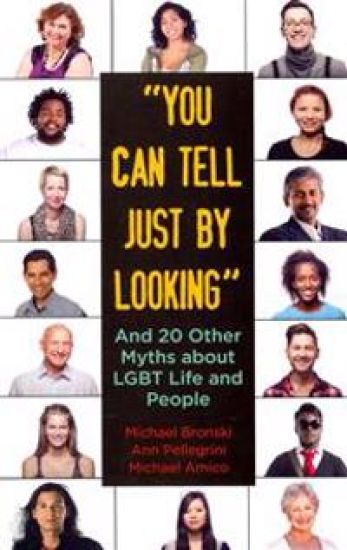
"You Can Tell Just By Looking"
Michael Bronski; Ann Pellegrini; Michael Amico
Beacon Press
2013
pokkari
2014 Lambda Literary Award Finalist: LGBT Nonfiction Breaks down the most commonly held misconceptions about lesbian, gay, bisexual, and transgender people and their lives In "You Can Tell Just by Looking" three scholars and activists come together to unpack enduring, popular, and deeply held myths about lesbian, gay, bisexual, and transgender people, culture, and life in America. Myths, such as "All Religions Condemn Homosexuality" and "Transgender People Are Mentally Ill," have been used to justify discrimination and oppression of LGBT people. Others, such as "Homosexuals Are Born That Way," have been embraced by LGBT communities and their allies. In discussing and dispelling these myths--including gay-positive ones--the authors challenge readers to question their own beliefs and to grapple with the complexities of what it means to be queer in the broadest social, political, and cultural sense.

Winner of a 2012 Stonewall Book Award in nonfiction A Queer History of the United States is more than a "who's who" of queer history: it is a book that radically challenges how we understand American history. Drawing upon primary-source documents, literature, and cultural histories, scholar and activist Michael Bronski charts the breadth of lesbian, gay, bisexual, and transgender history, from 1492 to the 1990s.


"Beyond (Straight and Gay) Marriage" reframes the family-rights debate by arguing that marriage shouldn't bestow special legal privileges upon couples because people, both heterosexual and LGBT, live in a variety of relationships-including unmarried couples of any sexual orientation, single-parent households, extended biological family units, and myriad other familial configurations. Nancy D. Polikoff shows how the law can value all families, and why it must.