Kirjojen hintavertailu. Mukana 12 657 676 kirjaa ja 12 kauppaa.

Kirjailija

Michael Burawoy

Kirjat ja teokset yhdessä paikassa: 14 kirjaa, julkaisuja vuosilta 1982-2021, suosituimpien joukossa Global Ethnography. Vertaile teosten hintoja ja tarkista saatavuus suomalaisista kirjakaupoista.

14 kirjaa

Kirjojen julkaisuhaarukka 1982-2021.

Global Ethnography

Global Ethnography

Michael Burawoy; Joseph A. Blum; Sheba George; Zsuzsa Gille; Millie Thayer; Teresa Gowan; Lynne Haney; Maren Klawiter; Steve Lopez; Sean O'Riain

University of California Press
2000
pokkari
In this follow-up to the highly successful "Ethnography Unbound", Michael Burawoy and nine colleagues break the bounds of conventional sociology, to explore the mutual shaping of local struggles and global forces. In contrast to the lofty debates between radical theorists, these nine studies excavate the dynamics and histories of globalization by extending out from the concrete, everyday world. The authors were participant observers in diverse struggles over extending citizenship, medicalizing breast cancer, dumping toxic waste, privatizing nursing homes, the degradation of work, the withdrawal of welfare rights, and the elaboration of body politics. From their insider vantage points, they show how groups negotiate, circumvent, challenge, and even re-create the complex global web that entangles them. Traversing continents and extending over three years, this collaborative research developed its own distinctive method of 'grounded globalization' to grasp the evaporation of traditional workplaces, the dissolution of enclaved communities, and the fluidity of identities. Forged between the local and global, these compelling essays make a powerful case for ethnography's insight into global dynamics.
Public Sociology

Public Sociology

Michael Burawoy

Polity Press
2021
nidottu
Michael Burawoy has helped to reshape the theory and practice of sociology across the Western world. Public Sociology is his most thoroughgoing attempt to explore what a truly committed, engaged sociology should look like in the twenty-first century. Burawoy looks back on the defining moments of his intellectual journey, exploring his pivotal early experiences as a researcher, such as his fieldwork in a Zambian copper mine and a Chicago factory. He recounts his time as a graduate and professor during the ideological ferment in sociology departments of the 1970s, and explores how his experiences intersected with a changing political and intellectual world up to the present. Recalling Max Weber, Burawoy argues that sociology is much more than just a discipline – it is a vocation, to be practiced everywhere and by everyone.
Public Sociology

Public Sociology

Michael Burawoy

Polity Press
2021
sidottu
Michael Burawoy has helped to reshape the theory and practice of sociology across the Western world. Public Sociology is his most thoroughgoing attempt to explore what a truly committed, engaged sociology should look like in the twenty-first century. Burawoy looks back on the defining moments of his intellectual journey, exploring his pivotal early experiences as a researcher, such as his fieldwork in a Zambian copper mine and a Chicago factory. He recounts his time as a graduate and professor during the ideological ferment in sociology departments of the 1970s, and explores how his experiences intersected with a changing political and intellectual world up to the present. Recalling Max Weber, Burawoy argues that sociology is much more than just a discipline – it is a vocation, to be practiced everywhere and by everyone.
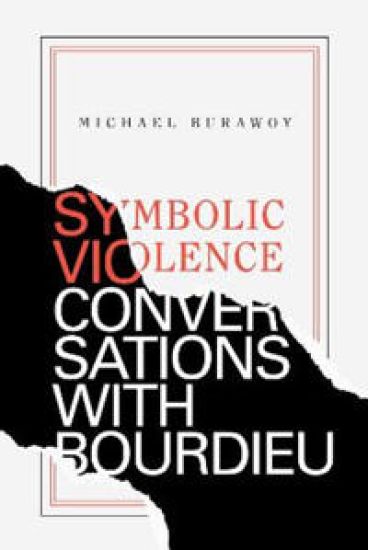
Symbolic Violence

Symbolic Violence

Michael Burawoy

Duke University Press
2019
sidottu
In Symbolic Violence Michael Burawoy brings Pierre Bourdieu into an extended debate with Marxism-a tradition Bourdieu ostensibly avoided. While Bourdieu's expansive body of work stands as a critique of Marx's inadequate account of cultural domination, Burawoy shows how Bourdieu's eschewal and rejection of Marxism led him to miss out on a number of productive theoretical engagements. In eleven “conversations,” Burawoy outlines the intellectual and biographical parallels and divergences between Bourdieu and the work of preeminent Marxist thinkers. Among many topics, Burawoy examines Bourdieu's appropriation and silencing of Beauvoir and her theory of masculine domination; the commonalities as well as differences in Bourdieu's and Fanon's thought on colonialism and revolution; the extent to which Gramsci's theory of hegemony aligns with Bourdieu's notion of symbolic violence; and both how Freire and Bourdieu understood education as the site of oppression. In showing how Bourdieu has more in common with these thinkers than Bourdieu himself cared to admit, Burawoy offers a critical assessment of Bourdieu's work that illuminates its paradoxes and reaffirms its significance for the twenty-first century.
Symbolic Violence

Symbolic Violence

Michael Burawoy

Duke University Press
2019
pokkari
In Symbolic Violence Michael Burawoy brings Pierre Bourdieu into an extended debate with Marxism-a tradition Bourdieu ostensibly avoided. While Bourdieu's expansive body of work stands as a critique of Marx's inadequate account of cultural domination, Burawoy shows how Bourdieu's eschewal and rejection of Marxism led him to miss out on a number of productive theoretical engagements. In eleven “conversations,” Burawoy outlines the intellectual and biographical parallels and divergences between Bourdieu and the work of preeminent Marxist thinkers. Among many topics, Burawoy examines Bourdieu's appropriation and silencing of Beauvoir and her theory of masculine domination; the commonalities as well as differences in Bourdieu's and Fanon's thought on colonialism and revolution; the extent to which Gramsci's theory of hegemony aligns with Bourdieu's notion of symbolic violence; and both how Freire and Bourdieu understood education as the site of oppression. In showing how Bourdieu has more in common with these thinkers than Bourdieu himself cared to admit, Burawoy offers a critical assessment of Bourdieu's work that illuminates its paradoxes and reaffirms its significance for the twenty-first century.
The Public Sociology Debate

The Public Sociology Debate

Michael Burawoy

University of British Columbia Press
2015
pokkari
In 2004, Michael Burawoy challenged sociologists to move beyond the ivory tower and into the realm of activism – to engage in public discourses about what society could or should be. His call to arms sparked intense debate among sociologists. Which side would "sociology" take? Would "public sociology" speak for all sociologists?In this volume, which opens with a foreword by Michael Burawoy, leading Canadian sociologists continue the conversation by discussing not only how and why they should do sociology but also how ethical judgments influence sociological practice and the evaluation of research. Most importantly, they ask whether and under what circumstances sociologists should advocate for social change. Regardless of whether they focus on activism, research, theory, or teaching, the contributors offer insights into where the discipline is heading and why it matters to people inside and outside the university.
The Public Sociology Debate

The Public Sociology Debate

Michael Burawoy

University of British Columbia Press
2014
sidottu
In 2004, Michael Burawoy challenged sociologists to move beyond the ivory tower and into the realm of activism – to engage in public discourses about what society could or should be. His call to arms sparked intense debate among sociologists. Which side would "sociology" take? Would "public sociology" speak for all sociologists?In this volume, which opens with a foreword by Michael Burawoy, leading Canadian sociologists continue the conversation by discussing not only how and why they should do sociology but also how ethical judgments influence sociological practice and the evaluation of research. Most importantly, they ask whether and under what circumstances sociologists should advocate for social change. Regardless of whether they focus on activism, research, theory, or teaching, the contributors offer insights into where the discipline is heading and why it matters to people inside and outside the university.
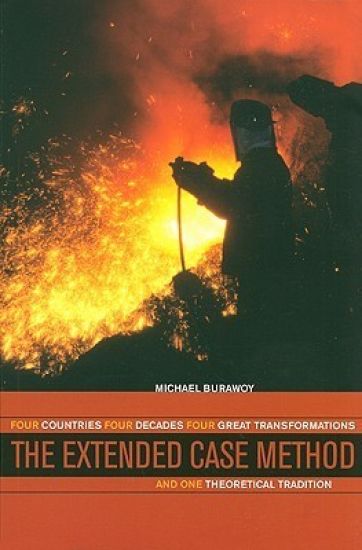
The Extended Case Method

The Extended Case Method

Michael Burawoy

University of California Press
2009
pokkari
In this remarkable collection of essays, Michael Burawoy develops the extended case method by connecting his own experiences among workers of the world to the great transformations of the twentieth century - the rise and fall of the Soviet Union and its satellites, the reconstruction of U.S. capitalism, and the African transition to post-colonialism in Zambia. Burawoy's odyssey began in 1968 in the Zambian copper mines and proceeded to Chicago's South Side, where he worked as a machine operator and enjoyed a unique perspective on the stability of advanced capitalism.In the 1980s, this perspective was deepened by contrast with his work in diverse Hungarian factories. Surprised by the collapse of socialism in Hungary in 1989, he journeyed in 1991 to the Soviet Union, which by the end of the year had unexpectedly dissolved. He then spent the next decade studying how the working class survived the catastrophic collapse of the Soviet economy. These essays, presented with a perspective that has benefited from time and rich experience, offer ethnographers a theory and a method for developing novel understandings of epochal change.
The Radiant Past

The Radiant Past

Michael Burawoy; Janos Lukacs

University of Chicago Press
1994
nidottu
Communism, once heralded as the "radiant future" of all humanity, has now become part of Eastern Europe's past. What does the record say about the legacy of communism as an organizational system? Michael Burawoy and Janos Lukacs consider this question from the standpoint of the Hungarian working class. Between 1983 and 1990 the authors carried out intensive studies in two core Hungarian industries, machine building and steel production, to produce the first extended participant-observation study of work and politics in state socialism. "A fascinating and engagingly written eyewitness report on proletarian life in the waning years of goulash communism. . . . A richly rewarding book, one that should interest political scientists in a variety of subfields, from area specialists and comparativists to political economists, as well as those interested in Marxist and post-Marxist theory."—Elizabeth Kiss, American Political Science Review"A very rich book. . . . It does not merely offer another theory of transition, but also presents a clear interpretive scheme, combined with sociological theory and vivid ethnographic description."—Ireneusz Bialecki, Contemporary Sociology"Its informed skepticism of post-Communist liberal euphoria, its concern for workers, and its fine ethnographic details make this work valuable."—"àkos Róna-Tas, American Journal of Sociology
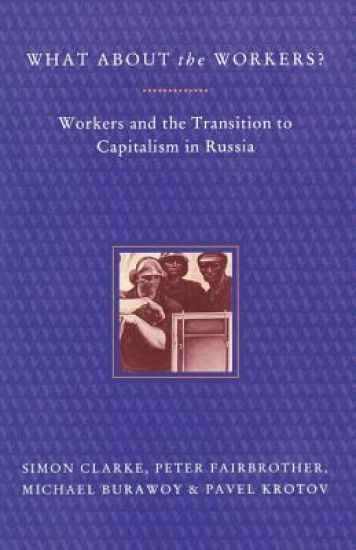
What About the Workers?

What About the Workers?

Michael Burawoy; Pavel Krotov; Peter Fairbrother; Simon Clarke

Verso Books
1993
nidottu
Most writing on the dramatic events in the former Soviet Union has been based on the assumption that Russia is engaged in a transition from "state socialism" to capitalism, and focuses on political and ideological debates formulated in these terms.This book questions whether Russia is in transition to capitalism and looks behind the political and ideological debates to focus on the development of the social relations of production, and on the class struggles to which these give rise. Simon Clarke introduces the book with an examination of the crisis of state socialism, in order to identify the dynamic of change in contemporary Russia. Michael Burawoy and Pavel Krotov develop a detailed case study of one Russian enterprise, which is followed by an analysis of the role of the trade unions in the Soviet system by Simon Clarke and Peter Fairbrother, on the basis of which they develop an analytical account of the development of the workers' movement in Russia since 1987. Simon Clarke concludes the book with a detailed examination of struggles around privatization.The common conclusion is that beneath the political turmoil the dominant class has renewed and restructured itself, but has not managed to overcome the challenge presented by the working class. The fragmentation and atomization of the working class remains a problem, but the struggle over the transformation of class relations is only just beginning.
The Radiant Past

The Radiant Past

Michael Burawoy; Janos Lukacs

University of Chicago Press
1992
sidottu
Communism, once heralded as the "radiant future" of all humanity, has now become part of Eastern Europe's past. What does the record say about the legacy of communism as an organizational system? Michael Burawoy and Janos Lukacs consider this question from the standpoint of the Hungarian working class. Between 1983 and 1990 the authors carried out intensive studies in two core Hungarian industries, machine building and steel production, to produce the first extended participant-observation study of work and politics in state socialism.
Ethnography Unbound

Ethnography Unbound

Michael Burawoy; Alice Burton; Ann Arnett Ferguson; Kathryn J. Fox

University of California Press
1991
pokkari
In this powerful volume, ten original ethnographies explore two important issues: the ways in which people confront the threats and disruptions of contemporary life, and the ways in which researchers can most effectively study the modern metropolis. With its twofold agenda, the volume emerges as a multi-layered dialogue between researcher and researched, participant and observer, educator and educated. These essays, produced in a refreshing collaborative effort by a senior scholar and ten graduate students, examine many facets of American urban life, among them new social movements that mobilize and work on behalf of people with AIDS and that fight against nuclear war; the decisive roles South East Asian women play in building new immigrant communities; and school programs for African-American children. Ethnography Unbound also explores the value of participant observation and the extended case method in social research, underlining how these methodological approaches deepen and enrich scholarship in the social sciences. The book poses theoretical and methodological questions in an open and lucid manner, prodding a rethinking of ethnographic research. Scholars and students alike will find it an essential text for the study of methodology and contemporary American life.
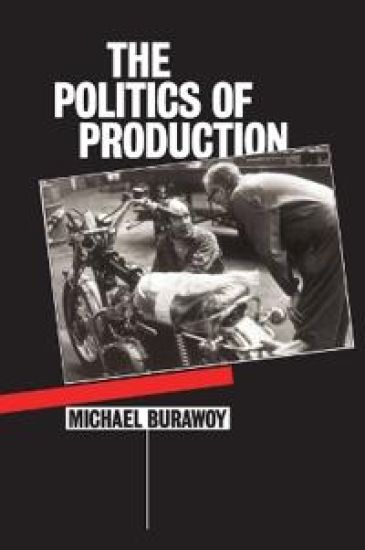
The Politics of Production

The Politics of Production

Michael Burawoy

Verso Books
1985
nidottu
In the wide ranging arguments about the fundamental tenets of Marxism nothing has had greater political significance than the theoretical questioning of the central role assigned to class struggle in the process of social transformation.The Politics of Production demonstrates, brilliantly, the pivotal importance of working class struggles through a rejection of both economistic conceptions of class and notions of the working class as innately revolutionary. This opens the way for an investigation of the political conditions in production that shape the character of working class action. Burawoy theorizes political regimes within production and the way they relate to state politics and then uses this framework to make a comparative analysis of factory regimes under capitalism and socialism.
Manufacturing Consent

Manufacturing Consent

Michael Burawoy

University of Chicago Press
1982
nidottu
Since the 1930s, industrial sociologists have tried to answer the question, Why do workers not work harder? Michael Burawoy spent ten months as a machine operator in a Chicago factory trying to answer different but equally important questions: Why do workers work as hard as they do? Why do workers routinely consent to their own exploitation? Manufacturing Consent, the result of Burawoy's research, combines rich ethnographical description with an original Marxist theory of the capitalist labor process. Manufacturing Consent is unique among studies of this kind because Burawoy has been able to analyze his own experiences in relation to those of Donald Roy, who studied the same factory thirty years earlier. Burawoy traces the technical, political, and ideological changes in factory life to the transformations of the market relations of the plant (it is now part of a multinational corporation) and to broader movements, since World War II, in industrial relations.