Kirjojen hintavertailu. Mukana 12 595 353 kirjaa ja 12 kauppaa.

Kirjailija

Michael C. Mackey

Kirjat ja teokset yhdessä paikassa: 9 kirjaa, julkaisuja vuosilta 1988-2021, suosituimpien joukossa Chaos, Fractals, and Noise. Vertaile teosten hintoja ja tarkista saatavuus suomalaisista kirjakaupoista.

9 kirjaa

Kirjojen julkaisuhaarukka 1988-2021.

Density Evolution Under Delayed Dynamics

Density Evolution Under Delayed Dynamics

Jérôme Losson; Michael C. Mackey; Richard Taylor; Marta Tyran-Kaminska

SPRINGER-VERLAG NEW YORK INC.
2021
nidottu
This monograph has arisen out of a number of attempts spanning almost five decades to understand how one might examine the evolution of densities in systems whose dynamics are described by differential delay equations. Though the authors have no definitive solution to the problem, they offer this contribution in an attempt to define the problem as they see it, and to sketch out several obvious attempts that have been suggested to solve the problem and which seem to have failed. They hope that by being available to the general mathematical community, they will inspire others to consider–and hopefully solve–the problem. Serious attempts have been made by all of the authors over the years and they have made reference to these where appropriate.
Density Evolution Under Delayed Dynamics

Density Evolution Under Delayed Dynamics

Jérôme Losson; Michael C. Mackey; Richard Taylor; Marta Tyran-Kaminska

Springer-Verlag New York Inc.
2020
sidottu
This monograph has arisen out of a number of attempts spanning almost five decades to understand how one might examine the evolution of densities in systems whose dynamics are described by differential delay equations. Though the authors have no definitive solution to the problem, they offer this contribution in an attempt to define the problem as they see it, and to sketch out several obvious attempts that have been suggested to solve the problem and which seem to have failed. They hope that by being available to the general mathematical community, they will inspire others to consider–and hopefully solve–the problem. Serious attempts have been made by all of the authors over the years and they have made reference to these where appropriate.
Simple Mathematical Models of Gene Regulatory Dynamics

Simple Mathematical Models of Gene Regulatory Dynamics

Michael C. Mackey; Moisés Santillán; Marta Tyran-Kaminska; Eduardo S. Zeron

Springer International Publishing AG
2016
nidottu
This is a short and self-contained introduction to the field of mathematical modeling of gene-networks in bacteria. As an entry point to the field, we focus on the analysis of simple gene-network dynamics. The notes commence with an introduction to the deterministic modeling of gene-networks, with extensive reference to applicable results coming from dynamical systems theory. The second part of the notes treats extensively several approaches to the study of gene-network dynamics in the presence of noise—either arising from low numbers of molecules involved, or due to noise external to the regulatory process. The third and final part of the notes gives a detailed treatment of three well studied and concrete examples of gene-network dynamics by considering the lactose operon, the tryptophan operon, and the lysis-lysogeny switch. The notes contain an index for easy location of particular topics as well as an extensive bibliography of the current literature. The target audience of these notes are mainly graduates students and young researchers with a solid mathematical background (calculus, ordinary differential equations, and probability theory at a minimum), as well as with basic notions of biochemistry, cell biology, and molecular biology. They are meant to serve as a readable and brief entry point into a field that is currently highly active, and will allow the reader to grasp the current state of research and so prepare them for defining and tackling new research problems.
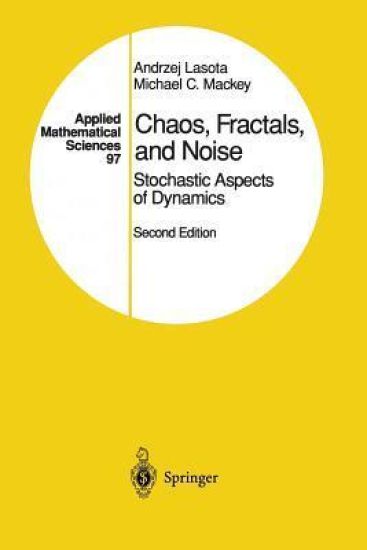
Chaos, Fractals, and Noise

Chaos, Fractals, and Noise

Andrzej Lasota; Michael C. Mackey

Springer-Verlag New York Inc.
2013
nidottu
The first edition of this book was originally published in 1985 under the ti­ tle "Probabilistic Properties of Deterministic Systems. " In the intervening years, interest in so-called "chaotic" systems has continued unabated but with a more thoughtful and sober eye toward applications, as befits a ma­ turing field. This interest in the serious usage of the concepts and techniques of nonlinear dynamics by applied scientists has probably been spurred more by the availability of inexpensive computers than by any other factor. Thus, computer experiments have been prominent, suggesting the wealth of phe­ nomena that may be resident in nonlinear systems. In particular, they allow one to observe the interdependence between the deterministic and probabilistic properties of these systems such as the existence of invariant measures and densities, statistical stability and periodicity, the influence of stochastic perturbations, the formation of attractors, and many others. The aim of the book, and especially of this second edition, is to present recent theoretical methods which allow one to study these effects. We have taken the opportunity in this second edition to not only correct the errors of the first edition, but also to add substantially new material in five sections and a new chapter.
Probabilistic Properties of Deterministic Systems

Probabilistic Properties of Deterministic Systems

Andrzej Lasota; Michael C. Mackey

Cambridge University Press
2008
pokkari
This book shows how densities arise in simple deterministic systems. There has been explosive growth in interest in physical, biological and economic systems that can be profitably studied using densities. Due to the inaccessibility of the mathematical literature there has been little diffusion of the applicable mathematics into the study of these 'chaotic' systems. This book will help to bridge that gap. The authors give a unified treatment of a variety of mathematical systems generating densities, ranging from one-dimensional discrete time transformations through continuous time systems described by integro-partial differential equations. They have drawn examples from many scientific fields to illustrate the utility of the techniques presented. The book assumes a knowledge of advanced calculus and differential equations, but basic concepts from measure theory, ergodic theory, the geometry of manifolds, partial differential equations, probability theory and Markov processes, and stochastic integrals and differential equations are introduced as needed.
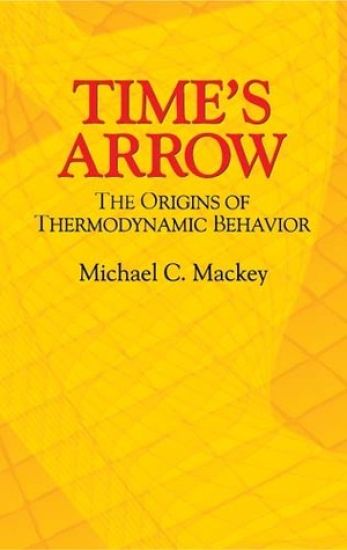
Time's Arrow

Time's Arrow

Michael C. Mackey

Dover Publications Inc.
2003
nidottu
Exploration of Second Law of Thermodynamics details fundamental dynamic properties behind construction of statistical mechanics. Topics include maximal entropy principles; invertible and noninvertible systems; ergodicity and unique equilibria; and asymptotic periodicity and entropy evolution. Geared toward physicists and applied mathematicians; suitable for advanced undergraduate and graduate courses. 1992 edition.
Chaos, Fractals, and Noise

Chaos, Fractals, and Noise

Andrzej Lasota; Michael C. Mackey

Springer-Verlag New York Inc.
1993
sidottu
The first edition of this book was originally published in 1985 under the ti­ tle "Probabilistic Properties of Deterministic Systems. " In the intervening years, interest in so-called "chaotic" systems has continued unabated but with a more thoughtful and sober eye toward applications, as befits a ma­ turing field. This interest in the serious usage of the concepts and techniques of nonlinear dynamics by applied scientists has probably been spurred more by the availability of inexpensive computers than by any other factor. Thus, computer experiments have been prominent, suggesting the wealth of phe­ nomena that may be resident in nonlinear systems. In particular, they allow one to observe the interdependence between the deterministic and probabilistic properties of these systems such as the existence of invariant measures and densities, statistical stability and periodicity, the influence of stochastic perturbations, the formation of attractors, and many others. The aim of the book, and especially of this second edition, is to present recent theoretical methods which allow one to study these effects. We have taken the opportunity in this second edition to not only correct the errors of the first edition, but also to add substantially new material in five sections and a new chapter.
Time’s Arrow: The Origins of Thermodynamic Behavior

Time’s Arrow: The Origins of Thermodynamic Behavior

Michael C. Mackey

Springer-Verlag New York Inc.
1993
nidottu
The Second Law of Thermodynamics has been called the most important law of nature: It is the law that gives a direction to processes that is not inherent in the laws of motion, that says the state of the universe is driven to thermal equilibrium. Its mathematical formulation is simple: The entropy of a closed system cannot decrease. Since the recognition that macroscopic phenomena have an atomic basis, it has remained a fundamental problem to reconcile the increase of entropy with the known reversibility of all the laws of microscopic physics. Professor Michael Mackey of McGill University here explores the dynamical basis for the Second Law, that is, he seeks to illuminate the fundamental dynamical properties required for the construction of a successful statistical mechanics. Aimed at physicists and applied mathematicians with an interest in the foundations of statistical mechanics, the book includes such new material as: a demonstration that the black body radiation law can be deduced from maximal entropy principles; a discussion of sufficient conditions for the existence of at least one state of thermodynamic equilibrium; a description of the behavior of entropy in asymptotically periodic systems; a necessary and sufficient condition for the evolution of entropy to a global maximum; and a presen- tation of the three main types of ergodic theorems and their proofs. He also explores the potential role of incomplete knowledge of dynamical variables, measurement imprecision, and the effects of noise in giving rise to entropy increases.
From Clocks to Chaos

From Clocks to Chaos

Leon Glass; Michael C. Mackey

Princeton University Press
1988
pokkari
In an important new contribution to the literature of chaos, two distinguished researchers in the field of physiology probe central theoretical questions about physiological rhythms. Topics discussed include: How are rhythms generated? How do they start and stop? What are the effects of perturbation of the rhythms? How are oscillations organized in space? Leon Glass and Michael Mackey address an audience of biological scientists, physicians, physical scientists, and mathematicians, but the work assumes no knowledge of advanced mathematics. Variation of rhythms outside normal limits, or appearance of new rhythms where none existed previously, are associated with disease. One of the most interesting features of the book is that it makes a start at explaining "dynamical diseases" that are not the result of infection by pathogens but that stem from abnormalities in the timing of essential functions. From Clocks to Chaos provides a firm foundation for understanding dynamic processes in physiology.