Kirjojen hintavertailu. Mukana 12 657 676 kirjaa ja 12 kauppaa.

Kirjailija

Michael C. Ruppert

Kirjat ja teokset yhdessä paikassa: 2 kirjaa, julkaisuja vuosilta 2004-2009, suosituimpien joukossa Confronting Collapse. Vertaile teosten hintoja ja tarkista saatavuus suomalaisista kirjakaupoista.

2 kirjaa

Kirjojen julkaisuhaarukka 2004-2009.

Confronting Collapse

Confronting Collapse

Michael C. Ruppert; Colin Campbell

Chelsea Green Publishing Co
2009
nidottu
The book that inspired the movie Collapse. The world is running short of energy-especially cheap, easy-to-find oil. Shortages, along with resulting price increases, threaten industrialized civilization, the global economy, and our entire way of life. In Confronting Collapse, author Michael C. Ruppert, a former LAPD narcotics officer turned investigative journalist, details the intricate connections between money and energy, including the ways in which oil shortages and price spikes triggered the economic crash that began in September 2008. Given the 96 percent correlation between economic growth and greenhouse gas emissions and the unlikelihood of economic growth without a spike in energy use, Ruppert argues that we are not, in fact, on the verge of economic recovery, but on the verge of complete collapse. Ruppert's truth is not merely inconvenient. It is utterly devastating. But there is still hope. Ruppert outlines a 25-point plan of action, including the creation of a second strategic petroleum reserve for the use of state and local governments, the immediate implementation of a national Feed-in Tariff mandating that electric utilities pay 3 percent above market rates for all surplus electricity generated from renewable sources, a thorough assessment of soil conditions nationwide, and an emergency action plan for soil restoration and sustainable agriculture.
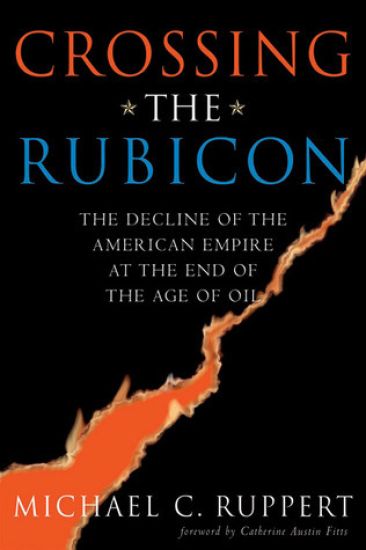
Crossing the Rubicon

Crossing the Rubicon

Michael C. Ruppert; Catherine Austin Fitts

New Society Publishers
2004
pokkari
The attacks of September 11, 2001 were accomplished through an amazing orchestration of logistics and personnel. Crossing the Rubicon discovers and identifies key suspects - finding some of them in the highest echelons of American government - by showing how they acted in concert to guarantee that the attacks produced the desired result. Crossing the Rubicon is unique not only for its case-breaking examination of 9/11, but for the breadth and depth of its world picture - an interdisciplinary analysis of petroleum, geopolitics, narco-traffic, intelligence and militarism - without which 9/11 cannot be understood. The US manufacturing sector has been mostly replaced by speculation on financial data whose underlying economic reality is a dark secret. Hundreds of billions of dollars in laundered drug money flow through Wall Street each year from opium and coca fields maintained by CIA-sponsored warlords and US-backed covert paramilitary violence. America's global dominance depends on a continually turning mill of guns, drugs, oil and money. Oil and natural gas - the fuels that make economic growth possible - are subsidized by American military force and foreign lending. In reality, 9/11 and the resulting "War on Terror" are parts of a massive authoritarian response to an emerging economic crisis of unprecedented scale. Peak Oil - the beginning of the end for our industrial civilization - is driving the elites of American power to implement unthinkably draconian measures of repression, warfare and population control. Crossing the Rubicon is more than a story. It is a map of the perilous terrain through which, together and alone, we are all now making our way.