

Kirjailija
Michael Carley
Kirjat ja teokset yhdessä paikassa: 11 kirjaa, julkaisuja vuosilta 1998-2025, suosituimpien joukossa The Book of Joe. Vertaile teosten hintoja ja tarkista saatavuus suomalaisista kirjakaupoista.
11 kirjaa
Kirjojen julkaisuhaarukka 1998-2025.
For the early pioneers of the social indicator movement, the possibilities of doing social good by developing the tools of social measurement seemed endless. However, in the early 1980s these high, and perhaps naïve, hopes remained unfulfilled, especially for the data needs of the policy-maker. If not pessimistic, administrators and public policy-makers were at least guarded about the usefulness of social indicators as an aid to increasingly complex decision-making.These difficulties reflected both policy-related and methodological issues. Originally published in 1981, Social Measurement and Social Indicators is not a ‘how-to’ guide on the construction of social indicators, but rather a critical and optimistic view of these central issues, as embodied in the literature and in practice at the time. Michael Carley contrasts some of the basic problems of social measurement with government’s needs for reliable information, organised by their policy usefulness and statistical sophistication.The book then discusses the critical relationship between social indicators and social theories and models, as well as the role of social information in the policy process. Later chapters look at the audience, the problems, and the prospects for national social reports; and explore in detail three different applications of social indicators to urban analysis. Throughout the book helpful examples are drawn from North American, UK and European experience.Social Measurement and Social Indicators is aimed at a cross-disciplinary audience in government and the universities. For students, it will serve as a compact introduction to the broad field of social indicators; for administrators, it explores philosophical and measurement problems and suggests criteria for interpretation; for researchers, it places social indicator efforts into a wider policy analysis perspective – with its inescapable political value judgemental, and bureaucratic aspects.
Edinburgh New Town
Michael Carley; Robert Dalziel; Pat Dargan; Simon Laird
Amberley Publishing
2021
nidottu
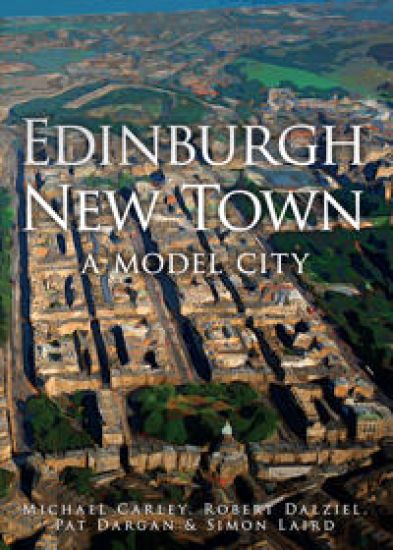
Edinburgh’s New Town, built between 1767 and 1850, is one of Europe’s finest neoclassical neighbourhoods, a triumph of town planning, with UNESCO World Heritage status. But the importance of the New Town goes far beyond the quality of its architecture. Nearly 250 years after it was built, today it is not only a carefully conserved Georgian neighbourhood but a vibrant community in which people from all walks of life thrive in harmonious surroundings. Those include over 7,000 residential properties of enormous variety, and its shops, schools, pubs, restaurants and community facilities, which contribute to its unique quality of life and attract visitors from around the world. This book celebrates the history and achievements of the New Town. Through photos, drawings, historic maps and aerial photography, the authors explore the New Town’s origins in the philiosophy of the Enlightenment and the role of politics, land ownership, finance, design and materials in its development. This is a friendly and accessible introduction to the exteriors and interiors of its buildings, with a walking tour included, drawing on both historic maps and modern satellite images. It links the New Town to current debates on urban architecture, concluding that it is an inspiring model for new communities around the world. This is a book for the passionate, knowledgeable lover of Georgian architecture, but equally for the casual visitor who wants to get to know the New Town better.

Andrew Grey is a young accountant, already introverted and isolated, who finds his life rerouted when a freak accident confines him to his apartment. Cut off from the few personal relationships he does maintain, he spirals dangerously inward in a direction that compromises his physical and mental health.As Andrew moves inward, we see how those around him are affected by both his presence and absence from their lives. His distant family, his coworkers, and even a few strangers find themselves impacted by a life most would have viewed as ineffectual.Know My Name is a novel of human connection and what happens when that connection disappears or doesn't exist. It is about life's maddening randomness and our attempts to make meaning of it. It is ultimately about the ripple effects of each of our lives, intended or not.
Edinburgh New Town
Michael Carley; Robert Dalziel; Pat Dargan; Simon Laird
Amberley Publishing
2015
sidottu
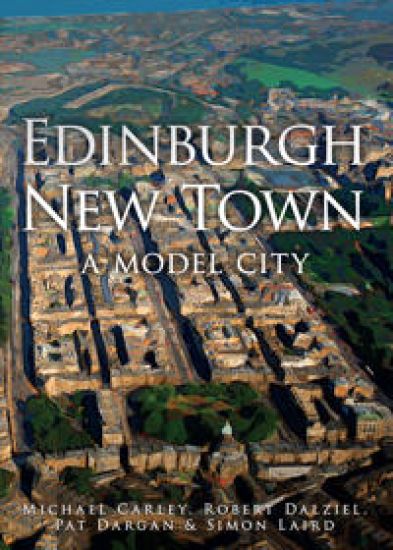
Edinburgh’s New Town, built between 1767 and 1850, is one of Europe’s finest neoclassical neighbourhoods, a triumph of town planning, with UNESCO World Heritage status. But the importance of the New Town goes far beyond the quality of its architecture. Nearly 250 years after it was built, today it is not only a carefully conserved Georgian neighbourhood but a vibrant community in which people from all walks of life thrive in harmonious surroundings. Those include over 7,000 residential properties of enormous variety, and its shops, schools, pubs, restaurants and community facilities, which contribute to its unique quality of life and attract visitors from around the world. This book celebrates the history and achievements of the New Town. Through photos, drawings, historic maps and aerial photography, the authors explore the New Town’s origins in the philiosophy of the Enlightenment and the role of politics, land ownership, finance, design and materials in its development. This is a friendly and accessible introduction to the exteriors and interiors of its buildings, with a walking tour included, drawing on both historic maps and modern satellite images. It links the New Town to current debates on urban architecture, concluding that it is an inspiring model for new communities around the world. This is a book for the passionate, knowledgeable lover of Georgian architecture, but equally for the casual visitor who wants to get to know the New Town better.
This text outlines the essential conditions for effective urban planning and management, placing "bottom-up" community initiatives at the heart of a push for equitable and sustainable development in cities. Case studies show how urban communities can become involved in improving their environment.
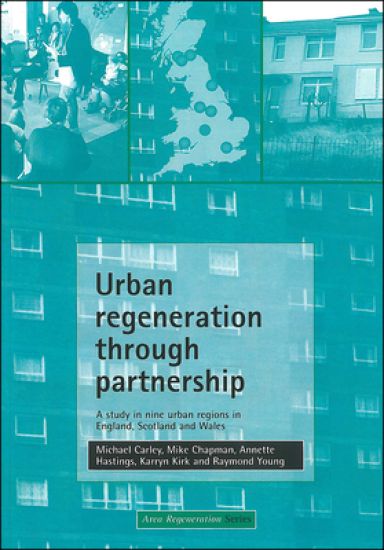
Urban regeneration through partnership
Michael Carley; Mike Chapman; Annette Hastings; Karryn Kirk; Raymond Young
Policy Press
2000
nidottu
During the past 10 years 'partnership' has become a defining characteristic of British urban regeneration. It is widely recognised that the multiple problems of economic decline, social exclusion and dereliction require holistic and area-specific responses that can only be provided by effective multi-agency working, through local partnerships. Yet, to date, there has been little systematic research into why partnerships succeed or fail; into what works and what does not. This report provides an in-depth study of the factors that influence the effectiveness of urban regeneration partnerships, and how they work within the emerging national policy context. Case studies were carried out in 27 partnerships in eight city-regions in England and Scotland and in the Welsh Valleys. Urban regeneration through partnership highlights the key lessons of partnership, exploring good practice in: · leadership; · visioning and consensus building; · translation of vision into workable objectives; · including the community and business in partnership; · human resources. The report explores what it calls the 'foundations of partnership', including the modernisation of local government, a coherent regional development framework and a sound national urban policy. In addition, it provides detailed information on the case studies themselves, and gives good practice recommendations. Urban regeneration through partnership is essential reading for workers and policy makers in urban regeneration partnerships, communities involved in urban regeneration and national and local government, as well as anyone with an interest in neighbourhood regeneration strategies and practice.
In a world where environmental problems spill across political, administrative and disciplinary boundaries, there is a pressing need for a clear understanding of the kinds of organizations, management structures and policy-making approaches required to bring about socially equitable and ecologically sustainable development. In this second edition, the authors incorporate lessons from a decade of work on the conditions of sustainability in both developed and developing countries. They prescribe action networks - partnerships of flexible, achievement-oriented actors - and present new case studies demonstrating the success of organizations that have applied this approach. They also introduce case studies on action networks that work simultaneously on international, national and local levels.

This work proposes a framework based on the concept of a fair distribution of environmental space to include the diverse needs of North and South. Drawing on research in 38 countries, it aims to give an equitable basis for global development in order to achieve sustainable consumption by the year 2050. The environmental space approach seeks to explain the limitations of the global market economy as a tool of development and to give us the means to alter it in order to achieve a genuine quality of life, rather than simple economic growth. In addition, this book seeks to urge all countries and peoples to consider and evaluate the environmental space approach and to join in a movement towards sustainable production and consumption for the 21st century.
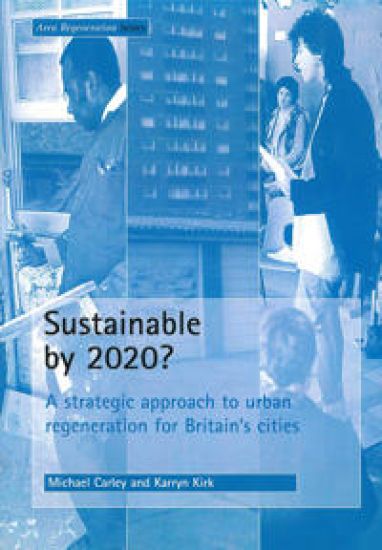
Thirty years of short-term initiatives have not reduced a pressing need for urban regeneration. If deprived households, polarised sink estates and derelict city landscapes are not to be with us 20 years hence, a broader, long-term approach is required. Sustainable by 2020? describes this strategic approach to city-wide regeneration, developed in a major research programme with case studies in Birmingham, Manchester, Glasgow and Edinburgh. The report sets out an agenda of innovation as a first step to sustainable cities. It provides a better understanding of how cities can shift away from the piecemeal approach to build on steady, year-on-year achievement by improving our capabilities in urban management and participation. Innovations suggested include: underpinning regeneration with a 25-year national perspective on the future of our cities and countryside, with policies to match; better integration between regional, city and local initiatives; city strategies linking physical, economic and social development, urban regeneration and Agenda 21; a life-long process of neighbourhood visioning as a right of all citizens, with participation beginning in primary school. The authors stress that leadership, determination and imagination are required, with professionals, politicians and citizens working together to achieve the kind of communities we would like to leave to our children. The report is essential reading for policy makers in national and local government, professionals and students, community representatives and everyone concerned with the future of Britain's cities.
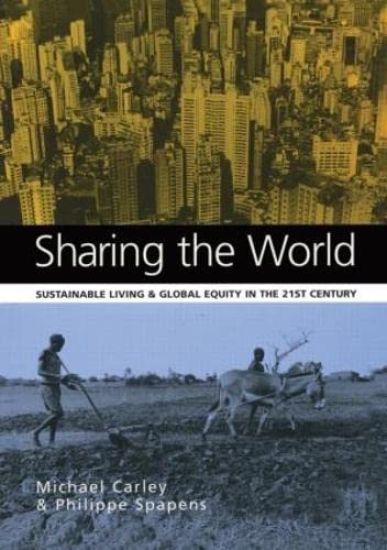
This work proposes a framework based on the concept of a fair distribution of environmental space to include the diverse needs of North and South. Drawing on research in 38 countries, it aims to give an equitable basis for global development in order to achieve sustainable consumption by the year 2050. The environmental space approach seeks to explain the limitations of the global market economy as a tool of development and to give us the means to alter it in order to achieve a genuine quality of life, rather than simple economic growth. In addition, this book seeks to urge all countries and peoples to consider and evaluate the environmental space approach and to join in a movement towards sustainable production and consumption for the 21st century.