Kirjojen hintavertailu. Mukana 12 657 676 kirjaa ja 12 kauppaa.

Kirjailija

Michael Collins

Kirjat ja teokset yhdessä paikassa: 96 kirjaa, julkaisuja vuosilta 1992-2026, suosituimpien joukossa Francis. Vertaile teosten hintoja ja tarkista saatavuus suomalaisista kirjakaupoista.

96 kirjaa

Kirjojen julkaisuhaarukka 1992-2026.

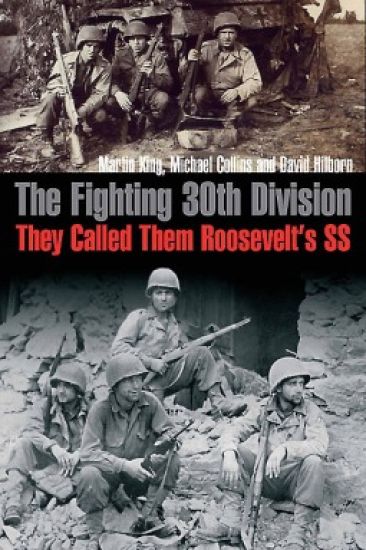
The Fighting 30th Division

The Fighting 30th Division

Martin King; David Hilborn; Michael Collins

Casemate Publishers
2015
sidottu
In World War I the 30th Infantry Division earned more Medals of Honor than any other American division. In World War II it spent more consecutive days in combat than almost any other outfit. Recruited mainly from the Carolinas and George and Tennessee, they were one of the hardest-fighting units the U.S. ever fielded in Europe. What was it about these men that made them so indomitable? They were tough and resilient for a start, but this division had something else. They possessed intrinsic zeal to engage the enemy that often left their adversaries in awe. Their U.S. Army nickname was the “Old Hickory” Division. But after encountering them on the battleifled, the Germans themselves came to call them “Roosevelt’s SS.” This book is a combat chronicle of this illustrious division that takes the reader right to the heart of the fighting through the eyes of those who were actually there. It goes from the hedgerows of Normandy to the 30th’s gallant stand against panzers at Mortain, to the brutal slugs around Aachen and the Westwall, and then to the Battle of the Bulge. Each chapter is meticulously researched and assembled with accurate timelines and after-action reports. The last remaining veterans of the 30th Division and attached units who saw the action firsthand relate their remarkable experiences here for the first, and probably the last time. This is precisely what military historians mean when they write about “fighting spirit.” There have been only a few books written about the 30th Division and none contained direct interviews with the veterans. This work follows their story from Normandy to the final victory in Germany, packed with previously untold accounts from the survivors. These are the men whose incredible stories epitomize what it was to be a GI in one of the toughest divisions in WWII.
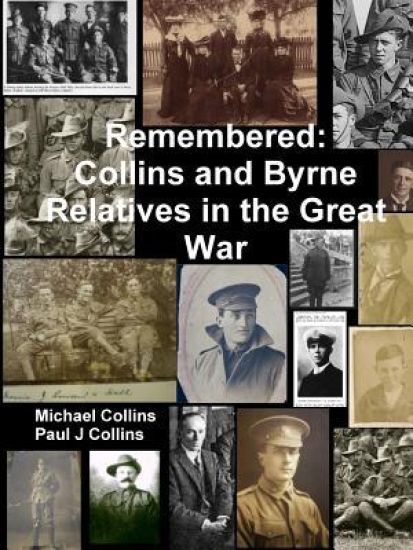
Remembered: Collins and Byrne Relatives in the Great War

Remembered: Collins and Byrne Relatives in the Great War

Paul J Collins; Michael Collins

Lulu.com
2015
nidottu
In World War I, 35 relatives of the Collins family aged between 18 and 57 volunteered for service - 15 came from the Collins side while 20 were from the Byrne side. Some never passed the enlistment process. Of those who served overseas, many were injured and a saddening percentage died. With interest in the war high due to its centenary, this book honours those who answered the call by detailing their service and lives using primary documents and the vast amount of resources available for researchers. It is hard to say whether these veterans cover the full range of Australia's involvement during the Great War, from being enlisted for a few weeks at the end of the war to dying, but there is no denying the 34 men and one woman whose lives are recorded here encompass a broad range of the Australian experience during the conflict.
Sport and Social Exclusion

Sport and Social Exclusion

Michael Collins; Tess Kay; Mike Collins

Routledge
2014
sidottu
Tackling social exclusion should be a central aim of any civilised social policy. In this meticulously revised and updated new edition of his groundbreaking study, Sport and Social Exclusion, Mike Collins has assembled a vast array of new evidence from a range of global sources to demonstrate how the effects of social exclusion are as evident in sport as they are in any area of society. The book uses sport as an important sphere for critical reflection on existing social policy and explores sport's role as a source of initiatives for tackling exclusion. It examines key topics such as: • What is meant by 'social exclusion' • How social exclusion affects citizenship and the chance to play sport • How exclusion from sport is linked to poverty, class, age, gender, ethnicity, disability, and involvement in youth delinquency, and living in towns or countryside • How exclusion is linked to concepts of personal and communal social capital.It uses four revised and five new major case studies as detailed illustrations, notably Be Active, Birmingham, the national PE and Youth/School Sport strategy, Positive Futures and Street Games..Sport and Social Exclusion features a wealth of original research data, including new and previously unpublished material, as well as important new studies of social exclusion policy and practice in the UK and elsewhere. This revised edition surveys all the most important changes in the policy landscape since first publication in 2002 and explores the likely impact of the London Olympic Games on sport policy in the UK. The book concludes with some typically forthright commendations and critiques from the author regarding the success of existing policies and the best way to tackle exclusion from sport and society in the future. By relating current policy to new research the book provides an essential guidebook for students, academics and policy makers working in sport policy and development."
Sport and Social Exclusion

Sport and Social Exclusion

Michael Collins; Tess Kay; Mike Collins

Routledge
2014
nidottu
Tackling social exclusion should be a central aim of any civilised social policy. In this meticulously revised and updated new edition of his groundbreaking study, Sport and Social Exclusion, Mike Collins has assembled a vast array of new evidence from a range of global sources to demonstrate how the effects of social exclusion are as evident in sport as they are in any area of society. The book uses sport as an important sphere for critical reflection on existing social policy and explores sport's role as a source of initiatives for tackling exclusion. It examines key topics such as: • What is meant by 'social exclusion' • How social exclusion affects citizenship and the chance to play sport • How exclusion from sport is linked to poverty, class, age, gender, ethnicity, disability, and involvement in youth delinquency, and living in towns or countryside • How exclusion is linked to concepts of personal and communal social capital.It uses four revised and five new major case studies as detailed illustrations, notably Be Active, Birmingham, the national PE and Youth/School Sport strategy, Positive Futures and Street Games..Sport and Social Exclusion features a wealth of original research data, including new and previously unpublished material, as well as important new studies of social exclusion policy and practice in the UK and elsewhere. This revised edition surveys all the most important changes in the policy landscape since first publication in 2002 and explores the likely impact of the London Olympic Games on sport policy in the UK. The book concludes with some typically forthright commendations and critiques from the author regarding the success of existing policies and the best way to tackle exclusion from sport and society in the future. By relating current policy to new research the book provides an essential guidebook for students, academics and policy makers working in sport policy and development."
Money and Banking in the UK (RLE: Banking & Finance)
This book is concerned with developments in three main areas of monetary history: domestic commercial banking; monetary policy; and the UK’s international financial position. For ease of analysis the 160 years under study are arranged into three clear chronological divisons. Part 1 covers the years 1826-1913, a period in which the UK emerged as the world’s leading economic power. It was in these years that an extensive and fully-operative domestic banking system was established. Part 2 covers 1914 to 1939 – the years which marked a break in the traditional monetary arrangements of the Victorian and Edwardian eras. Part 3 covers 1939-1986 when the dominance of state influence within the domestic money markets was re-established by the Second World War and the acceptance by the authorities of the obligation to ‘manage’ the economy which meant that successive postwar governments took direct responsibility for the conduct of monetary and credit policy.
Forever Young

Forever Young

John W. Young; James R. Hansen; Michael Collins

University Press of Florida
2013
nidottu
He walked on the Moon. He flew six space missions in three different programs--more than any other human. He served with NASA for more than four decades. His peers called him the ""astronaut's astronaut.""Enthusiasts of space exploration have long waited for John Young to tell the story of his two Gemini flights, his two Apollo missions, the first-ever Space Shuttle flight, and the first Spacelab mission. Forever Young delivers all that and more: Young's personal journey from engineering graduate to fighter pilot, to test pilot, to astronaut, to high NASA official, to clear-headed predictor of the fate of Planet Earth.Young, with the assistance of internationally distinguished aerospace historian James Hansen, recounts the great episodes of his amazing flying career in fascinating detail and with wry humor. He portrays astronauts as ordinary human beings and NASA as an institution with the same ups and downs as other major bureaucracies. He frankly discusses the risks of space travel, including what went wrong with the Challenger and Columbia shuttles.Forever Young is one of the last memoirs produced by an early American astronaut. It is the first memoir written by a chief of the NASA astronaut corps. Young's experiences and candor make this book indispensable to everyone interested in the U.S. space program.
Money and Banking in the UK (RLE: Banking & Finance)
This book is concerned with developments in three main areas of monetary history: domestic commercial banking; monetary policy; and the UK’s international financial position. For ease of analysis the 160 years under study are arranged into three clear chronological divisons. Part 1 covers the years 1826-1913, a period in which the UK emerged as the world’s leading economic power. It was in these years that an extensive and fully-operative domestic banking system was established. Part 2 covers 1914 to 1939 – the years which marked a break in the traditional monetary arrangements of the Victorian and Edwardian eras. Part 3 covers 1939-1986 when the dominance of state influence within the domestic money markets was re-established by the Second World War and the acceptance by the authorities of the obligation to ‘manage’ the economy which meant that successive postwar governments took direct responsibility for the conduct of monetary and credit policy.
Empire, Nationalism and the Postcolonial World
By presenting a new interpretation of Rabindranath Tagore’s English language writings, this book places the work of India’s greatest Nobel Prize winner and cultural icon in the context of imperial history and thereby bridges the gap between Tagore studies and imperial/postcolonial historiography.Using detailed archival research, the book charts the origins of Tagore’s ideas in Indian religious traditions and discusses the impact of early Indian nationalism on Tagore’s thinking. It offers a new interpretation of Tagore’s complex debates with Gandhi about the colonial encounter, Tagore’s provocative analysis of the impact of British imperialism in India and his questioning of nationalism as a pathway to authentic postcolonial freedom. The book also demonstrates how the man and his ideas were received and interpreted in Britain during his lifetime and how they have been sometimes misrepresented by nationalist historians and postcolonial theorists after Tagore’s death.An alternative interpretation based on an intellectual history approach, this book places Tagore’s sense of agency, his ideas and intentions within a broader historical framework. Offering an exciting critique of postcolonial theory from a historical perspective, it is a timely contribution in the wake of the 150th anniversary of Tagore's birth in 2011.
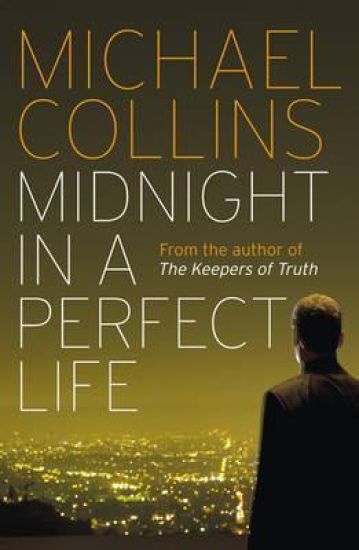
Midnight in a Perfect Life

Midnight in a Perfect Life

Michael Collins

Weidenfeld Nicolson
2011
pokkari
From the BOOKER-shortlisted author of THE KEEPERS OF TRUTH. A writer's journey towards fatherhood throws up shadows from his past.Karl is a troubled writer standing on the precipice of forty. After a degree of success in his early career he is now battling with what he terms his 'opus', his legacy to the world. But his partner Lori, the main breadwinner, is also thinking about her destiny and wants a child. As they embark on fertility treatment, Karl is forced to confront his deepest fear - that he will turn out to be like his father, a travelling salesman who was found dead after apparently committing murder when Karl was just thirteen. Unbeknown to Lori, Karl has already taken loans out against their house to pay for his mother's care home, and his freelance work, ghosting for a crime writer called Perry Fennimore, has dried up. As the fertility treatment progresses, Karl feels increasingly distanced from his relationship and the safety of home, and attracted to the shadowlands of Chicago's backstreets. When Fennimore re-emerges with a proposal, Karl begins to tap this new source of creativity - but just how far will he go in his pursuit of the ultimate story?