Kirjojen hintavertailu. Mukana 12 595 353 kirjaa ja 12 kauppaa.

Kirjailija

Michael Fulford

Kirjat ja teokset yhdessä paikassa: 9 kirjaa, julkaisuja vuosilta 2003-2024, suosituimpien joukossa Iron Age and Romano-British Settlements and Landscapes of Salisbury Plain. Vertaile teosten hintoja ja tarkista saatavuus suomalaisista kirjakaupoista.

9 kirjaa

Kirjojen julkaisuhaarukka 2003-2024.

Silchester Insula IX

Silchester Insula IX

Michael Fulford; Amanda Clarke; Nicholas Pankhurst

SOCIETY FOR THE PROMOTION OF ROMAN STUDIES
2024
sidottu
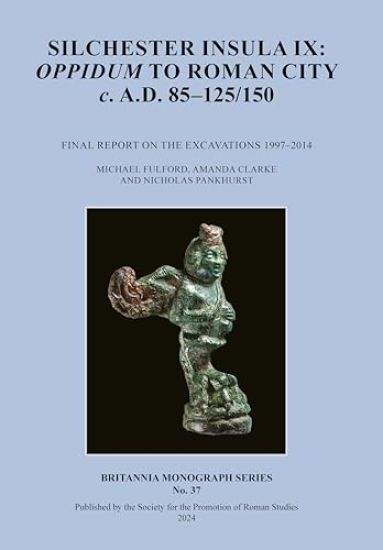
Silchester (Calleva) experienced major disruption in the late first century A.D. as the Iron Age oppidum was transformed into the Roman city responsible for the administration of the civitas of the Atrebates. Aligned on the cardinal points, a rectilinear street grid was laid across the settlement replacing the late Iron Age network of streets and lanes oriented north-west/south-east and north-east/south-west. While the pre-existing property boundaries within Insula IX were retained there was a total re-build within them. The excavated area contained one complete property and fragments of three of its neighbours. Rather than conform to the new grid all the buildings were constructed at 45 degrees to it, reasserting the late Iron Age orientations. The timber-framed buildings within the complete property consisted of a row of three — a rectangular kitchen, a town-house and a roundhouse — separated by a yard from a re-built taberna, also diagonal to the street on which it fronted. The surgical and writing instruments associated with the circular building suggested it functioned as a healer’s and/or teacher’s house. This volume completes the publication of the excavations in Insula IX, 1997–2014.
The Emperor Nero's Pottery and Tilery at Little London, Pamber, by Silchester, Hampshire
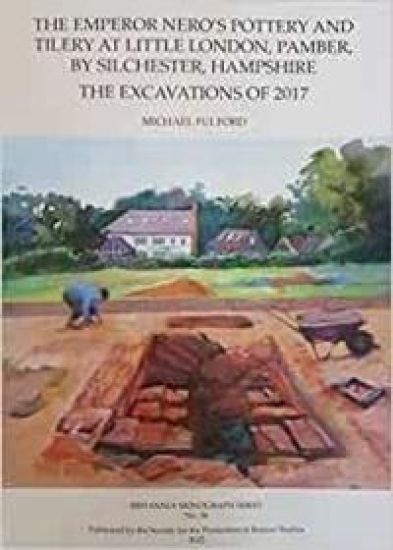
Previously suspected on the basis of a tile stamped with the name and titles of the emperor Nero found alongside other brick and tile in the ploughsoil, excavation of two tile kilns at Little London near Silchester, Hampshire confirmed production during the reign of Nero. In addition to the manufacture of standard bricks and roofing materials, the kilns produced the more specialist materials required for building bath-houses. Work on the fabrics and distinctive, roller-stamped flue-tiles shows that products reached a wide variety of destinations between Cirencester, some 100 km to the north-west, and Chichester, on the south coast, though Silchester appears to have been the main market and is the only location where Nero-stamped tile has so far been found. A suggestion is made linking the stamped tile to the visit to Britain by the emperor’s trusted freedman, Polyclitus in the aftermath of the Boudican revolt. An unexpected discovery was the ancillary production from at least three pottery kilns of a wide range of pre-Flavian domestic wares, so far only identified in Silchester and its environs. Alongside the publication of the kilns there are illustrated catalogues of the complete range of brick and tile types produced as well as of the pottery. Other reports include analysis of the fuels used and a suite of radiocarbon dates which support the pottery evidence for production ceasing in the early Flavian period. Analysis of the numerous animal foot-impressions on the bricks presents one aspect of the environment of the kilns.
Silchester Revealed

Silchester Revealed

Michael Fulford

Windgather Press
2021
nidottu
With its apparently complete town plan, revealed by the Society of Antiquaries of London’s great excavation project, 1890-1909, Silchester is one of the best known towns in Roman Britain and the Roman world more widely. Since the 1970s excavations by the author and the University of Reading on several sites including the amphitheatre, the defences, the forum basilica, the public baths, a temple and an extensive area of an entire insula, as well as surveys of the suburbs and immediate hinterland, have radically increased our knowledge of the town and its development over time from its origins to its abandonment. This research has discovered the late Iron Age oppidum and allowed us to characterise the nature of the settlement with its strong Gallic connections and widespread political and trading links across southern Britain, to Gaul and to southern Europe and the Mediterranean.Following a review of the evidence for the impact of the Roman conquest of A.D. 43/44, the settlement’s transformation into a planned Roman city is traced, and its association with the Emperor Nero is explored. With the re-building in masonry of the great forum basilica in the early second century, the city reached the peak of its physical development. Defence building, first in earthwork, then in stone in the later third century are major landmarks of the third century, but the town can be shown to have continued to flourish, certainly up to the early fifth century and the end of the Roman administration of Britain. The enigma of the Silchester ogham stone is explored and the story of the town and its transformation to village is taken up to the fourteenth century.Modern archaeological methods have allowed us to explore a number of themes demonstrating change over time, notably the built and natural environments of the town, the diet, dress, health, leisure activities, living conditions, occupations and ritual behaviour of the inhabitants, and the role of the town as communications centre, economic hub and administrative centre of the tribal ‘county’ of the Atrebates.
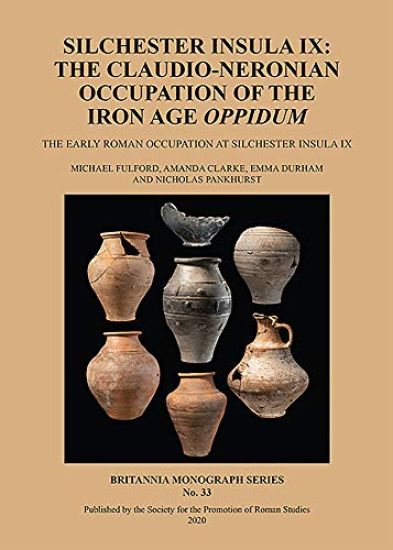
Silchester Insula IX: The Claudio-Neronian Occupation of the Iron Age Oppidum

Silchester Insula IX: The Claudio-Neronian Occupation of the Iron Age Oppidum

Michael Fulford; Amanda Clarke; Emma Durham; Nicholas Pankhurst

Society for the Promotion of Roman Studies
2020
nidottu
How did a major nucleated settlement respond to the Roman conquest? Occupation of Silchester (Calleva) after the Roman invasion of south-east Britain in A.D. 43 shows remarkable continuity from the pre-Roman Iron Age oppidum. Although the settlement was crossed by strategic Roman roads, the network of lanes and compounds, crowded with round and rectangular buildings, otherwise remained little changed until c. A.D. 85. The contents of rubbish pits and wells give remarkable insights into the diet, occupations, identity and ritualistic behaviour of the inhabitants, while the richly varied provenances of the pottery and other finds reveal the local, regional and long-distance connections of the community. Although there is clear evidence of investment in the town in the reign of Nero, the pre-existing settlement was not swept away until the Roman street grid was established c. A.D. 85.This volume follows on from the publication of Late Iron Age Calleva, Britannia Monograph 32 (2018)
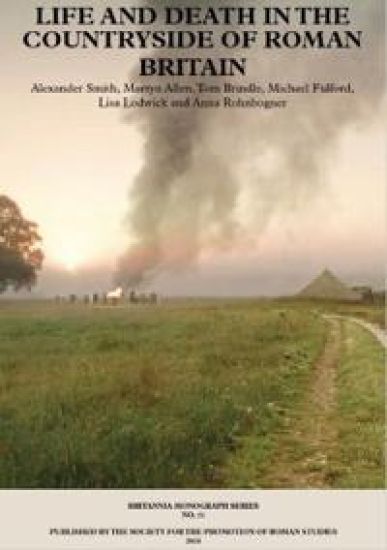
New Visions of the Countryside of Roman Britain Volume 3:  Life and Death in the Countryside of Roman Britain

New Visions of the Countryside of Roman Britain Volume 3: Life and Death in the Countryside of Roman Britain

Alexander Smith; Martyn Allen; Tom Brindle; Michael Fulford; Lisa Lodwick; Anna Rohnbogner

Society for the Promotion of Roman Studies
2018
nidottu
This volume focuses upon the people of rural Roman Britain – how they looked, lived, interacted with the material and spiritual worlds surrounding them, and also how they died, and what their physical remains can tell us. Analyses indicate a geographically and socially diverse society, influenced by pre-existing cultural traditions and varying degrees of social connectivity. Incorporation into the Roman empire certainly brought with it a great deal of social change, though contrary to many previous accounts depicting bucolic scenes of villa-life, it would appear that this change was largely to the detriment of many of those living in the countryside.
Silchester

Silchester

Jenny Halstead; Michael Fulford

Two Rivers Press
2015
nidottu
The Roman Town at Silchester, Calleva Atrebatum, was a working archaeological dig – the University of Reading Field School – which took place every summer until 2014. Then, the dig was filled in, for future archaeologists to dig up again in the future. Taking advantage of the last opportunity to record ‘life on the dig’ in 2014, artist Jenny Halstead spent the summer creating and collating material for a beautiful and historically important book. Jenny’s superior draughtsmanship, her eye for colour and her wide variety of techniques have produced evocative, lively images of life “on the dig” to illustrate Michael Fulford’s fascinating account of the archaeological purpose of the project and the process by which it was conducted. From excavating, washing and cleaning the finds to teaching and arranging student entertainment, the final summer of the Town Life Project is captured here in all its richness – a fitting and enduring record of this historic episode in the life of an ancient city.
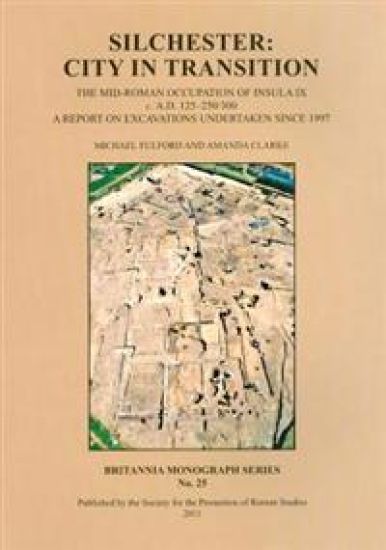
Silchester

Silchester

Michael Fulford; Amanda Clarke

Society for the Promotion of Roman Studies
2011
nidottu
Characterising urban life, City in Transition is the second volume reporting on the archaeology of the continuing excavation of Silchester Insula IX, taking the story down to the early 2nd century. In describing the evidence for the occupation of the 2nd and 3rd centuries it follows on from Life and Labour in Late Roman Silchester (2006), which published the late Roman occupation. Geochemical and micromorphological analyses inform the interpretation of the use of space within buildings and, together with the study of an abundant material culture and environmental record, provide a rich characterisation of the houses and their occupants. The report sheds important light on the urban condition, debating such themes as population density, status, occupation, diet and domestic ritual.
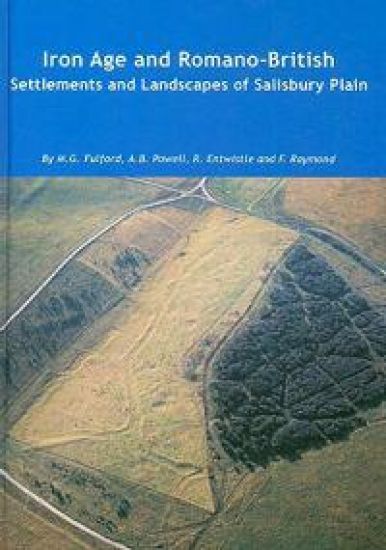
Iron Age and Romano-British Settlements and Landscapes of Salisbury Plain

Iron Age and Romano-British Settlements and Landscapes of Salisbury Plain

Michael Fulford; Roger Powell; R. Entwistle; F. Raymond

Trust for Wessex Archaeology Ltd
2006
sidottu
Altogether, some 18 settlement sites were discovered of which 13 were Romano-British, three were Iron Age, and two produced evidence of Middle-Late Bronze Age occupation. This book presents the results of a series of fieldwalking surveys and excavations of Iron Age and Romano-British sites in two areas of the Salisbury Plain Training Area.