Kirjojen hintavertailu. Mukana 12 595 353 kirjaa ja 12 kauppaa.

Kirjailija

Michael G. Flaherty

Kirjat ja teokset yhdessä paikassa: 7 kirjaa, julkaisuja vuosilta 1999-2022, suosituimpien joukossa The Textures of Time. Vertaile teosten hintoja ja tarkista saatavuus suomalaisista kirjakaupoista.

7 kirjaa

Kirjojen julkaisuhaarukka 1999-2022.

The Cage of Days

The Cage of Days

Michael G. Flaherty; K. C. Carceral

Columbia University Press
2022
sidottu
Prisons operate according to the clockwork logic of our criminal justice system: we punish people by making them “serve” time. The Cage of Days combines the perspectives of K. C. Carceral, a formerly incarcerated convict criminologist, and Michael G. Flaherty, a sociologist who studies temporal experience. Drawing from Carceral’s field notes, his interviews with fellow inmates, and convict memoirs, this book reveals what time does to prisoners and what prisoners do to time.Carceral and Flaherty consider the connection between the subjective dimensions of time and the existential circumstances of imprisonment. Convicts find that their experience of time has become deeply distorted by the rhythm and routines of prison and by how authorities ensure that an inmate’s time is under their control. They become obsessed with the passage of time and preoccupied with regaining temporal autonomy, creating elaborate strategies for modifying their perception of time. To escape the feeling that their lives lack forward momentum, prisoners devise distinctive ways to mark the passage of time, but these tactics can backfire by intensifying their awareness of temporality. Providing rich and nuanced analysis grounded in the distinctive voices of diverse prisoners, The Cage of Days examines how prisons regulate time and how prisoners resist the temporal regime.
The Cage of Days

The Cage of Days

Michael G. Flaherty; K. C. Carceral

Columbia University Press
2022
pokkari
Prisons operate according to the clockwork logic of our criminal justice system: we punish people by making them “serve” time. The Cage of Days combines the perspectives of K. C. Carceral, a formerly incarcerated convict criminologist, and Michael G. Flaherty, a sociologist who studies temporal experience. Drawing from Carceral’s field notes, his interviews with fellow inmates, and convict memoirs, this book reveals what time does to prisoners and what prisoners do to time.Carceral and Flaherty consider the connection between the subjective dimensions of time and the existential circumstances of imprisonment. Convicts find that their experience of time has become deeply distorted by the rhythm and routines of prison and by how authorities ensure that an inmate’s time is under their control. They become obsessed with the passage of time and preoccupied with regaining temporal autonomy, creating elaborate strategies for modifying their perception of time. To escape the feeling that their lives lack forward momentum, prisoners devise distinctive ways to mark the passage of time, but these tactics can backfire by intensifying their awareness of temporality. Providing rich and nuanced analysis grounded in the distinctive voices of diverse prisoners, The Cage of Days examines how prisons regulate time and how prisoners resist the temporal regime.
Ethnographies of Youth and Temporality

Ethnographies of Youth and Temporality

Michael G. Flaherty

Temple University Press,U.S.
2014
sidottu
As we experience and manipulate time-be it as boredom or impatience-it becomes an object: something materialized and social, something that affects perception, or something that may motivate reconsideration and change. The editors and contributors to this important new book, Ethnographies of Youth and Temporality, have provided a diverse collection of ethnographic studies and theoretical explorations of youth experiencing time in a variety of contemporary socio-cultural settings. The essays in this volume focus on time as an external and often troubling factor in young people’s lives, and shows how emotional unrest and violence but also creativity and hope are responses to troubling times. The chapters discuss notions of time and its and its “objectification” in diverse locales including the Georgian Republic, Brazil, Denmark and Uganda. Based on long-term ethnographic fieldwork, the essays in Ethnographies of Youth and Temporality use youth as a prism to understand time and its subjective experience. In the series Global Youth, edited by Craig Jeffrey and Jane Dyson
A Watched Pot

A Watched Pot

Michael G. Flaherty

New York University Press
2000
pokkari
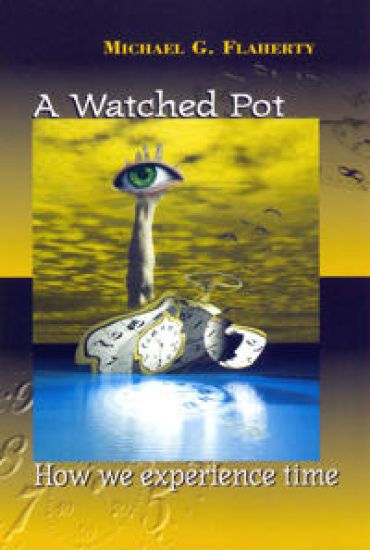
Time, it has been said, is the enemy. In an era of harried lives, time seems increasingly precious as hours and days telescope and our lives often seem to be flitting past. And yet, at other times, the minutes drag on, each tick of the clock excruciatingly drawn out. What explains this seeming paradox? Based upon a full decade's empirical research, Michael G. Flaherty's new book offers remarkable insights on this most universal human experience. Flaherty surveys hundreds of individuals of all ages in an attempt to ascertain how such phenomena as suffering, violence, danger, boredom, exhilaration, concentration, shock, and novelty influence our perception of time. Their stories make for intriguing reading, by turns familiar and exotic, mundane and dramatic, horrific and funny. A qualitative and quantitative tour de force, A Watched Pot presents what may well be the first fully integrated theory of time and will be of interest to scientists, humanists, social scientists and the educated public alike. A Choice Outstanding Academic Book.
A Watched Pot

A Watched Pot

Michael G. Flaherty

New York University Press
1999
sidottu
Time, it has been said, is the enemy. In an era of harried lives, time seems increasingly precious as hours and days telescope and our lives often seem to be flitting past. And yet, at other times, the minutes drag on, each tick of the clock excruciatingly drawn out. What explains this seeming paradox? Based upon a full decade's empirical research, Michael G. Flaherty's new book offers remarkable insights on this most universal human experience. Flaherty surveys hundreds of individuals of all ages in an attempt to ascertain how such phenomena as suffering, violence, danger, boredom, exhilaration, concentration, shock, and novelty influence our perception of time. Their stories make for intriguing reading, by turns familiar and exotic, mundane and dramatic, horrific and funny. A qualitative and quantitative tour de force, A Watched Pot presents what may well be the first fully integrated theory of time and will be of interest to scientists, humanists, social scientists and the educated public alike. A Choice Outstanding Academic Book.