Kirjojen hintavertailu. Mukana 12 104 523 kirjaa ja 12 kauppaa.

Kirjailija

Michael G. Lenné

Kirjat ja teokset yhdessä paikassa: 5 kirjaa, julkaisuja vuosilta 2015-2018, suosituimpien joukossa Distributed Situation Awareness in Road Transport. Vertaile teosten hintoja ja tarkista saatavuus suomalaisista kirjakaupoista.

5 kirjaa

Kirjojen julkaisuhaarukka 2015-2018.

Distributed Situation Awareness in Road Transport

Distributed Situation Awareness in Road Transport

Paul M. Salmon; Gemma Jennie Megan Read; Guy H. Walker; Michael G. Lenné; Neville A. Stanton

Ashgate Publishing Limited
2018
sidottu
How can we design transport environments that cater to the situation awareness needs of different end-users? This book answers this question by showcasing how state-of-the-art human factors theory and methods can be used to understand how situation awareness differs across drivers, cyclists, motorcyclists, and pedestrians and creates new designs that cater to these diverse situation awareness needs. Written by experts in the field and based on a major program of work funded by the Australian Research Council, this book outlines the distributed situation awareness model and provides practical guidance on how to study situation awareness naturalistically and how to create designs that support, rather than hinder, situation awareness. The book closes by outlining outline a generic framework to support similar applications in other areas, and discusses future applications in areas such as vehicle automation, artificial intelligence, and cybersecurity.Features Challenges traditional road safety analysis, design processes and conventions Outlines a novel on-road study methodology for analyzing naturalistic interactions among drivers, cyclists, motorcyclists and pedestrians Presents a review of state-of-the-art situation awareness theory and methods Provides practical guidance on a series of human factors methods Describes a framework to support the design of transport environments Evaluates new intersection concepts that encompass features designed to prevent collisions at intersections
Increasing Motorcycle Conspicuity

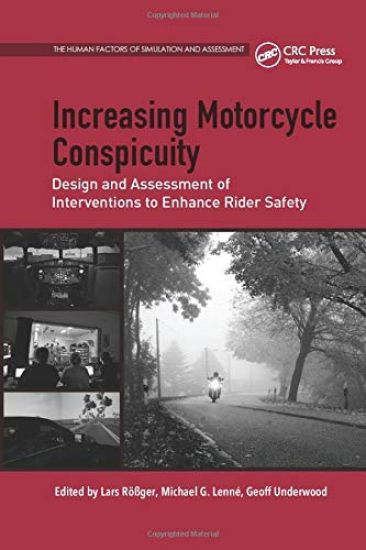
Increasing Motorcycle Conspicuity

Lars Rößger; Michael G. Lenné

CRC Press
2017
nidottu
It’s a widely recognised trend that powered-two-wheelers' (PTWs) use has been steadily increasing and is projected to increase further. While providing benefits to the community in the form of reduced traffic congestion and environmental benefits, the risks to PTW riders remain and visibility will always be a key issue. Increasing Motorcycle Conspicuity aims to illustrate how driving simulation, field studies and laboratory experiments can be used to improve rider safety through the design and evaluation of a range of safety measures. The book outlines the factors that contribute to PTW visibility and detection by car drivers, and presents case studies to illustrate how the various methods can be used to explore the contribution of these factors. The final chapter of the book highlights the utility of a simulation-based approach to improving PTW safety and discusses this method’s future applications. The case studies collected within the volume cover phases of the design of conspicuity treatments and provide a broad spectrum of empirical strategies for assessing the interventions. The book is most directly relevant to researchers and applied scientists from the fields of traffic/transportation psychology and human factors, as well as to practitioners from the traffic safety sector.
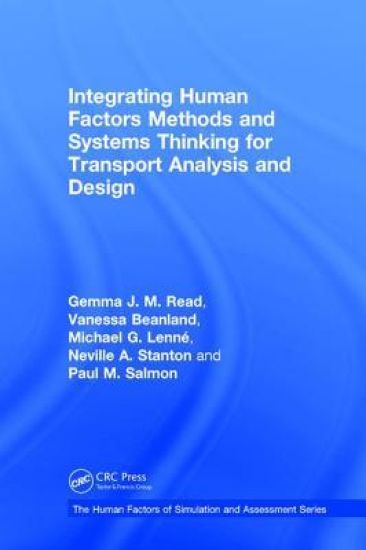
Integrating Human Factors Methods and Systems Thinking for Transport Analysis and Design

Integrating Human Factors Methods and Systems Thinking for Transport Analysis and Design

Gemma J. M. Read; Vanessa Beanland; Michael G. Lenné; Neville A. Stanton; Paul M. Salmon

CRC Press
2017
nidottu
Governments and road safety agencies around the world have either introduced or are considering 'safe system' strategies, a long overdue acknowledgement that different elements of the road system contribute to road safety outcomes. Human factors approaches have a leading role here in both conceptualising the road system as a complex sociotechnical system and in providing practical approaches to support true systems-based countermeasures. This book illustrates the potential for integrating contemporary systems-based human factors methods with modern day driving-assessment methods, such as vehicle instrumentation and driving simulation, to understand and enhance performance in modern day road-transport systems. The book outlines why a fundamental paradigm shift is needed in the way these systems are designed and operated, and illustrates how a wide range of accepted human-factors approaches can be applied successfully to road transport to revolutionise the countermeasure design process. The practical illustrations of these human factors methods are applied to a long-standing road and rail safety issue: rail level crossings, where the road and rail systems intersect. The final chapter of the book highlights the utility of the human factors approach to reducing road trauma and discusses future applications of the approach.
Integrating Human Factors Methods and Systems Thinking for Transport Analysis and Design

Integrating Human Factors Methods and Systems Thinking for Transport Analysis and Design

Gemma J. M. Read; Vanessa Beanland; Michael G. Lenné; Neville A. Stanton; Paul M. Salmon

Ashgate Publishing Limited
2017
sidottu
Governments and road safety agencies around the world have either introduced or are considering 'safe system' strategies, a long overdue acknowledgement that different elements of the road system contribute to road safety outcomes. Human factors approaches have a leading role here in both conceptualising the road system as a complex sociotechnical system and in providing practical approaches to support true systems-based countermeasures. This book illustrates the potential for integrating contemporary systems-based human factors methods with modern day driving-assessment methods, such as vehicle instrumentation and driving simulation, to understand and enhance performance in modern day road-transport systems. The book outlines why a fundamental paradigm shift is needed in the way these systems are designed and operated, and illustrates how a wide range of accepted human-factors approaches can be applied successfully to road transport to revolutionise the countermeasure design process. The practical illustrations of these human factors methods are applied to a long-standing road and rail safety issue: rail level crossings, where the road and rail systems intersect. The final chapter of the book highlights the utility of the human factors approach to reducing road trauma and discusses future applications of the approach.
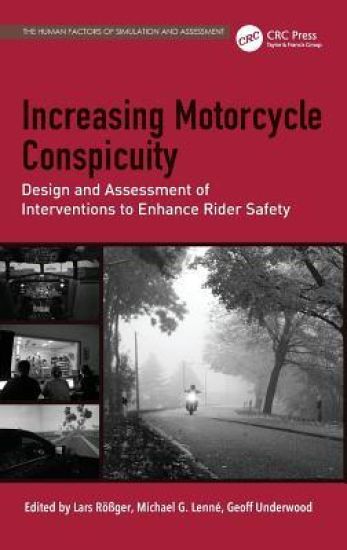
Increasing Motorcycle Conspicuity

Increasing Motorcycle Conspicuity

Lars Rößger; Michael G. Lenné

CRC Press
2015
sidottu
It’s a widely recognised trend that powered-two-wheelers' (PTWs) use has been steadily increasing and is projected to increase further. While providing benefits to the community in the form of reduced traffic congestion and environmental benefits, the risks to PTW riders remain and visibility will always be a key issue. Increasing Motorcycle Conspicuity aims to illustrate how driving simulation, field studies and laboratory experiments can be used to improve rider safety through the design and evaluation of a range of safety measures. The book outlines the factors that contribute to PTW visibility and detection by car drivers, and presents case studies to illustrate how the various methods can be used to explore the contribution of these factors. The final chapter of the book highlights the utility of a simulation-based approach to improving PTW safety and discusses this method’s future applications. The case studies collected within the volume cover phases of the design of conspicuity treatments and provide a broad spectrum of empirical strategies for assessing the interventions. The book is most directly relevant to researchers and applied scientists from the fields of traffic/transportation psychology and human factors, as well as to practitioners from the traffic safety sector.