Kirjojen hintavertailu. Mukana 12 390 323 kirjaa ja 12 kauppaa.

Kirjailija

Michael Gagarin

Kirjat ja teokset yhdessä paikassa: 9 kirjaa, julkaisuja vuosilta 1989-2024, suosituimpien joukossa Classical Rhetoric and Contemporary Law. Vertaile teosten hintoja ja tarkista saatavuus suomalaisista kirjakaupoista.

9 kirjaa

Kirjojen julkaisuhaarukka 1989-2024.

Classical Rhetoric and Contemporary Law

Classical Rhetoric and Contemporary Law

Vasileios Adamidis; Elizabeth C. Britt; David A. Frank; Michael Gagarin; Eugene Garver; Mark A. Hannah; Catherine L. Langford; Craig A. Meyer; Susan E. Provenzano; Nick J. Sciullo; Laura A. Webb

THE UNIVERSITY OF ALABAMA PRESS
2024
sidottu
Pairs passages from works of classical rhetoric with contemporary legal rulings to highlight and analyze their deep and abiding connections in matters of persuasionClassical Rhetoric and Contemporary Law: A Critical Reader is a rich work that analyzes the interplay between ancient rhetorical traditions and modern legal practice, reestablishing the lost connections between law and classical rhetoric. From Isocrates’s Panegyricus in 380 BCE to the landmark US Supreme Court case Trump v. Hawaii in 2018, and from Antiphon’s fifth century BCE First Tetralogy to 1995’s O. J. Simpson trial, the volume draws on an array of sources to illuminate how ancient rhetorical insights may even today challenge and enrich our grasp of contemporary legal principles. The collection opens with a brisk review of the historical development of rhetoric. The second part examines a pair of rhetorical theorists whose works frame the period across which classical rhetoric declined as a mode of thought. A contemporary appellate case contrasts with the work of Giambattista Vico, an eighteenth-century professor of rhetoric who warned of the separation of law from rhetoric. The analysis of the work of twentieth-century scholars ChaÏm Perelman and Lucie Olbrects-Tyteca shows that where Cartesian rationality fails, the humanistic tradition of rhetoric allows the law to respond to the needs of justice. In the third part, ten case studies bring together a classical rhetorical theorist with a contemporary court case, demonstrating the abiding relevance of the classical tradition to contemporary jurisprudence. With its cross-disciplinary appeal, Classical Rhetoric and Contemporary Law encompasses the work of legal, rhetorical, English, and communication scholars alike, catalyzing interactive exploration into the profound ways ancient rhetorical insights continue to shape our comprehension of today’s legal landscape.CONTRIBUTORS Vasileios Adamidis / Elizabeth C. Britt / Kirsten K. Davis / David A. Frank / Michael Gagarin / Eugene Garver / Mark A. Hannah / Catherine L. Langford / Brian N. Larson / Craig A. Meyer / Francis J. Mootz III / Susan E. Provenzano / Nick J. Sciullo / Kristen K. Tiscione / Laura A. Webb
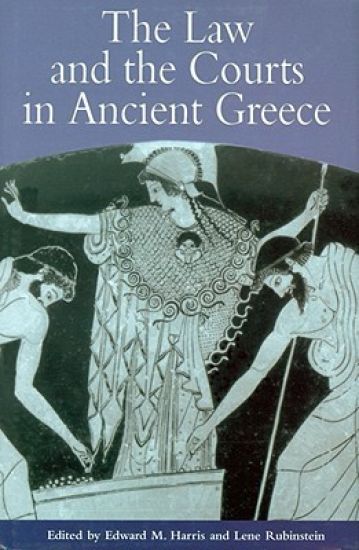
The Law and the Courts in Ancient Greece

The Law and the Courts in Ancient Greece

Christopher Carey; Angelos Chaniotis; Michael Gagarin; Edward Harris; Adriaan Lanni; David Mirhady; Frederick Naiden; Robert Parker; Peter Rhodes; James Sickinger

Bristol Classical Press
2004
sidottu
How successful were the Athenians and other Greeks in bringing about the rule of law? What did the Greeks recognise as 'law' both in the 'polis' and internationally? How did the courts attempt to implement this ideal, and how successful were they? This collection of essays sets out to answer these questions, concentrating on the following themes: law, religion and the sources of legitimacy; substance and procedure; legal arguments in court; documents and witnesses; and law in an international context. There is much here to interest not only specialists in Greek law, but also those concerned more generally with both Greek history and the history of law.
The Laws of Ancient Crete, c.650-400 BCE

The Laws of Ancient Crete, c.650-400 BCE

Michael Gagarin; Paula Perlman

Oxford University Press
2020
nidottu
This volume presents the Greek text of approximately 200 stone inscriptions, which detail the laws of ancient Crete in the archaic and classical periods, c.650-400 BCE. The texts of the inscriptions, many of which are fragmentary and relatively unknown, are accompanied by an English translation and also two commentaries; one focused on epigraphical and linguistic issues, and the other, requiring no knowledge of Greek, focused on legal and historical issues. The texts are preceded by a substantial introduction, which surveys the geography, history, writing habits, social and political structure, economy, religion, and law of Crete in this period.
Democratic Law in Classical Athens

Democratic Law in Classical Athens

Michael Gagarin

University of Texas Press
2020
sidottu
The democratic legal system created by the Athenians was completely controlled by ordinary citizens, with no judges, lawyers, or jurists involved. It placed great importance on the litigants’ rhetorical performances. Did this make it nothing more than a rhetorical contest judged by largely uneducated citizens that had nothing to do with law, a criticism that some, including Plato, have made?Michael Gagarin argues to the contrary, contending that the Athenians both controlled litigants’ performances and incorporated many other unusual features into their legal system, including rules for interrogating slaves and swearing an oath. The Athenians, Gagarin shows, adhered to the law as they understood it, which was a set of principles more flexible than our current understanding allows. The Athenians also insisted that their legal system serve the ends of justice and benefit the city and its people. In this way, the law ultimately satisfied most Athenians and probably produced just results as often as modern legal systems do. Comprehensive and wide-ranging, Democratic Law in Classical Athens offers a new perspective for viewing a legal system that was democratic in a way only the Athenians could achieve.
The Laws of Ancient Crete, c.650-400 BCE

The Laws of Ancient Crete, c.650-400 BCE

Michael Gagarin; Paula Perlman

Oxford University Press
2016
sidottu
This volume presents the Greek text of approximately 200 stone inscriptions, which detail the laws of ancient Crete in the archaic and classical periods, c.650-400 BCE. The texts of the inscriptions, many of which are fragmentary and relatively unknown, are accompanied by an English translation and also two commentaries; one focused on epigraphical and linguistic issues, and the other, requiring no knowledge of Greek, focused on legal and historical issues. The texts are preceded by a substantial introduction, which surveys the geography, history, writing habits, social and political structure, economy, religion, and law of Crete in this period.
Writing Greek Law

Writing Greek Law

Michael Gagarin

Cambridge University Press
2011
pokkari
The use of writing in the development of Greek law was unique. In this comparative study Professor Gagarin shows the reader how Greek law developed and explains why it became so different from the legal systems with which most legal historians are familiar. While other early communities wrote codes of law for academic or propaganda purposes, the Greeks used writing extensively to make their laws available to a relatively large segment of the community. On the other hand, the Greeks made little use of writing in litigation whereas other cultures used it extensively in this area, often putting written documents at the heart of the judicial process. Greek law thereby avoided becoming excessively technical and never saw the development of a specialised legal profession. This book will be of interest to those with an interest in the history of law, as well as ancient historians.
Writing Greek Law

Writing Greek Law

Michael Gagarin

Cambridge University Press
2008
sidottu
The use of writing in the development of Greek law was unique. In this comparative study Professor Gagarin shows the reader how Greek law developed and explains why it became so different from the legal systems with which most legal historians are familiar. While other early communities wrote codes of law for academic or propaganda purposes, the Greeks used writing extensively to make their laws available to a relatively large segment of the community. On the other hand, the Greeks made little use of writing in litigation whereas other cultures used it extensively in this area, often putting written documents at the heart of the judicial process. Greek law thereby avoided becoming excessively technical and never saw the development of a specialised legal profession. This book will be of interest to those with an interest in the history of law, as well as ancient historians.
Antiphon the Athenian

Antiphon the Athenian

Michael Gagarin

University of Texas Press
2002
pokkari
Winner, Friends of the Dallas Public Library Award from the Texas Institute of Letters, 2003Antiphon was a fifth-century Athenian intellectual (ca. 480-411 BCE) who created the profession of speechwriting while serving as an influential and highly sought-out adviser to litigants in the Athenian courts. Three of his speeches are preserved, together with three sets of Tetralogies (four hypothetical paired speeches), whose authenticity is sometimes doubted. Fragments also survive of intellectual treatises on subjects including justice, law, and nature (physis), which are often attributed to a separate Antiphon the Sophist. Were these two Antiphons really one and the same individual, endowed with a wide-ranging mind ready to tackle most of the diverse intellectual interests of his day?Through an analysis of all these writings, this book convincingly argues that they were composed by a single individual, Antiphon the Athenian. Michael Gagarin sets close readings of individual works within a wider discussion of the fifth-century Athenian intellectual climate and the philosophical ferment known as the sophistic movement. This enables him to demonstrate the overall coherence of Antiphon's interests and writings and to show how he was a pivotal figure between the sophists and the Attic orators of the fourth century. In addition, Gagarin's argument allows us to reassess the work of the sophists as a whole, so that they can now be seen as primarily interested in logos (speech, argument) and as precursors of fourth-century rhetoric, rather than in their usual role as foils for Plato.
Early Greek Law

Early Greek Law

Michael Gagarin

University of California Press
1989
pokkari
Drawing on the evidence of anthropology as well as ancient literature and inscriptions, Gagarin examines the emergence of law in Greece from the 8th through the 6th centuries B.C., that is, from the oral culture of Homer and Hesiod to the written enactment of codes of law in most major cities.