Kirjojen hintavertailu. Mukana 12 390 323 kirjaa ja 12 kauppaa.

Kirjailija

Michael H. Morris

Kirjat ja teokset yhdessä paikassa: 8 kirjaa, julkaisuja vuosilta 2001-2024, suosituimpien joukossa Entrepreneurship Programs and the Modern University. Vertaile teosten hintoja ja tarkista saatavuus suomalaisista kirjakaupoista.

8 kirjaa

Kirjojen julkaisuhaarukka 2001-2024.

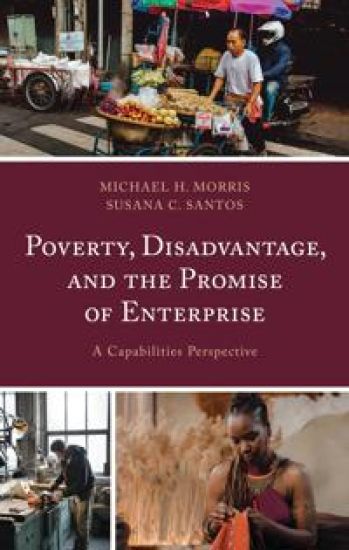
Poverty, Disadvantage, and the Promise of Enterprise

Poverty, Disadvantage, and the Promise of Enterprise

Michael H. Morris; Susana C. Santos

BLOOMSBURY PUBLISHING PLC
2024
sidottu
Can entrepreneurship serve as a pathway out of poverty? Are the poor able to create ventures that can improve their economic circumstances and enhance their lives? Poverty, Disadvantage and the Promise of Enterprise: A Capabilities Perspective argue that “it depends”. To understand the poverty and entrepreneurship interface, we must first understand poverty. Using a lens of disadvantage theory and the capabilities framework, the book explores the implications of poverty’s complex, multi-dimensional nature when one is trying to start and grow a business. Four key liabilities directly impact the opportunities these individuals are able to recognize, the types of ventures they create, how the businesses perform, and the impacts on the well-being of the entrepreneur. Because of these liabilities, these ventures tend to fall into what the authors call the commodity trap, where they struggle with low sales volumes and marginal profits. However, the trap is avoidable, and, with the right kinds of support, the performance of these ventures can be meaningfully improved. Key design elements of a successful intervention approach, together with an alternative perspective on the roles of community-based entrepreneurial ecosystems and public policy, are introduced. Emphasis is also placed on the critical roles of faith, hustle, and the fears of both failure and success.
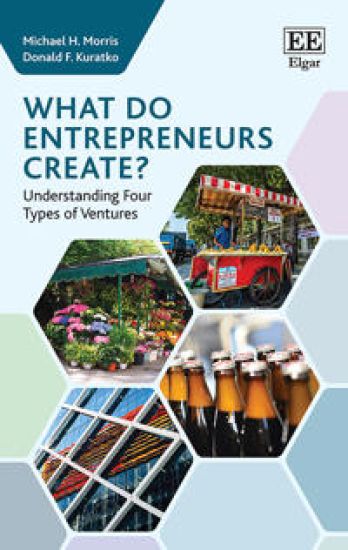
What do Entrepreneurs Create?

What do Entrepreneurs Create?

Michael H. Morris; Donald F. Kuratko

Edward Elgar Publishing Ltd
2021
nidottu
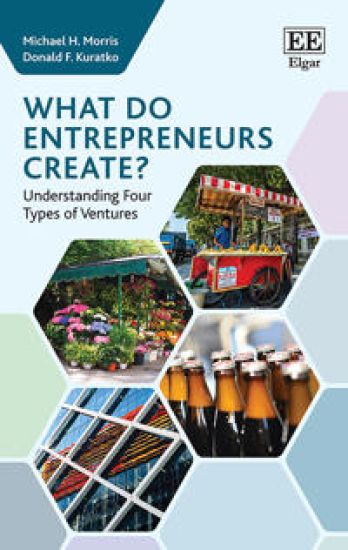
This book addresses the different kinds of businesses launched by entrepreneurs and explains why their differences are so critical for our understanding of entrepreneurship. While entrepreneurs create a wide variety of businesses, overwhelming emphasis has been placed on explosive growth firms such as Facebook, Google, Amazon, Uber and Airbnb. Although important, these businesses represent less than one percent of start-ups. The book distinguishes four types of new ventures: survival, lifestyle, managed growth and aggressive growth. Underlying characteristics of each type are investigated, together with the resources, skills and capabilities necessary for their success. Issues that arise based on this typology are explored, including reasons why ventures of one type rarely change to become another, and how entrepreneurs determine which they should pursue. In addition, the authors introduce the 'portfolio' concept, where the need to develop a balanced mix of venture types is emphasized. The principal audiences for What Do Entrepreneurs Create? include entrepreneurship educators, scholarly researchers, public policy developers, economic development professionals, and community organizations striving to foster entrepreneurial activity.
What do Entrepreneurs Create?

What do Entrepreneurs Create?

Michael H. Morris; Donald F. Kuratko

Edward Elgar Publishing Ltd
2020
sidottu
This book addresses the different kinds of businesses launched by entrepreneurs and explains why their differences are so critical for our understanding of entrepreneurship. While entrepreneurs create a wide variety of businesses, overwhelming emphasis has been placed on explosive growth firms such as Facebook, Google, Amazon, Uber and Airbnb. Although important, these businesses represent less than one percent of start-ups. The book distinguishes four types of new ventures: survival, lifestyle, managed growth and aggressive growth. Underlying characteristics of each type are investigated, together with the resources, skills and capabilities necessary for their success. Issues that arise based on this typology are explored, including reasons why ventures of one type rarely change to become another, and how entrepreneurs determine which they should pursue. In addition, the authors introduce the 'portfolio' concept, where the need to develop a balanced mix of venture types is emphasized. The principal audiences for What Do Entrepreneurs Create? include entrepreneurship educators, scholarly researchers, public policy developers, economic development professionals, and community organizations striving to foster entrepreneurial activity.
Poverty and Entrepreneurship in Developed Economies

Poverty and Entrepreneurship in Developed Economies

Michael H. Morris; Susana C. Santos; Xaver Neumeyer

Edward Elgar Publishing Ltd
2018
sidottu
'These authors take an in-depth look at poverty in developed countries and offer the unique solution of entrepreneurship's empowering and transformative venture creation impact to the problem. They introduce a framework as a holistic approach for understanding what is required for the low-income individual to successfully pursue the entrepreneurial path. For anyone concerned about the alleviation of poverty, this is a must read!'- Donald F. Kuratko, Indiana University, Bloomington, US'Poor people are more frequently business owners than any other economic group, but, because of resource constraints, they rarely break out of the informal economy so their entrepreneurship co-exists with poverty rather than replacing it. Could we reduce the resource constraints and simultaneously educate poor people about business management and strategy, more poor people could break into the formal sector, creating jobs and building wealth exactly where jobs and wealth are most needed. The social benefit would be huge. In their pragmatic, informed, and readable manual, Morris, Santos, and Neumeyer bring together the inter-disciplinary information that a public/private partnership requires to launch a successful effort to reduce poverty by enabling the entrepreneurship of the poor. In a nutshell, the public sector provides the infrastructure; the private sector and NGOs provide the business education. Everyone who has a practical or theoretical interest in poverty, entrepreneurship, or social policy should read this book.'- Ivan Light, University of California, Los Angeles, US While extensively explored as a solution to poverty at the base of the pyramid, this is the first in-depth examination of entrepreneurship and the poor within advanced economies. Entrepreneurship is presented as a source of empowerment that represents an alternative pathway out of poverty. The book explores the underlying nature of poverty and draws implications for new venture creation. This book fosters a richer dialog among academics, government officials, policy makers, economic development professionals, bankers and the financial community, leaders of non-profit organizations, and others committed to moving beyond status quo solutions - committed to finding ways to help people create their own entrepreneurial pathways out of poverty.
Entrepreneurship Programs and the Modern University

Entrepreneurship Programs and the Modern University

Michael H. Morris; Donald F. Kuratko; Jeffrey R.Cornwall Cornwall

Edward Elgar Publishing Ltd
2015
nidottu
After more than 30 years of impressive growth, what have we learned about building world-class entrepreneurship programs within universities?After tracing the evolution of entrepreneurship within institutions of higher learning, the authors explore the key elements that constitute a comprehensive entrepreneurship program. Best practices at leading universities and differing kinds of academic environments are highlighted. They examine multiple aspects of program management and infrastructure, including curriculum and degree program development, where entrepreneurship is administratively housed, how it is organized, and approaches to staffing and resource acquisition.The perspectives shared in the book enable university presidents, entrepreneurship students, provosts, deans, entrepreneurship program directors, faculty members, and others to better capitalize upon the empowering and transformative potential of entrepreneurship.
Entrepreneurship Programs and the Modern University

Entrepreneurship Programs and the Modern University

Michael H. Morris; Donald F. Kuratko; Jeffrey R.Cornwall Cornwall

Edward Elgar Publishing Ltd
2013
sidottu
After more than 30 years of impressive growth, what have we learned about building world-class entrepreneurship programs within universities?After tracing the evolution of entrepreneurship within institutions of higher learning, the authors explore the key elements that constitute a comprehensive entrepreneurship program. Best practices at leading universities and differing kinds of academic environments are highlighted. They examine multiple aspects of program management and infrastructure, including curriculum and degree program development, where entrepreneurship is administratively housed, how it is organized, and approaches to staffing and resource acquisition.The perspectives shared in the book enable university presidents, entrepreneurship students, provosts, deans, entrepreneurship program directors, faculty members, and others to better capitalize upon the empowering and transformative potential of entrepreneurship.
Entrepreneurship as Experience

Entrepreneurship as Experience

Michael H. Morris; Christopher G. Pryor; Minet Schindehutte

Edward Elgar Publishing Ltd
2012
sidottu
Do entrepreneurs create ventures or do venture experiences create entrepreneurs? The authors of Entrepreneurship as Experience propose that the answer is 'both'. This important volume examines how individuals experience the creation of a venture as it happens and how that experience determines the types of entrepreneur and venture that ultimately emerge. In essence, entrepreneurship is an experience consisting of large numbers of key events such as a first sale, hiring a first employee, losing a big account - events that are processed and made sense of by the entrepreneur. They produce cognitive, emotional and physiological responses, which impact decision-making and behavior. The result is an experience that is purposive, diverse, uncertain, ambiguous and transformative - and unique to each individual. Here, the authors argue that as experience unfolds both entrepreneur and venture are being constructed and emerge in unique forms. This experiential view introduces an entirely new lens through which entrepreneurship can be examined. Entrepreneurship as Experience comprises chapters dedicated to sociological, anthropological and psychological research related to human experiencing; the volume presents a new frame for understanding the role of emotions and feelings in venture creation and lays out a conceptual framework for understanding how real-time experiencing informs the entrepreneurial process. New insights are provided regarding how the entrepreneurial mindset and an entrepreneurial identity are formed, and why entrepreneurs take on certain traits and develop certain competencies. Further, the authors put forth new approaches to conducting research on the entrepreneurial experience. Students - advanced as well as undergraduate - and scholars of entrepreneurship, innovation, strategy and management will find themselves turning often to the ideas and research presented here.
Business-to-Business Marketing

Business-to-Business Marketing

Michael H. Morris; Leyland Pitt; Earl Dwight Honeycutt

SAGE Publications Inc
2001
sidottu
Thoroughly updated, this much anticipated new edition provides students with a comprehensive, state-of-the-art view of industrial marketing. With a focus on strategic thinking and acting, the authors examine the distinct challenges of the business-to-business marketplace. These include: faster product and service development; shortened product life cycles;, new processes for selling, distribution, and customer service; increase in entrepreneurial firms; and the need to create and sustain long-term customer relationships. Separate chapters are devoted to buying decisions, market research and analysis, and purchasing practices, including treatment of the latest technological developments in just-in-time systems, Web-based procurement, and enterprise resource planning and manufacturing systems. Each chapter includes illustrations of real world marketing issues, key concepts, learning objectives, and discussion questions.