Kirjojen hintavertailu. Mukana 12 595 353 kirjaa ja 12 kauppaa.

Kirjailija

Michael Haugh

Kirjat ja teokset yhdessä paikassa: 8 kirjaa, julkaisuja vuosilta 2013-2024, suosituimpien joukossa Im/Politeness Implicatures. Vertaile teosten hintoja ja tarkista saatavuus suomalaisista kirjakaupoista.

8 kirjaa

Kirjojen julkaisuhaarukka 2013-2024.

Sociopragmatics of Japanese

Sociopragmatics of Japanese

Yasuko Obana; Michael Haugh

TAYLOR FRANCIS LTD
2024
nidottu
Obana and Haugh question the extent to which commonly accepted theories in pragmatics can readily explain sociopragmatic phenomena in Japanese. Studies of Japanese in pragmatics have often challenged the cross-linguistic relevance of dominant theories. However, they have also inadvertently perpetuated stereotypes about the Japanese. It is often been assumed, for instance, that Japanese people are less strategic, more polite and more reliant on tacit forms of communication than speakers of other languages. But the Japanese are not as polite as one might think. The aim of this book is thus to question those folk assumptions around politeness, impoliteness, irony and indirectness while at the same time emphasizing that close examination of sociopragmatic phenomena in Japanese yields important empirical insights that combat common theoretical assumptions in pragmatics. The content is structured in three parts, in which the authors highlight a key building block of a theory of sociopragmatics. Part I focuses on indexing through the lens of chapters on honorifics, routine formula and politeness strategies. Part II focuses on evaluating through the lens of chapters on giving/receiving expressions and honorific irony. Finally, Part III focuses on relating through the lens of chapters on joint utterances and off record requests. Throughout the chapters the authors draw attention to ways in which these three dimensions are invariably intertwined in various ways.This book is not simply a collection of studies that promotes our understanding of the sociopragmatics of a particular language, but goes deeper and challenges what many have taken for granted in pragmatics. It proposes a framework for exploring sociopragmatic phenomena, building on the key sociopragmatic axes of indexing, evaluating and relating, and offers fresh new perspectives on time-honoured phenomena in pragmatics.It will interest scholars and postgraduate students in pragmatics, particularly those specializing in: politeness, impoliteness, indirectness and irony. The book explains what Japanese terms mean, and all the Japanese examples are morphologically-glossed. Therefore, teachers (and advanced learners) of Japanese at all levels will benefit from the book as it will enrich their knowledge of the Japanese language.

Sociopragmatics of Japanese

Sociopragmatics of Japanese

Yasuko Obana; Michael Haugh

TAYLOR FRANCIS LTD
2023
sidottu
Obana and Haugh question the extent to which commonly accepted theories in pragmatics can readily explain sociopragmatic phenomena in Japanese. Studies of Japanese in pragmatics have often challenged the cross-linguistic relevance of dominant theories. However, they have also inadvertently perpetuated stereotypes about the Japanese. It is often been assumed, for instance, that Japanese people are less strategic, more polite and more reliant on tacit forms of communication than speakers of other languages. But the Japanese are not as polite as one might think. The aim of this book is thus to question those folk assumptions around politeness, impoliteness, irony and indirectness while at the same time emphasizing that close examination of sociopragmatic phenomena in Japanese yields important empirical insights that combat common theoretical assumptions in pragmatics. The content is structured in three parts, in which the authors highlight a key building block of a theory of sociopragmatics. Part I focuses on indexing through the lens of chapters on honorifics, routine formula and politeness strategies. Part II focuses on evaluating through the lens of chapters on giving/receiving expressions and honorific irony. Finally, Part III focuses on relating through the lens of chapters on joint utterances and off record requests. Throughout the chapters the authors draw attention to ways in which these three dimensions are invariably intertwined in various ways.This book is not simply a collection of studies that promotes our understanding of the sociopragmatics of a particular language, but goes deeper and challenges what many have taken for granted in pragmatics. It proposes a framework for exploring sociopragmatic phenomena, building on the key sociopragmatic axes of indexing, evaluating and relating, and offers fresh new perspectives on time-honoured phenomena in pragmatics.It will interest scholars and postgraduate students in pragmatics, particularly those specializing in: politeness, impoliteness, indirectness and irony. The book explains what Japanese terms mean, and all the Japanese examples are morphologically-glossed. Therefore, teachers (and advanced learners) of Japanese at all levels will benefit from the book as it will enrich their knowledge of the Japanese language.
Im/Politeness Implicatures

Im/Politeness Implicatures

Michael Haugh

De Gruyter Mouton
2016
isokokoinen pokkari
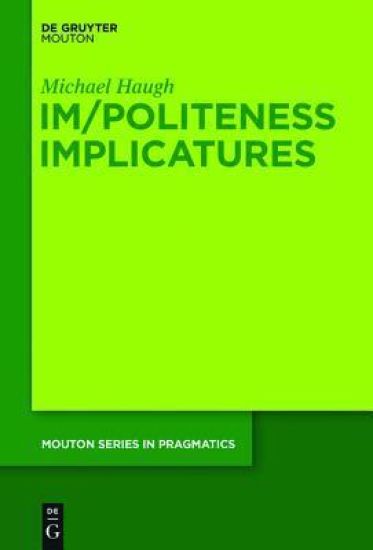
This volume brings together two highly researched but also highly controversial concepts, those of politeness and implicature. A theory of implicature as social action and im/politeness as social practice is developed that opens up new ways of examining the relationship between them. It constitutes a fresh look at the issues involved that redresses the current imbalance between social and pragmatic accounts of im/politeness.
Im/Politeness Implicatures

Im/Politeness Implicatures

Michael Haugh

De Gruyter Mouton
2014
sidottu
This volume brings together two highly researched but also highly controversial concepts, those of politeness and implicature. A theory of implicature as social action and im/politeness as social practice is developed that opens up new ways of examining the relationship between them. It constitutes a fresh look at the issues involved that redresses the current imbalance between social and pragmatic accounts of im/politeness.
Pragmatics and the English Language

Pragmatics and the English Language

Jonathan Culpeper; Michael Haugh

Red Globe Press
2014
nidottu
How do we interpret language and expose its meanings? How does pragmatics describe the English language? Where can we go to acquire a deeper understanding of pragmatics?Pragmatics and the English Language is a bold new textbook that presents an innovative and exciting way of looking at the subject. This new perspective, called integrative pragmatics, steers a course between what have historically been considered irreconcilable perspectives. With an emphasis on empirical data, the book is filled with examples from cartoons, films and historical sources, as well as face-to-face and digitally-mediated interactions, all of which are used to help the reader develop a better understanding of the theory.Pragmatics and the English Language:- Focuses on both the pragmatic aspects of English and how pragmatics is shaped by English- Synthesizes traditional ideas with state-of-the-art pragmatics research- Goes far beyond the coverage found in other pragmatics textbooksShedding light on the English language in highly original ways, Pragmatics and the English Language is essential reading for advanced students of the English language and linguistics, along with anybody else who wishes to develop a more in-depth knowledge of pragmatics.
Pragmatics and the English Language

Pragmatics and the English Language

Jonathan Culpeper; Michael Haugh

Red Globe Press
2014
sidottu
How do we interpret language and expose its meanings? How does pragmatics describe the English language? Where can we go to acquire a deeper understanding of pragmatics?Pragmatics and the English Language is a bold new textbook that presents an innovative and exciting way of looking at the subject. This new perspective, called integrative pragmatics, steers a course between what have historically been considered irreconcilable perspectives. With an emphasis on empirical data, the book is filled with examples from cartoons, films and historical sources, as well as face-to-face and digitally-mediated interactions, all of which are used to help the reader develop a better understanding of the theory.Pragmatics and the English Language:- Focuses on both the pragmatic aspects of English and how pragmatics is shaped by English- Synthesizes traditional ideas with state-of-the-art pragmatics research- Goes far beyond the coverage found in other pragmatics textbooksShedding light on the English language in highly original ways, Pragmatics and the English Language is essential reading for advanced students of the English language and linguistics, along with anybody else who wishes to develop a more in-depth knowledge of pragmatics.
Understanding Politeness

Understanding Politeness

Dániel Z. Kádár; Michael Haugh

Cambridge University Press
2013
pokkari
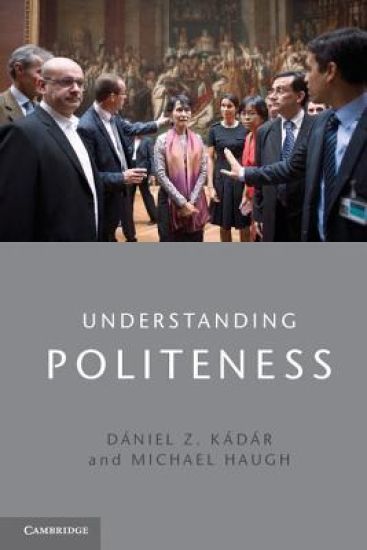
Politeness is key to all of our relationships and plays a fundamental part in the way we communicate with each other and the way we define ourselves. It is not limited only to conventional aspects of linguistic etiquette, but encompasses all types of interpersonal behaviour through which we explore and maintain our relationships. This groundbreaking exploration navigates the reader through this fascinating area and introduces them to a variety of new insights. The book is divided into three parts and is based on an innovative framework which relies on the concepts of social practice, time and space. In this multidisciplinary approach, the authors capture a range of user and observer understandings and provide a variety of examples from different languages and cultures. With its reader-friendly style, carefully constructed exercises and useful glossary, Understanding Politeness will be welcomed by both researchers and postgraduate students working on politeness, pragmatics and sociolinguistics more broadly.
Understanding Politeness

Understanding Politeness

Dániel Z. Kádár; Michael Haugh

Cambridge University Press
2013
sidottu
Politeness is key to all of our relationships and plays a fundamental part in the way we communicate with each other and the way we define ourselves. It is not limited only to conventional aspects of linguistic etiquette, but encompasses all types of interpersonal behaviour through which we explore and maintain our relationships. This groundbreaking exploration navigates the reader through this fascinating area and introduces them to a variety of new insights. The book is divided into three parts and is based on an innovative framework which relies on the concepts of social practice, time and space. In this multidisciplinary approach, the authors capture a range of user and observer understandings and provide a variety of examples from different languages and cultures. With its reader-friendly style, carefully constructed exercises and useful glossary, Understanding Politeness will be welcomed by both researchers and postgraduate students working on politeness, pragmatics and sociolinguistics more broadly.