Kirjojen hintavertailu. Mukana 12 137 197 kirjaa ja 12 kauppaa.

Kirjailija

Michael Hout

Kirjat ja teokset yhdessä paikassa: 4 kirjaa, julkaisuja vuosilta 1983-2006, suosituimpien joukossa Mobility Tables. Vertaile teosten hintoja ja tarkista saatavuus suomalaisista kirjakaupoista.

4 kirjaa

Kirjojen julkaisuhaarukka 1983-2006.

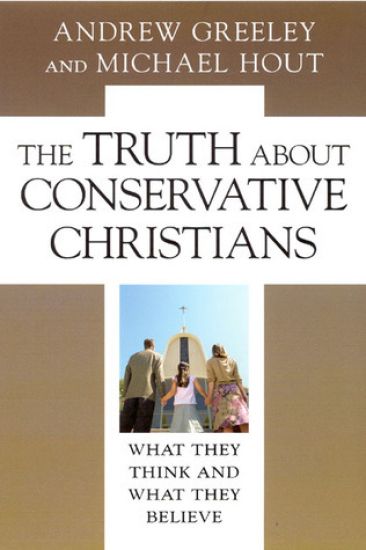
The Truth about Conservative Christians

The Truth about Conservative Christians

Andrew M. Greeley; Michael Hout

University of Chicago Press
2006
sidottu
Ever since the reelection of President Bush, conservative Christians have been stereotyped in the popular media: Bible-thumping militants and anti-intellectual zealots determined to impose their convictions on such matters as evolution, school prayer, pornography, abortion, and homosexuality on the rest of us. But conservative Christians are not as fanatical or intractable as many people think, nor are they necessarily the monolithic voting block or political base that kept Bush in power. Andrew M. Greeley and Michael Hout's eye-opening book expertly conveys the complexity, variety, and sensibilities of conservative Christians, dispelling the myths that have long shrouded them in prejudice and political bias. For starters, Greeley and Hout reveal that class and income have trumped moral issues for these Americans more often than we realize: a dramatic majority of working-class and lower-class conservative Christians backed liberals such as Jimmy Carter and Bill Clinton during their runs for president. And when it comes to abortion, most conservative Christians are not consistently pro-life in the absolute fashion usually assumed: they are still more likely to oppose the practice than other Americans, but 86 percent of them are willing to tolerate it to protect the health of the mother or when the woman has been raped, and 22 percent of them are even pro-choice. What do conservative Christians really think about evolution, homosexuality, or even the meaning of the word of God? Answering these questions and more, The Truth about Conservative Christians will interest—and surprise—a broad range of readers, especially in this heated election year.
Inequality by Design

Inequality by Design

Claude S. Fischer; Michael Hout; Martín Sánchez Jankowski; Samuel R. Lucas; Ann Swidler; Kim Voss

Princeton University Press
1996
pokkari
As debate rages over the widening and destructive gap between the rich and the rest of Americans, Claude Fischer and his colleagues present a comprehensive new treatment of inequality in America. They challenge arguments that expanding inequality is the natural, perhaps necessary, accompaniment of economic growth. They refute the claims of the incendiary bestseller The Bell Curve (1994) through a clear, rigorous re-analysis of the very data its authors, Richard Herrnstein and Charles Murray, used to contend that inherited differences in intelligence explain inequality. Inequality by Design offers a powerful alternative explanation, stressing that economic fortune depends more on social circumstances than on IQ, which is itself a product of society. More critical yet, patterns of inequality must be explained by looking beyond the attributes of individuals to the structure of society. Social policies set the "rules of the game" within which individual abilities and efforts matter. And recent policies have, on the whole, widened the gap between the rich and the rest of Americans since the 1970s. Not only does the wealth of individuals' parents shape their chances for a good life, so do national policies ranging from labor laws to investments in education to tax deductions. The authors explore the ways that America--the most economically unequal society in the industrialized world--unevenly distributes rewards through regulation of the market, taxes, and government spending. It attacks the myth that inequality fosters economic growth, that reducing economic inequality requires enormous welfare expenditures, and that there is little we can do to alter the extent of inequality. It also attacks the injurious myth of innate racial inequality, presenting powerful evidence that racial differences in achievement are the consequences, not the causes, of social inequality. By refusing to blame inequality on an unchangeable human nature and an inexorable market--an excuse that leads to resignation and passivity--Inequality by Design shows how we can advance policies that widen opportunity for all.
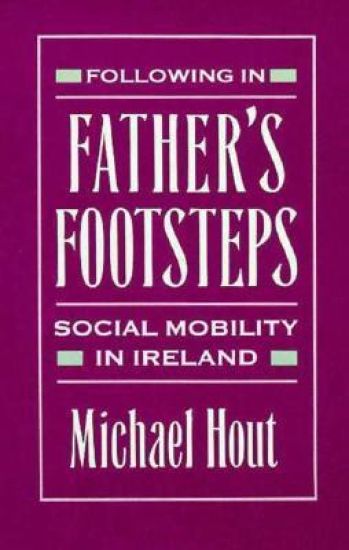
Following in Father’s Footsteps

Following in Father’s Footsteps

Michael Hout

Harvard University Press
1989
sidottu
This is the first systematic study of patterns of social mobility in Ireland. It covers a recent period—the 1960s—when Ireland was undergoing rapid economic growth and modernization. The author thus was able to test the widely accepted hypothesis that growth weakens class barriers. To his surprise he found that it did not. Social mobility increased somewhat, but among mobile men the better jobs still went to those from advantaged social class origins. Despite economic development and demographic change, the underlying link between social origins and career destinations remained unchanged.In chapters on education, life cycle, religion, and farming, Michael Hout shows how inequality persists in contemporary Ireland. In the last chapter he reviews evidence from other countries and concludes that governments must take action against class barriers in education and employment practices if inequality is to be reduced. Economic growth creates jobs, he argues, but economic growth alone cannot allocate those jobs fairly.
Mobility Tables

Mobility Tables

Michael Hout

SAGE Publications Inc
1983
nidottu
Explains the most widely used methods for analyzing cross-classified data on occupational origins and destinations. Reviews classic definitions, models, and sources of mobility data, as well as elementary operations for analyzing mobility tables.