Kirjojen hintavertailu. Mukana 12 390 323 kirjaa ja 12 kauppaa.

Kirjailija

Michael J. Lynch

Kirjat ja teokset yhdessä paikassa: 11 kirjaa, julkaisuja vuosilta 2014-2025, suosituimpien joukossa John Davenant's Hypothetical Universalism. Vertaile teosten hintoja ja tarkista saatavuus suomalaisista kirjakaupoista.

Mukana myös kirjoitusasut: Michael J Lynch

11 kirjaa

Kirjojen julkaisuhaarukka 2014-2025.

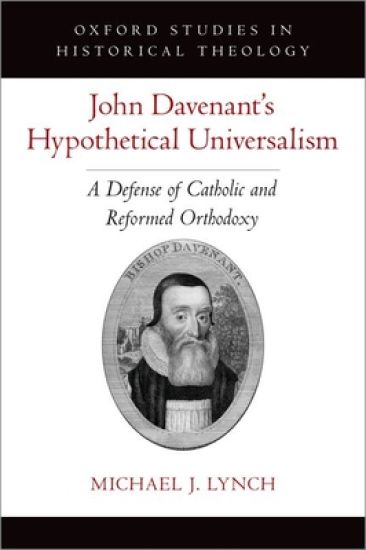
John Davenant's Hypothetical Universalism

John Davenant's Hypothetical Universalism

Michael J. Lynch

Oxford University Press Inc
2021
sidottu
Recently there has been a revival of interest in the views held by Reformed theologians within the parameters of confessional orthodoxy. For example, the doctrine known as 'hypothetical universalism'--the idea that although Christ died in some sense for every person, his death was intended to bring about the salvation only for those who were predestined for salvation. Michael Lynch focuses on the hypothetical universalism of the English theologian and bishop John Davenant (1572-1641), arguing that it has consistently been misinterpreted and misrepresented as a via media between Arminian and Reformed theology. A close examination of Davenent's De Morte Christi, is the central core of the study. Lynch offers a detailed exposition of Davenant's doctrine of universal redemption in dialogue with his understanding of closely related doctrines such as God's will, predestination, providence, and covenant theology. He defends the thesis that Davenant's version of hypothetical universalism represents a significant strand of the Augustinian tradition, including the early modern Reformed tradition. The book examines the patristic and medieval periods as they provided the background for the Lutheran, Remonstrant, and Reformed reactions to the so-called Lombardian formula ('Christ died sufficiently for all, effectually for the elect'). It traces how Davenant and his fellow British delegates at the Synod of Dordt shaped the Canons of Dordt in such a way as to allow for their English hypothetical universalism.
Exploring Green Criminology

Exploring Green Criminology

Michael J. Lynch; Paul B. Stretesky

Routledge
2014
nidottu
Few criminologists have drawn attention to the fact that widespread and significant forms of harm such as green or environmental crimes are neglected by criminology. Others have suggested that green crimes present the most important challenge to criminology as a discipline. This book argues that criminology needs to take green harms more seriously and to be revolutionized so that it forms part of the solution to the large environmental problems currently faced across the world. It asks how criminology should be redesigned to consider green/environmental harm as a key area of study in an era where destruction of the earth and the world’s ecosystem is a major concern and examines why this has remained unaccomplished so far. The chapters in this book apply an environmental frame of reference underlying a green approach to issues which can be addressed from within criminology and which can encourage criminologists and environmentalists to respond and react differently to environmental crime.
Permutation Statistical Methods for Criminology and Criminal Justice

Permutation Statistical Methods for Criminology and Criminal Justice

Kenneth J. Berry; Janis E. Johnston; Michael A. Long; Paul Stretesky; Michael J. Lynch

Springer International Publishing AG
2025
sidottu
This book takes a unique approach to explaining permutation statistical methods for advanced undergraduate students, graduate students, faculty, researchers, and other professionals interested in the areas of criminology or criminal justice. The book integrates permutation statistical methods with a wide range of classical statistical methods. It opens with a comparison of two models of statistical inference: the classical population model espoused by J. Neyman and E. Pearson and the permutation model first introduced by R.A. Fisher and E.J.G. Pitman. Numerous comparisons of permutation and classical statistical methods are illustrated with examples from criminology and criminal justice and supplemented with a variety of R scripts for ease of computation. The text follows the general outline of an introductory textbook in statistics with chapters on central tendency, variability, one-sample tests, two-sample tests, matched-pairs tests, completely-randomized analysis of variance, randomized-blocks analysis of variance, simple linear regression and correlation, and the analysis of goodness of fit and contingency. Unlike classical statistical methods, permutation statistical methods do not rely on theoretical distributions, avoid the usual assumptions of normality and homogeneity, depend solely on the observed data, and do not require random sampling, making permutation statistical methods ideal for analyzing criminology and criminal justice databases. Permutation methods are relatively new in that it took modern computing power to make them available to those working in criminology and criminal justice research. The book contains detailed examples of permutation analyses. Each analysis is paired with a conventional analysis; for example, a permutation test of the difference between experimental and control groups is contrasted with Student's two-sample $t$ test. An added feature is the inclusion of multiple historical notes on the origin and development of both parametric and conventional tests and measures. Designed for an audience with a basic statistical background and a strong interest in parametric and non-parametric statistics, the book can easily serve as a textbook for undergraduate and graduate students in criminology, criminal justice, or sociology, as well as serving as a research source for faculty, researchers, and other professionals in the area of criminology. No statistical training beyond a first course in statistics is required, but some knowledge of, or interest in, criminology or criminal justice is assumed.
Applying Benford's Law for Assessing the Validity of Social Science Data

Applying Benford's Law for Assessing the Validity of Social Science Data

Michael A. Long; Paul B. Stretesky; Kenneth J. Berry; Janis E. Johnston; Michael J. Lynch

Cambridge University Press
2023
sidottu
Benford's Law is a probability distribution for the likelihood of the leading digit in a set of numbers. This book seeks to improve and systematize the use of Benford's Law in the social sciences to assess the validity of self-reported data. The authors first introduce a new measure of conformity to the Benford distribution that is created using permutation statistical methods and employs the concept of statistical agreement. In a switch from a typical Benford application, this book moves away from using Benford's Law to test whether the data conform to the Benford distribution, to using it to draw conclusions about the validity of the data. The concept of 'Benford validity' is developed, which indicates whether a dataset is valid based on comparisons with the Benford distribution and, in relation to this, diagnostic procedure that assesses the impact of not having Benford validity on data analysis is devised.
Applying Benford's Law for Assessing the Validity of Social Science Data

Applying Benford's Law for Assessing the Validity of Social Science Data

Michael A. Long; Paul B. Stretesky; Kenneth J. Berry; Janis E. Johnston; Michael J. Lynch

Cambridge University Press
2023
pokkari
Benford's Law is a probability distribution for the likelihood of the leading digit in a set of numbers. This book seeks to improve and systematize the use of Benford's Law in the social sciences to assess the validity of self-reported data. The authors first introduce a new measure of conformity to the Benford distribution that is created using permutation statistical methods and employs the concept of statistical agreement. In a switch from a typical Benford application, this book moves away from using Benford's Law to test whether the data conform to the Benford distribution, to using it to draw conclusions about the validity of the data. The concept of 'Benford validity' is developed, which indicates whether a dataset is valid based on comparisons with the Benford distribution and, in relation to this, diagnostic procedure that assesses the impact of not having Benford validity on data analysis is devised.
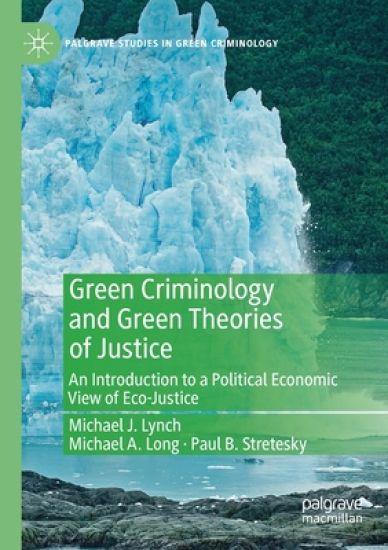
Green Criminology and Green Theories of Justice

Green Criminology and Green Theories of Justice

Michael J. Lynch; Michael A. Long; Paul B. Stretesky

Springer Nature Switzerland AG
2021
nidottu
This book offers an alternative analysis of the various theories and dimensions of green and environmental justice which are rooted in political economy. Much green criminological literature sidelines political economic theoretical insights and therefore with this work the authors enrich the field by vigorously exploring such perspectives. It engages with a number of studies relevant to a political economic approach to justice in order to make two key arguments: that capitalism has produced profound ecological injustices and that the concept of ecological justice (human and ecological rights) itself needs critiquing. Green Criminology and Green Theories of Justice is a timely text which urges the field to revisit its radical roots in social justice while broadening its disciplinary horizons to include a meaningful analysis of political economy and its role in producing and responding to environmental harm andinjustice.
Straybeck Rising

Straybeck Rising

Michael J Lynch

Solodog Publishing
2020
pokkari
The Premier demands loyalty and controls his people through terror and violence. Thirty-three years ago, Robb Calloway almost died when he stood against the Government. He was captured, tortured and forced to live out his days a broken man.Now he watches helplessly as his eldest son - Ryan - follows the same path. Ryan slips deeper into Straybeck's underworld where revolutionaries and criminals fight against the gunnermen. A place where truth and lies are beyond separation and even the giants can't keep blood off the streets.Bursting into the dystopian genre, Straybeck Rising is a compelling and heart-breaking story of one family's struggle to survive. It shows a boy growing up too fast and a father and brother who can't keep him safe.
Green Criminology and Green Theories of Justice

Green Criminology and Green Theories of Justice

Michael J. Lynch; Michael A. Long; Paul B. Stretesky

Springer Nature Switzerland AG
2020
sidottu
This book offers an alternative analysis of the various theories and dimensions of green and environmental justice which are rooted in political economy. Much green criminological literature sidelines political economic theoretical insights and therefore with this work the authors enrich the field by vigorously exploring such perspectives. It engages with a number of studies relevant to a political economic approach to justice in order to make two key arguments: that capitalism has produced profound ecological injustices and that the concept of ecological justice (human and ecological rights) itself needs critiquing. Green Criminology and Green Theories of Justice is a timely text which urges the field to revisit its radical roots in social justice while broadening its disciplinary horizons to include a meaningful analysis of political economy and its role in producing and responding to environmental harm andinjustice.
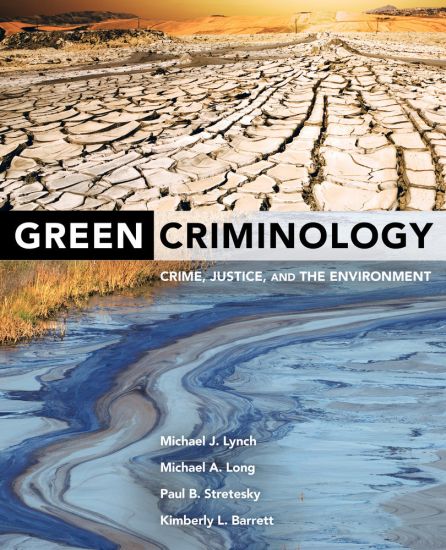
Green Criminology

Green Criminology

Michael J. Lynch; Michael A. Long; Paul B. Stretesky; Kimberly L. Barrett

University of California Press
2017
pokkari
This groundbreaking text provides an overview and assessment of green criminology as well as a call to action. Green Criminology draws attention to the ways in which the political-economic organization of capitalism causes ecological destruction and disorganization. Focusing on real-world issues of green crime and justice, chapters include political-economic examinations of ecological withdrawals, ecological additions, toxic towns, wildlife poaching and trafficking, environmental justice, environmental laws, and nongovernment environmental organizations. The book also presents an unintimidating introduction to research from the physical sciences on issues such as climate change, pollution levels, and the ecological footprint of humans, providing a truly interdisciplinary foundation for green criminological analysis. To help students succeed in the course-and to encourage them to see themselves as future green criminology researchers-end-of-chapter materials include: *Questions and Activities for Students that review topics students should be able to conceptualize and address*Lessons for Researchers that provide ideas about additional research that might be worthwhile to undertake
Exploring Green Criminology

Exploring Green Criminology

Michael J. Lynch; Paul B. Stretesky

Routledge
2014
sidottu
Few criminologists have drawn attention to the fact that widespread and significant forms of harm such as green or environmental crimes are neglected by criminology. Others have suggested that green crimes present the most important challenge to criminology as a discipline. This book argues that criminology needs to take green harms more seriously and to be revolutionized so that it forms part of the solution to the large environmental problems currently faced across the world. It asks how criminology should be redesigned to consider green/environmental harm as a key area of study in an era where destruction of the earth and the world’s ecosystem is a major concern and examines why this has remained unaccomplished so far. The chapters in this book apply an environmental frame of reference underlying a green approach to issues which can be addressed from within criminology and which can encourage criminologists and environmentalists to respond and react differently to environmental crime.