Kirjojen hintavertailu. Mukana 12 558 791 kirjaa ja 12 kauppaa.

Kirjailija

Michael K. Goodman

Kirjat ja teokset yhdessä paikassa: 3 kirjaa, julkaisuja vuosilta 2011-2021, suosituimpien joukossa Geographies of Food. Vertaile teosten hintoja ja tarkista saatavuus suomalaisista kirjakaupoista.

3 kirjaa

Kirjojen julkaisuhaarukka 2011-2021.

Geographies of Food

Geographies of Food

Moya Kneafsey; Damian Maye; Lewis Holloway; Michael K. Goodman

Bloomsbury Academic
2021
nidottu
What is the future of food in light of growing threats from the climate emergency and natural resource depletion, as well as economic and social inequality? This textbook engages with this question, and considers the complex relationships between food, place, and space, providing students with an introduction to the contemporary and future geographies of food and the powerful role that food plays in our everyday lives. Geographies of Food explores contemporary food issues and crises in all their dimensions, as well as the many solutions currently being proposed. Drawing on global case studies from the Majority and Minority Worlds, it analyses the complex relationships operating between people and processes at a range of geographical scales, from the shopping decisions of consumers in a British or US supermarket, to food insecurity in Sub-Saharan Africa, to the high-level political negotiations at the World Trade Organization and the strategies of giant American and European agri-businesses whose activities span several continents.With over 60 color images and a range of lively pedagogical features, Geographies of Food is essential reading for undergraduates studying food and geography.
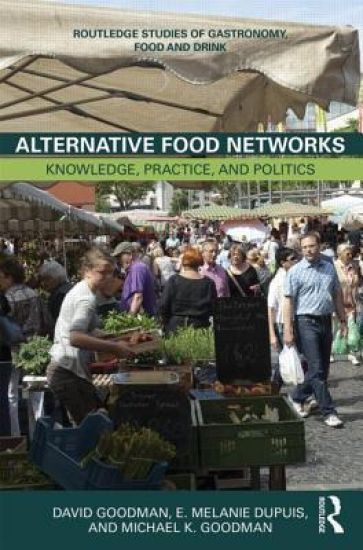
Alternative Food Networks

Alternative Food Networks

David Goodman; E. Melanie DuPuis; Michael K. Goodman

Routledge
2013
nidottu
Farmers’ markets, veggie boxes, local foods, organic products and Fair Trade goods – how have these once novel, "alternative" foods, and the people and networks supporting them, become increasingly familiar features of everyday consumption? Are the visions of "alternative worlds" built on ethics of sustainability, social justice, animal welfare and the aesthetic values of local food cultures and traditional crafts still credible now that these foods crowd supermarket shelves and other "mainstream" shopping outlets? This timely book provides a critical review of the growth of alternative food networks and their struggle to defend their ethical and aesthetic values against the standardizing pressures of the corporate mainstream with its "placeless and nameless" global supply networks. It explores how these alternative movements are "making a difference" and their possible role as fears of global climate change and food insecurity intensify. It assesses the different experiences of these networks in three major arenas of food activism and politics: Britain and Western Europe, the United States, and the global Fair Trade economy. This comparative perspective runs throughout the book to fully explore the progressive erosion of the interface between alternative and mainstream food provisioning. As the era of "cheap food" draws to a close, analysis of the limitations of market-based social change and the future of alternative food economies and localist food politics place this book at the cutting-edge of the field. The book is thoroughly informed by contemporary social theory and interdisciplinary social scientific scholarship, formulates an integrative social practice framework to understand alternative food production-consumption, and offers a unique geographical reach in its case studies.
Alternative Food Networks

Alternative Food Networks

David Goodman; E. Melanie DuPuis; Michael K. Goodman

Routledge
2011
sidottu
Farmers’ markets, veggie boxes, local foods, organic products and Fair Trade goods – how have these once novel, "alternative" foods, and the people and networks supporting them, become increasingly familiar features of everyday consumption? Are the visions of "alternative worlds" built on ethics of sustainability, social justice, animal welfare and the aesthetic values of local food cultures and traditional crafts still credible now that these foods crowd supermarket shelves and other "mainstream" shopping outlets? This timely book provides a critical review of the growth of alternative food networks and their struggle to defend their ethical and aesthetic values against the standardizing pressures of the corporate mainstream with its "placeless and nameless" global supply networks. It explores how these alternative movements are "making a difference" and their possible role as fears of global climate change and food insecurity intensify. It assesses the different experiences of these networks in three major arenas of food activism and politics: Britain and Western Europe, the United States, and the global Fair Trade economy. This comparative perspective runs throughout the book to fully explore the progressive erosion of the interface between alternative and mainstream food provisioning. As the era of "cheap food" draws to a close, analysis of the limitations of market-based social change and the future of alternative food economies and localist food politics place this book at the cutting-edge of the field. The book is thoroughly informed by contemporary social theory and interdisciplinary social scientific scholarship, formulates an integrative social practice framework to understand alternative food production-consumption, and offers a unique geographical reach in its case studies.