

Kirjailija
Michael Mann
Kirjat ja teokset yhdessä paikassa: 57 kirjaa, julkaisuja vuosilta 1973-2026, suosituimpien joukossa Michael Mann Project 2. Vertaile teosten hintoja ja tarkista saatavuus suomalaisista kirjakaupoista.
57 kirjaa
Kirjojen julkaisuhaarukka 1973-2026.

A riveting, magical escapade about finding friendship and the courage to set yourself free against all odds. Kidnapped and forced to shovel coal underground, in a half-bombed power station, 12-year-old Luke Smith-Sharma keeps his head down and hopes he can earn his freedom from the evil Tabitha Margate. Then one day he discovers he can see things that others can't. Ghostly things. A ghostly girl named Alma, who can bend the shape of clouds to her will and rides them through the night sky. With Alma's help, Luke discovers his own innate powers and uncovers the terrible truth of why Tabatha is kidnapping children and forcing them to shovel coal. Desperate to escape, Luke teams up with Alma, his best friend Ravi, and new girl Jess. Can Luke and his friends get away before they each become victims to a cruel and sinister scheme? Debut author Michael Mann delivers a wildly imaginative middle grade fantasy set in a smoke-stained world that's sure to entertain readers who are eager for an adventure with paranormal superpowers. A Kirkus Reviews Best Book of the Year
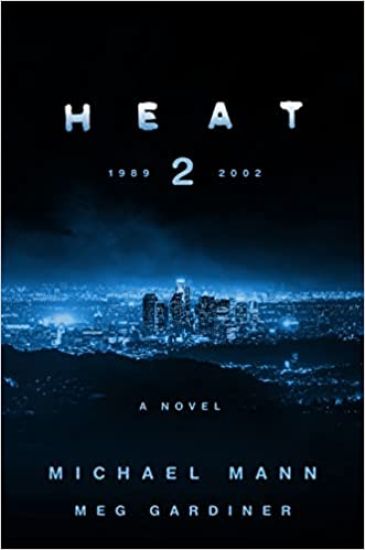
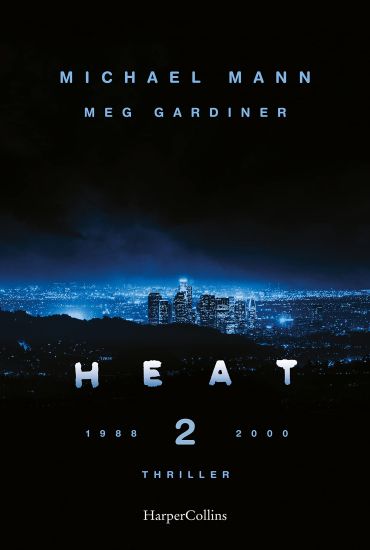
Instant #1 New York Times Bestseller Michael Mann, four-time-Oscar-nominated writer-director of The Last of the Mohicans, The Insider, Ali, Miami Vice, Collateral, and Heat teams up with Edgar Award-winning author Meg Gardiner to deliver Mann's first novel, an explosive return to the universe and characters of his classic crime film--with an all-new story unfolding in the years before and after the iconic movie"A hard-boiled, cinematic read that moves as fast as a well-planned heist." --EsquireOne day after the end of Heat, Chris Shiherlis (Val Kilmer) is holed up in Koreatown, wounded, half delirious, and desperately trying to escape LA. Hunting him is LAPD detective Vincent Hanna (Al Pacino). Hours earlier, Hanna killed Shiherlis's brother in arms Neil McCauley (Robert De Niro) in a gunfight under the strobe lights at the foot of an LAX runway. Now Hanna's determined to capture or kill Shiherlis, the last survivor of McCauley's crew, before he ghosts out of the city.In 1988, seven years earlier, McCauley, Shiherlis, and their highline crew are taking scores on the West Coast, the US-Mexican border, and now in Chicago. Driven, daring, they're pulling in money and living vivid lives. And Chicago homicide detective Vincent Hanna--a man unreconciled with his history--is following his calling, the pursuit of armed and dangerous men into the dark and wild places, hunting an ultraviolent gang of home invaders.Meanwhile, the fallout from McCauley's scores and Hanna's pursuit cause unexpected repercussions in a parallel narrative, driving through the years following Heat.Heat 2 projects its dimensional and richly drawn men and women into whole new worlds--from the inner sanctums of rival crime syndicates in a South American free-trade zone to transnational criminal enterprises in Southeast Asia. The novel brings you intimately into these lives. In Michael Mann's Heat universe, they will confront new adversaries in lethal circumstances beyond all boundaries.Heat 2 is engrossing, moving, and tragic--a masterpiece of crime fiction with the same extraordinary ambitions, scope, and rich characterizations as the epic film.
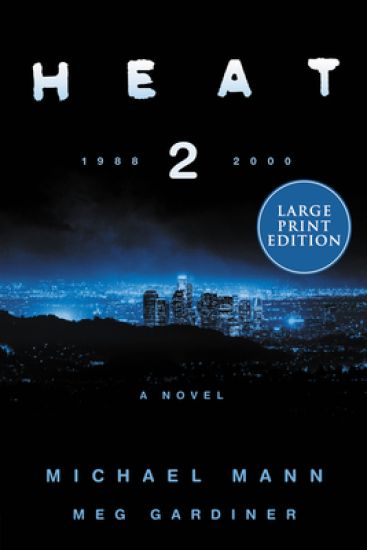
Instant #1 New York Times Bestseller Michael Mann, four-time-Oscar-nominated writer-director of The Last of the Mohicans, The Insider, Ali, Miami Vice, Collateral, and Heat teams up with Edgar Award-winning author Meg Gardiner to deliver Mann's first novel, an explosive return to the universe and characters of his classic crime film--with an all-new story unfolding in the years before and after the iconic movie"A hard-boiled, cinematic read that moves as fast as a well-planned heist." --EsquireOne day after the end of Heat, Chris Shiherlis (Val Kilmer) is holed up in Koreatown, wounded, half delirious, and desperately trying to escape LA. Hunting him is LAPD detective Vincent Hanna (Al Pacino). Hours earlier, Hanna killed Shiherlis's brother in arms Neil McCauley (Robert De Niro) in a gunfight under the strobe lights at the foot of an LAX runway. Now Hanna's determined to capture or kill Shiherlis, the last survivor of McCauley's crew, before he ghosts out of the city.In 1988, seven years earlier, McCauley, Shiherlis, and their highline crew are taking scores on the West Coast, the US-Mexican border, and now in Chicago. Driven, daring, they're pulling in money and living vivid lives. And Chicago homicide detective Vincent Hanna--a man unreconciled with his history--is following his calling, the pursuit of armed and dangerous men into the dark and wild places, hunting an ultraviolent gang of home invaders.Meanwhile, the fallout from McCauley's scores and Hanna's pursuit cause unexpected repercussions in a parallel narrative, driving through the years following Heat.Heat 2 projects its dimensional and richly drawn men and women into whole new worlds--from the inner sanctums of rival crime syndicates in a South American free-trade zone to transnational criminal enterprises in Southeast Asia. The novel brings you intimately into these lives. In Michael Mann's Heat universe, they will confront new adversaries in lethal circumstances beyond all boundaries.Heat 2 is engrossing, moving, and tragic--a masterpiece of crime fiction with the same extraordinary ambitions, scope, and rich characterizations as the epic film.
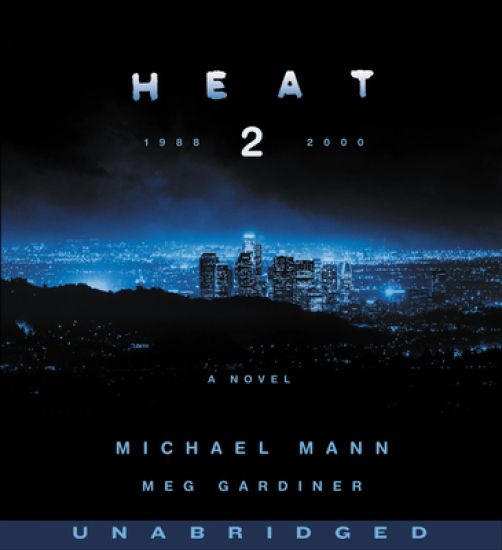
Instant #1 New York Times Bestseller Michael Mann, four-time-Oscar-nominated writer-director of The Last of the Mohicans, The Insider, Ali, Miami Vice, Collateral, and Heat teams up with Edgar Award-winning author Meg Gardiner to deliver Mann's first novel, an explosive return to the universe and characters of his classic crime film--with an all-new story unfolding in the years before and after the iconic movieOne day after the end of Heat, Chris Shiherlis (Val Kilmer) is holed up in Koreatown, wounded, half delirious, and desperately trying to escape LA. Hunting him is LAPD detective Vincent Hanna (Al Pacino). Hours earlier, Hanna killed Shiherlis's brother in arms Neil McCauley (De Niro) in a gunfight under the strobe lights at the foot of an LAX runway. Now Hanna's determined to capture or kill Shiherlis, the last survivor of McCauley's crew, before he ghosts out of the city.In 1988, seven years earlier, McCauley, Shiherlis, and their highline crew are taking scores on the West Coast, the US-Mexican border, and now in Chicago. Driven, daring, they're pulling in money and living vivid lives. And Chicago homicide detective Vincent Hanna--a man unreconciled with his history--is following his calling, the pursuit of armed and dangerous men into the dark and wild places, hunting an ultraviolent gang of home invaders.Meanwhile, the fallout from McCauley's scores and Hanna's pursuit cause unexpected repercussions in a parallel narrative, driving through the years following Heat.Heat 2 projects its dimensional and richly drawn men and women into whole new worlds--from the inner sanctums of rival crime syndicates in a South American free-trade zone to transnational criminal enterprises in Southeast Asia. The novel brings you intimately into these lives. In Michael Mann's Heat universe, they will confront new adversaries in lethal circumstances beyond all boundaries.Heat 2 is engrossing, moving, and tragic--a masterpiece of crime fiction with the same extraordinary ambitions, scope, and rich characterizations as the epic film.

Shortlisted for the Financial Times and McKinsey Business Book of the Year Award, and one of The Observer’s ‘Thirty books to help us understand the world’. Are we really to blame for the climate crisis? Over 70 per cent of global emissions come from the same 100 organisations, but fossil-fuel companies have taken no responsibility themselves. Instead, they have waged a 30-year campaign to blame individuals. The result has been disastrous for our planet. In The New Climate War, renowned scientist Michael E. Mann argues that all is not lost. He draws the battle lines between the people and the polluters — fossil-fuel companies, right-wing plutocrats, and petro-states — and outlines a plan for forcing our governments and corporations to wake up and make real change.

Catch the wind. Find your freedom. A riveting, magical adventure set deep underneath a richly reimagined London for 9+ readers.

'A superbly inventive and magical debut'Piers Torday 'Beautifully written and filled with unforgettable characters ... a diamond of a book'Ross MacKenzie'Utterly original, thrilling, strange and cracking good fun ... every chapter is packed full of wild imagination'Liz HyderCatch the wind. Find your freedom.A riveting, magical adventure set deep underneath a richly reimagined London for 9+ readers.Kidnapped and forced to shovel coal underneath a half-bombed, blackened power station, 12-year-old Luke's life is miserable. Then, he discovers he can see things others can't. Ghostly things. Specifically, a ghost-girl named Alma. Alma, who can ride clouds through the night sky and bend their shape to her will, befriends Luke. And with Alma's help, Luke discovers he is in fact a rare being - half-human and half-something else ...Then Luke learns the terrible truth of why children are being kidnapped and forced to work in the power station, and he becomes even more desperate to escape.Can Luke find out who he really is ... and find his freedom?A riveting, magical adventure set deep underneath a richly reimagined London by exciting debut author Michael Mann.

The award-winning climate scientist Michael E. Mann and the Pulitzer Prize–winning political cartoonist Tom Toles have been on the front lines of the fight against climate denialism for most of their careers. They have witnessed the manipulation of the media by business and political interests and the unconscionable play to partisanship on issues that affect the well-being of billions. The lessons they have learned have been invaluable, inspiring this brilliant, colorful escape hatch from the madhouse of the climate wars. The Madhouse Effect portrays the intellectual pretzels into which denialists must twist logic to explain away the clear evidence that human activity has changed Earth's climate. Toles's cartoons collapse counter-scientific strategies into their biased components, helping readers see how to best strike at these fallacies. Mann's expert skills at science communication aim to restore sanity to a debate that continues to rage against widely acknowledged scientific consensus. The synergy of these two climate science crusaders enlivens the gloom and doom of so many climate-themed books—and may even convert die-hard doubters to the side of sound science.
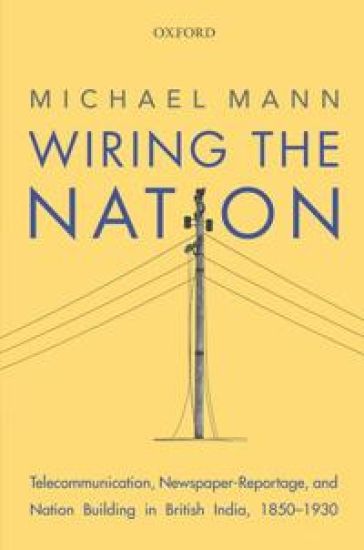
News today is understood as the most recent information available from places all over the world. It was the telegraph which gave birth to this understanding by profoundly transforming the global press landscape at the turn of the nineteenth century. Select information bought from agencies like Reuters, Wolff, Havas, and Associated Press made their way into newspapers-'news' became a commodity and journalism as we know it was born. In British India, after the Great Rebellion of 1857-8 and with the end of the Mughal dynasty, the concept of a shared cultural community was lost. In the decades that followed, telegraphically disseminated news played a leading role in shaping an all-India public sphere, in the process resurrecting the idea of a unified nation-an idea that formed the basis of the anti-colonial struggle launched soon after. As Wiring the Nation traces the social, cultural, and political consequences of the telegraph in colonial India, this new mode of communication emerges not merely as a technological marvel, but also as a force with the power to influence the imagination of an entire nation.


The award-winning climate scientist Michael E. Mann and the Pulitzer Prize-winning political cartoonist Tom Toles have been on the front lines of the fight against climate denialism for most of their careers. They have witnessed the manipulation of the media by business and political interests and the unconscionable play to partisanship on issues that affect the well-being of billions. The lessons they have learned have been invaluable, inspiring this brilliant, colorful escape hatch from the madhouse of the climate wars. The Madhouse Effect portrays the intellectual pretzels into which denialists must twist logic to explain away the clear evidence that human activity has changed Earth's climate. Toles's cartoons collapse counter-scientific strategies into their biased components, helping readers see how to best strike at these fallacies. Mann's expert skills at science communication aim to restore sanity to a debate that continues to rage against widely acknowledged scientific consensus. The synergy of these two climate science crusaders enlivens the gloom and doom of so many climate-themed books-and may even convert die-hard doubters to the side of sound science.

This comprehensive history of modern South Asia explores the historical development of the Subcontinent from the beginning of the eighteenth century to the present day from local and regional, as opposed to European, perspectives. Michael Mann charts the role of emerging states within the Mughal Empire, the gradual British colonial expansion in the political setting of the Subcontinent and shows how the modern state formation usually associated with Western Europe can be seen in some regions of India, linking Europe and South Asia together as part of a shared world history. This book looks beyond the Subcontinent’s post-colonial history to consider the political, economic, social and cultural development of Pakistan and Bangladesh as well as Sri Lanka and Nepal, and to examine how these developments impacted the region’s citizens.South Asia’s Modern History begins with a general introduction which provides a geographical, environmental and historiographical overview. This is followed by thematic chapters which discuss Empire Building and State Formation, Agriculture and Agro-Economy, Silviculture and Scientific Forestry, Migration, Circulation and Diaspora, Industrialisation and Urbanisation and Knowledge, Science, Technology and Power, demonstrating common themes across the decades and centuries. This book will be perfect for all students of South Asian history.

This comprehensive history of modern South Asia explores the historical development of the Subcontinent from the beginning of the eighteenth century to the present day from local and regional, as opposed to European, perspectives. Michael Mann charts the role of emerging states within the Mughal Empire, the gradual British colonial expansion in the political setting of the Subcontinent and shows how the modern state formation usually associated with Western Europe can be seen in some regions of India, linking Europe and South Asia together as part of a shared world history. This book looks beyond the Subcontinent’s post-colonial history to consider the political, economic, social and cultural development of Pakistan and Bangladesh as well as Sri Lanka and Nepal, and to examine how these developments impacted the region’s citizens.South Asia’s Modern History begins with a general introduction which provides a geographical, environmental and historiographical overview. This is followed by thematic chapters which discuss Empire Building and State Formation, Agriculture and Agro-Economy, Silviculture and Scientific Forestry, Migration, Circulation and Diaspora, Industrialisation and Urbanisation and Knowledge, Science, Technology and Power, demonstrating common themes across the decades and centuries. This book will be perfect for all students of South Asian history.
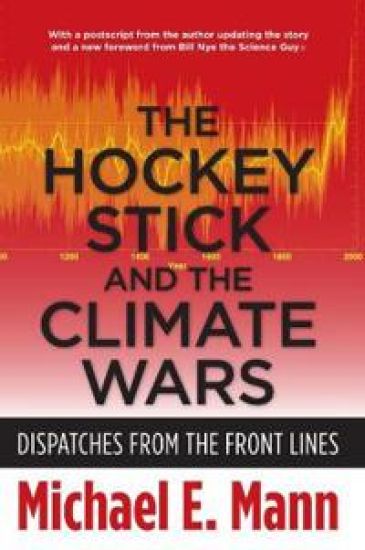
The ongoing assault on climate science in the United States has never been more aggressive, more blatant, or more widely publicized than in the case of the Hockey Stick graph-a clear and compelling visual presentation of scientific data, put together by MichaelE. Mann and his colleagues, demonstrating that global temperatures have risen in conjunction with the increase in industrialization and the use of fossil fuels. Here was an easy-to-understand graph that, in a glance, posed a threat to major corporate energy interests and those who do their political bidding. The stakes were simply too high to ignore the Hockey Stick-and so began a relentless attack on a body of science and on the investigators whose work formed its scientific basis. The Hockey Stick achieved prominence in a 2001 UN report on climate change and quickly became a central icon in the "climate wars." The real issue has never been the graph's data but rather its implied threat to those who oppose governmental regulation and other restraints to protect the environment and planet. Mann, lead author of the original paper in which the Hockey Stick first appeared, shares the story of the science and politics behind this controversy. He reveals key figures in the oil and energy industries and the media frontgroups who do their bidding in sometimes slick, sometimes bare-knuckled ways. Mann concludes with the real story of the 2009 "Climategate" scandal, in which climate scientists' emails were hacked. This is essential reading for all who care about our planet's health and our own well-being.

The Sources of Social Power: Volume 4, Globalizations, 1945–2011
Michael Mann
Cambridge University Press
2013
sidottu
Distinguishing four sources of power – ideological, economic, military and political – this series traces their interrelations throughout human history. This fourth volume covers the period from 1945 to the present, focusing on the three major pillars of post-war global order: capitalism, the nation-state system and the sole remaining empire of the world, the United States. In the course of this period, capitalism, nation-states and empires interacted with one another and were transformed. Mann's key argument is that globalization is not just a single process, because there are globalizations of all four sources of social power, each of which has a different rhythm of development. Topics include the rise and beginnings of decline of the American Empire, the fall or transformation of communism (respectively, the Soviet Union and China), the shift from neo-Keynesianism to neoliberalism, and the three great crises emerging in this period – nuclear weapons, the great recession and climate change.
The Sources of Social Power: Volume 4, Globalizations, 1945–2011
Michael Mann
Cambridge University Press
2012
pokkari
Distinguishing four sources of power – ideological, economic, military and political – this series traces their interrelations throughout human history. This fourth volume covers the period from 1945 to the present, focusing on the three major pillars of post-war global order: capitalism, the nation-state system and the sole remaining empire of the world, the United States. In the course of this period, capitalism, nation-states and empires interacted with one another and were transformed. Mann's key argument is that globalization is not just a single process, because there are globalizations of all four sources of social power, each of which has a different rhythm of development. Topics include the rise and beginnings of decline of the American Empire, the fall or transformation of communism (respectively, the Soviet Union and China), the shift from neo-Keynesianism to neoliberalism, and the three great crises emerging in this period – nuclear weapons, the great recession and climate change.
The Sources of Social Power: Volume 2, The Rise of Classes and Nation-States, 1760–1914
Michael Mann
Cambridge University Press
2012
sidottu
Distinguishing four sources of power in human societies - ideological, economic, military and political - The Sources of Social Power traces their interrelations throughout human history. This second volume deals with power relations between the Industrial Revolution and the First World War, focusing on France, Great Britain, Hapsburg Austria, Prussia/Germany and the United States. Based on considerable empirical research, it provides original theories of the rise of nations and nationalism, of class conflict, of the modern state and of modern militarism. While not afraid to generalize, it also stresses social and historical complexity. Michael Mann sees human society as 'a patterned mess' and attempts to provide a sociological theory appropriate to this, his final chapter giving an original explanation of the causes of the First World War. First published in 1993, this new edition of Volume 2 includes a new preface by the author examining the impact and legacy of the work.
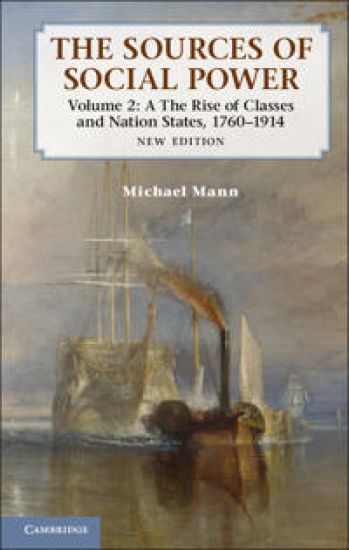
The Sources of Social Power: Volume 2, The Rise of Classes and Nation-States, 1760–1914
Michael Mann
Cambridge University Press
2012
pokkari
Distinguishing four sources of power in human societies - ideological, economic, military and political - The Sources of Social Power traces their interrelations throughout human history. This second volume deals with power relations between the Industrial Revolution and the First World War, focusing on France, Great Britain, Hapsburg Austria, Prussia/Germany and the United States. Based on considerable empirical research, it provides original theories of the rise of nations and nationalism, of class conflict, of the modern state and of modern militarism. While not afraid to generalize, it also stresses social and historical complexity. Michael Mann sees human society as 'a patterned mess' and attempts to provide a sociological theory appropriate to this, his final chapter giving an original explanation of the causes of the First World War. First published in 1993, this new edition of Volume 2 includes a new preface by the author examining the impact and legacy of the work.