Kirjailija
Michael Marder
Kirjat ja teokset yhdessä paikassa: 47 kirjaa, julkaisuja vuosilta 2010-2026, suosituimpien joukossa The Phoenix Complex. Vertaile teosten hintoja ja tarkista saatavuus suomalaisista kirjakaupoista.
47 kirjaa
Kirjojen julkaisuhaarukka 2010-2026.
Flowers of Fire is a poetic and experimental collaboration between artist Anaïs Tondeur and philosopher Michael Marder, created during a residency in Naples in dialogue with scientists and the inhabitants of the Terra dei Fuochi. The project intertwines photography, ecology, and philosophy to address a landscape marked by pollution and environmental trauma. Using an innovative technique of phytography, Tondeur lets plants imprint their own presence onto photosensitive paper and textiles recovered from landfills—images born from sunlight, soil, and vegetal touch. Marder responds with letters addressed to the plants, read aloud by the artist in a ritual of correspondence and care. Together, their dialogue gives form to an ethics of listening and reciprocity between human and vegetal life. Both artwork and ecological meditation, Flowers of Fire invites us to imagine new bonds of responsibility with the living world.
Pyropolitics
Michael Marder; Slavoj Z?iz?ek
ibidem-Verlag, Jessica Haunschild u Christian Schon
2025
nidottu
From the books and heretics burnt on the pyres of the Inquisition to self-immolations at protest rallies, from the massive burning of oil on the global scale to inflammatory speech, from the imagery of revolutionary sparks ready to ignite the spirits of the oppressed to car bombings in the Middle East—fire proves to be an indispensable element of the political. To account for this elemental source of heat and light, Pyropolitics delineates a semantico-discursive field, replete with the literal and metaphorical mentions and uses of fires, flames, sparks, immolations, incinerations, and burning in political theory and practices. Relying on classical political theory, literature, theology, contemporary philosophy, and an analysis of current events, Michael Marder argues that geopolitics, or the politics of the Earth, has always had an unstable, at once shadowy and blinding, underside-pyropolitics, or the politics of fire. If this obscure double of geopolitics is, increasingly, dictating the rules of the game today, then it is crucial to learn to speak its language, to discern its manifestations, and to project where our world ablaze is heading.
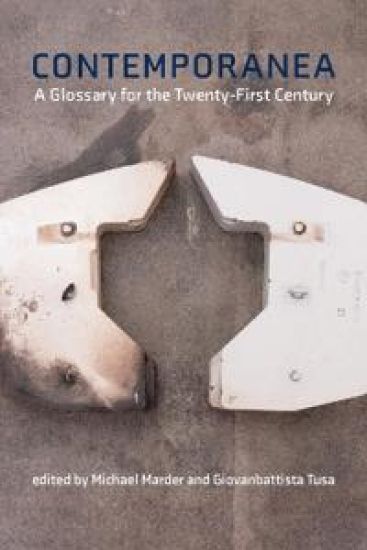
A groundbreaking, multidisciplinary collection that rethinks our present moment and anticipates the key concepts that will shape and direct the twenty-first century.Contemporanea is a nascent lexicon for the twenty-first century edited by seasoned philosophers and authors Michael Marder and Giovanbattista Tusa. The collection showcases perspectives from a range of noteworthy thinkers in philosophy, ecology, and cultural studies, as well as artists, from across the globe, including Slavoj Zizek, Timothy Morton, Denise Ferreira Da Silva, and Vandana Shiva, who each describe what they anticipate will be the concepts shaping the trajectory of this century—everything from the world state to the nuclear taboo, automation to Teslaism, plant sexuality to arachnomancy, and ecotrauma to resonances, to name a few.This century, as the editors explain, has to date grounded itself in the debris of the preceding century, whose revolutions and struggles failed to transform our time: post-colonialism, post-fascism, and post-liberalism have morphed into neocolonialism, neoliberalism, and neofascism, often combined in a previously unimaginable mix. And, just as the political developments at the beginning of the twenty-first century revived and reshuffled those of the preceding epoch, so too have philosophical trends sought to breathe fresh life into the stillborn -isms of the past—realism, vitalism, logicism, materialism, empiricism, criticism—adding the adjective “new” and sometimes “radical” before them. To articulate a different future, another language is needed. And, to develop another language, one needs to develop fresh concepts, including the concepts proposed in this collection.ContributorsMieke Bal, Claudia Baracchi, Amanda Boetzkes, Erik Bordeleau, Anita Chari, Emanuele Coccia, Valentina Desideri, Roberto Esposito, Filipe Ferreira, Denise Ferreira da Silva, Claire Fontaine, Graham Harman, Yogi Hale Hendlin, Ranjit Hoskote, Cymene Howe, Daniel Innerarity, Joela Jacobs, Ken Kawashima, Sabu Kohso, Bogna Konior, Brandon LaBelle, Anna Longo, Artemy Magun, Michael Marder, Michael Marder, Jason Bahbak Mohaghegh, Timothy Morton, Mycelium, Jean-Luc Nancy, Bahar Noorizadeh, Kelly Oliver, Uriel Orlow, Richard Polt, Marcia Sá Cavalcante Schuback, Tomás Saraceno, Vandana Shiva, Anton Tarasyuk, Anaïs Tondeur, Giovanbattista Tusa, Sjoerd van Tuinen, Santiago Zabala, Zahi Zalloua, Slavoj Žižek
Filosoofia äärealadel elab hulganisti olevusi, kes ei ole inimesed ega loomad, teiste seas leiame sealt ka taimed. Tänapäeva filosoofid hoiduvad enamasti taimse elu kohta ontoloogilisi ja eetilisi küsimusi tõstatamast, aga Michael Marder seab selles raamatus just taimse elu metafüüsika dekonstruktsiooni esiplaanile. Ta joonistab välja taime elu eksistentsiaalse mõõtme ja inimese mõtlemise taimse algupära, et kinnitada taimede potentsiaali üldistavale loogikale vastu panna ja otstarbekesksuse kitsastest piiridest üle astuda. Taimede "metafüüsikajärgset" elu rekonstrueerides keskendub Marder nende iseloomulikule ajalisusele, vabadusele ja ainelisele teadmisele, mida võiks ehk nimetada ka tarkuseks. "Taimmõtlemine" on tema jaoks mittekognitiivne, mitteideatsiooniline ja mittepildiline mõtlemise viis, mis on taimedele iseloomulik, ühtlasi tähistab see inimese mõtte tagasipöördumist juurte juurde ja lähenemist taimedele.Michael Marder (snd 1980 Moskvas) on filosoof ning Baskimaa Ülikooli filosoofiaprofessor, kelle uurimistöö keskendub fenomenoloogilise traditsiooni toel keskkonnafilosoofiale ja poliitikateooriale. Ta on kirjutanud rea raamatuid vegetaalse elu filosoofiast, milles pöörab põhjalikult tähelepanu taimede olemisviisidele.
Plants are commonly considered immobile, in contrast to humans and other animals. But vegetal existence involves many place-based forms of change: stems growing upward, roots spreading outward, fronds unfurling in response to sunlight, seeds traveling across wide distances, and other intricate relationships with the surrounding world. How do plants as sessile, growing, decaying, and metamorphosing beings shape the places they inhabit, and how are they shaped by them? How do human places interact with those of plants—in lived experience; in landscape painting; in cultivation and contemplation; in forests, fields, gardens, and cities?Examining these questions and many more, Plants in Place is a collaborative study of vegetal phenomenology at the intersection of Edward S. Casey’s phenomenology of place and Michael Marder’s plant-thinking. It focuses on both the microlevel of the dynamic constitution of plant edges or a child’s engagement with moss and the macrolevel of habitats that include the sociality of trees. This compelling portrait of plants and their places provides readers with new ways to appreciate the complexity and vitality of vegetal life. Eloquent, descriptively rich, and insightful, the book also shows how the worlds of plants can enhance our understanding and experience of place more broadly.
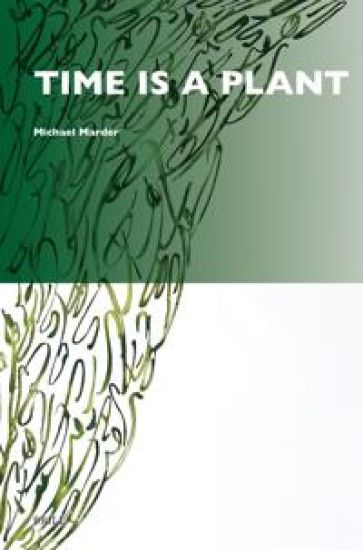
"Our" world is vegetal. None of it would have been in existence were it not for the life activity of plants. Time, discernible in the rhythms, intervals, logics, articulations, and disarticulations of the world, is the time of plants. Starting from scientific, philosophical, and theological insights into the time of plants, Michael Marder's new study gently steers readers toward the vegetality of time. Specters and spirits, cosmic trees and phytogenesis, the vegetal apriori and weird chronos, the seeds of events and the branches of divergent chronologies, diachronic phases and symbiotic assemblages join the rich tapestry of this work to proclaim, Time is a plant "Michael Marder's Time Is a Plant is philosophy at its most productive. As far as imaginable from the postmodern conundrum, it states its premise openly in its title and elaborates it in a clear way with impeccable logic. The life of a plant in all its alterations, its generation and decay, is treated as more than just a metaphor of time: it renders visible the innermost structure of the deployment of time. What makes Marder's book unique is the very feature that makes it na ve in the best sense of the term: Marder ignores all the endless self-reflexive precautions that characterize much of contemporary thought and simply plunges into basic ontological considerations. Time Is a Plant is a breath of fresh air in our stale philosophical scene. It proves that a thing can be done by simply doing it." -Slavoj Zizek, author of Surplus-Enjoyment: A Guide for the Non-Perplexed (2022) and Freedom: A Disease without Cure (2023)
Notes on Ex-Futures
Johanna Gustafsson Fürst; Asier Mendizabal; Michael Marder
Praun Guermouche
2023
nidottu
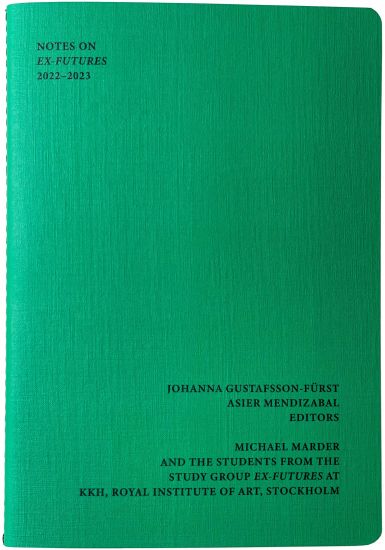
Notes on Ex-Futures contains a description of the process by Johanna Gustafsson Fürst, the text by Asier Mendizabal that formed the starting point of the project, and a text by philosopher Michael Marder who, as part of this process, held a lecture at the Royal Institute of Art. But first and foremost, it is a compilation of reactions and reflections from a group of art students. Contributors in alphabetical order: Annie Åkerman, Tilde Björk, Sarali Borg, Leona Cauklija, Zeynep Çolpan, Stella Dieden Richter, Philip Dufva, Viktoria Ekdahl, Axel Gagge, Johanna Gustafsson Fürst, Sanna Håkans, Anna Heymowska, Manju Jatta, Vladyslav Kamensky, Nicole Khadivi, Johanna Kindahl, Olga Krüssenberg, Andrea Larsson, Linnea Lindberg, Sebastian Lindén, Johan Lundborg, Lina Lundquist, Michael Marder, Mari Mattsson, Asier Mendizabal, Kayo Mpoyi, Kristina Nenzén, Christopher Robin Nordström, David Permén, Ebba Rost, Sonia Sagan, Ossian Söderqvist, Erik Thörnqvist, Aex Valijani, Andreas Widoff, Hedvig Wijkström, Sofia Zwahlen
Ilden viser seg å være et uunnværlig element i politikken - fra bøker og heretikere som gikk opp i flammer på inkvisisjonens bål til demonstranter som tenner på seg selv, fra forbruket av fossilt brensel til flammende taler, fra revolusjonens gnist som skal antenne de undertrykte, til bilbomber og den brente jords taktikk. Med utgangspunkt i politisk teori, teologi, filosofi, litteratur og film argumenterer den canadiske filosofen Michael Marder for at geopolitikk, eller jordens politikk, alltid har hatt pyropolitikken, eller ildens politikk, som sin ustabile underside. Hvis pyropolitikken, som geopolitikkens obskure dobbeltgjenger, i økende grad dikterer spillereglene i verden i dag, er det avgjørende at vi lærer å snakke dens språk, at vi forstår hvordan den manifesterer seg, og at vi reflekterer over hvor dagens brennende verden er på vei.
Spanning a decade of Michael Marder’s contributions as a public intellectual, Senses of Upheavals documents a period of exceptional global turmoil. Thrown into mayhem by right-wing populisms and a pandemic, combined with skyrocketing economic inequalities and worsening environmental crises, the world is on the verge of collapse. Could revolutionary practical-intellectual proposals to learn how to coexist from plants or to rethink the very meaning of energy chart the way to a better, more livable, and, perhaps, calmer world? Nonetheless, such proposals themselves constitute nothing short of an upheaval in philosophy, plant sciences, and environmental studies. We are doomed to upheavals, it seems; the point is not to deflect, but to choose judiciously among them.
Green Mass is a meditation on—and with—twelfth-century Christian mystic and polymath Saint Hildegard of Bingen. Attending to Hildegard's vegetal vision, which greens theological tradition and imbues plant life with spirit, philosopher Michael Marder uncovers a verdant mode of thinking. The book stages a fresh encounter between present-day and premodern concerns, ecology and theology, philosophy and mysticism, the material and the spiritual, in word and sound. Hildegard's lush notion of viriditas, the vegetal power of creation, is emblematic of her deeply entwined understanding of physical reality and spiritual elevation. From blossoming flora to burning desert, Marder plays with the symphonic multiplicity of meanings in her thought, listening to the resonances between the ardency of holy fire and the aridity of a world aflame. Across Hildegard's cosmos, we hear the anarchic proliferation of her ecological theology, in which both God and greening are circular, without beginning or end. Introduced with a foreword by philosopher Marcia Sá Cavalcante Schuback and accompanied by cellist Peter Schuback's musical movements, which echo both Hildegard's own compositions and key themes in each chapter of the book, this multifaceted work creates a resonance chamber, in which to discover the living world anew. The original compositions accompanying each chapter are available free for streaming and for download at www.sup.org/greenmass
Hegel’s The Phenomenology of Spirit has been one of the most important works of philosophy since the nineteenth century, while the question of energy has been crucial to life in the twenty-first century. In this book, Michael Marder integrates the two, narrating a story about the trials and tribulations of energy embedded in Hegel’s dialectics. Through an original interpretation of actuality (Wirklichkeit) as energy in the Hegelian corpus, the book provides an exciting lens for understanding the dialectical project and the energy-starved condition of our contemporaneity. To elaborate this theory, Marder undertakes a meticulous rereading of major parts of the Phenomenology, where the energy deficit of mere consciousness gives way to the energy surplus of self-consciousness and its self-delimitation in the domain of reason. In so doing, he denounces the current understanding of energy as pure potentiality, linking this mindset to pollution, profit-driven economies, and environmental crises. Surprising and deeply engaged with its contemporary implications, this book doesn’t simply illuminate aspects of The Phenomenology of Spirit — it provides an entirely new understanding of Hegel’s ideas.
From books and heretics burnt on the pyres of the Inquisition to self-immolations at protest rallies, from the burning of fossil fuels to inflammatory speech, from the imagery of revolutionary sparks ready to ignite the spirits of the oppressed to car bombings and “scorched earth” policy, fire proves to be an indispensable element of the political. Pyropolitics in the World Ablaze builds upon the scintillating, by turns horrifying and hopeful, images and realities of flames, hearths, sparks, immolations, melting pots, incinerations, and burning in political thought and practices. Relying on classical political theory, theology, philosophy, literature and cinema, as well as an analysis of current events, Michael Marder argues that geo-politics, or the politics of the Earth, has always had an unstable, at once shadowy and blinding, underside—pyro-politics, or the politics of fire. If this obscure double of geopolitics is increasingly dictating the rules of the game today, then it is crucial to learn to speak its language, to discern its manifestations and to project where our world ablaze is heading.
Understanding the political and ecological implications of Heidegger’s work without ignoring his noxious public engagements The most controversial philosopher of the twentieth century, Martin Heidegger has influenced generations of intellectuals even as his involvement with Nazism and blatant anti-Semitism, made even clearer after the publication of his Black Notebooks, have recently prompted some to discard his contributions entirely. For Michael Marder, Heidegger’s thought remains critical for interpretations of contemporary politics and our relation to the natural environment.Bringing together and reframing more than a decade of Marder’s work on Heidegger, this volume questions the wholesale rejection of Heidegger, arguing that dismissive readings of his project overlook the fact that it is impossible to grasp without appreciating his lifelong commitment to phenomenology and that Heidegger’s anti-Semitism is an aberration in his still-relevant ecological and political thought, rather than a defining characteristic. Through close readings of Heidegger’s books and seminars, along with writings by other key phenomenologists and political philosophers, Marder contends that neither Heidegger’s politics nor his reflections on ecology should be considered in isolation from his phenomenology. By demonstrating the codetermination of his phenomenological, ecological, and political thinking, Marder accounts for Heidegger’s failures without either justifying them or suggesting that they invalidate his philosophical endeavor as a whole.
Grafting: do we ever do anything other than that? And are we ever free from vegetal influences when we engage in its operations? For the philosopher Michael Marder, our reflections on vegetal life have a fundamental importance in how we can reflect on our own conceptions of ethics, politics, and philosophy in general. Taking as his starting point the simple vegetal conception of grafting, Marder guides the reader through his concise and numerous reflections on what could be described as a vegetal philosophy. Grafts are transplants either of a shoot inserted into the trunk of another tree or, surgically, of skin (among other living tissues). They are delicate operations intended to preserve, improve, and modify both the grafted materials and the body that receives them. To graft is to create unlikely encounters, hybrid mixes, and novel surfaces. Moving across disciplinary lines, Grafts combines the lessons of plant science with the history of philosophy, semiotics, literary compositions, and political theory. Co-authoring some of the texts with other philosophers, plant scientists and artists, Marder allows their insights to be grafted onto his own, and vice versa. Weighing in on contemporary debates such as the ethics of biotechnology, dietary practices or political organization, Marder inserts an unmistakable vegetal perspective into topics of discussion where it normally wouldnt be found. Transferring the living tissue of his own texts into another context, he helps them live better, more fully, than otherwise.
Blossoming from a correspondence between Luce Irigaray and Michael Marder, Through Vegetal Being is an intense personal, philosophical, and political meditation on the significance of the vegetal for our lives, our ways of thinking, and our relations with human and nonhuman beings. The vegetal world has the potential to rescue our planet and our species and offers us a way to abandon past metaphysics without falling into nihilism. Luce Irigaray has argued in her philosophical work that living and coexisting are deficient unless we recognize sexuate difference as a crucial dimension of our existence. Michael Marder believes the same is true for vegetal difference. Irigaray and Marder consider how plants contribute to human development by sustaining our breathing, nourishing our senses, and keeping our bodies and minds alive. They note the importance of returning to ancient Greek tradition and engaging with Eastern teachings to revive a culture closer to nature. As a result, we can reestablish roots when we are displaced and recover the vital energy we need to improve our sensibility and relation to others. This generative discussion points toward a more universal way of becoming human that is embedded in the vegetal world.