Kirjojen hintavertailu. Mukana 12 458 264 kirjaa ja 12 kauppaa.

Kirjailija

Michael R. Auslin

Kirjat ja teokset yhdessä paikassa: 6 kirjaa, julkaisuja vuosilta 1972-2020, suosituimpien joukossa The Meiji Restoration. Vertaile teosten hintoja ja tarkista saatavuus suomalaisista kirjakaupoista.

6 kirjaa

Kirjojen julkaisuhaarukka 1972-2020.

The Meiji Restoration

The Meiji Restoration

W. G. Beasley; Michael R. Auslin

Stanford University Press
1972
sidottu
For Japan, the Meiji Restoration of 1868 has something of the significance that the French Revolution has for France: it is the point from which modern history begins. In this now classic work of Japanese history, the late W. G. Beasley offers a comprehensive account of the origins, development, and immediate aftermath of the events that restored Imperial rule to Japan. He makes the case that the origins of the Meiji Restoration are not found in economic distress or class struggle, but in a growing sense of national danger and national pride spurred by Japan's contacts with the West. Nationalism provided the impetus for overthrowing the Tokugawa military government and reuniting Japan under the Emperor Meiji. Only when the Tokugawa were gone did their successors turn, of necessity, to the making of modern Japan, seeking strength and stability in new social patterns. Originally published in 1972, this new paperback edition contains a foreword written by Michael R. Auslin that celebrates Beasley's legacy.
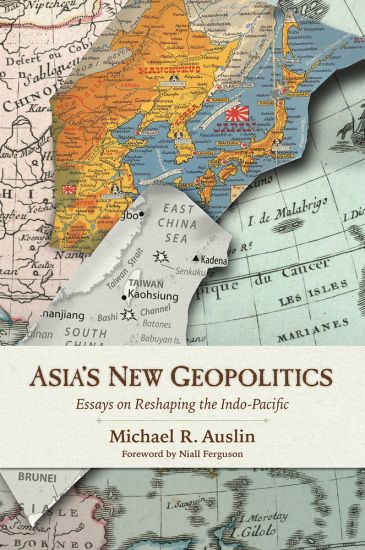
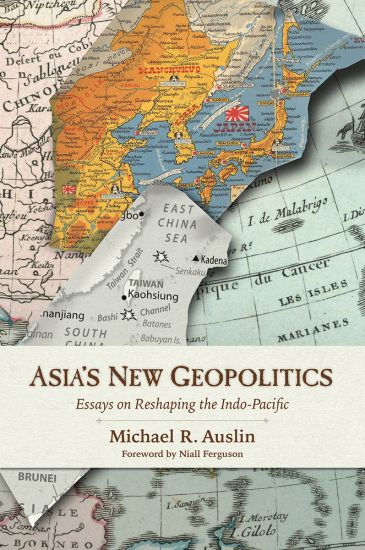
Asia's New Geopolitics

Asia's New Geopolitics

Michael R. Auslin

Hoover Institution Press,U.S.
2020
nidottu
The Indo-Pacific is fast becoming the world's dominant region. As it grows in power and wealth, geopolitical competition has reemerged, threatening future stability not merely in Asia but around the globe. China is aggressive and uncooperative, and increasingly expects the world to bend to its wishes. The focus on Sino-US competition for global power has obscured 'Asia's other great game': the rivalry between Japan and China. A modernizing India risks missing out on the energies and talents of millions of its women, potentially hampering the broader role it can play in the world. And in North Korea, the most frightening question raised by Kim Jong-un's pursuit of the ultimate weapon is also the simplest: can he control his nukes? In Asia's New Geopolitics: Essays on Reshaping the Indo-Pacific, Michael R. Auslin examines these and other key issues transforming the Indo-Pacific and the broader world. He also explores the history of American strategy in Asia from the 18th century through today. Taken together, Auslin's essays convey the richness and diversity of the region: with more than three billion people, the Indo-Pacific contains over half of the global population, including the world's two most populous nations: India and China. In a riveting final chapter, Auslin imagines a war between America and China in a bid for regional hegemony and what this conflict might look like.
Asia's New Geopolitics

Asia's New Geopolitics

Michael R. Auslin

Hoover Institution Press,U.S.
2020
sidottu
The Indo-Pacific is fast becoming the world's dominant region. Now, as it grows in power and wealth, geopolitical competition has reemerged, threatening future stability not merely in Asia but around the globe. China is aggressive and uncooperative, and increasingly expects the world to bend to its wishes. The focus on Sino-US competition for global power has obscured 'Asia's other great game': the rivalry between Japan and China. A modernizing India risks missing out on the energies and talents of millions of its women, potentially hampering the broader role it can play in the world. And in North Korea, the most frightening question raised by Kim Jong-un's pursuit of the ultimate weapon is also the simplest: can he control his nukes? In Asia's New Geopolitics: Essays on Reshaping the Indo-Pacific, Michael R. Auslin examines these and other key issues transforming the Indo-Pacific and the broader world. He also explores the history of American strategy in Asia, from the 18th century through today. Taken together, Auslin's essays convey the richness and diversity of the region: with more than three billion people, the Indo-Pacific contains over half of the global population, including the world's two most populous nations, India and China. In a riveting final chapter, Auslin imagines a war between America and China in a bid for regional hegemony and what this conflict might look like.
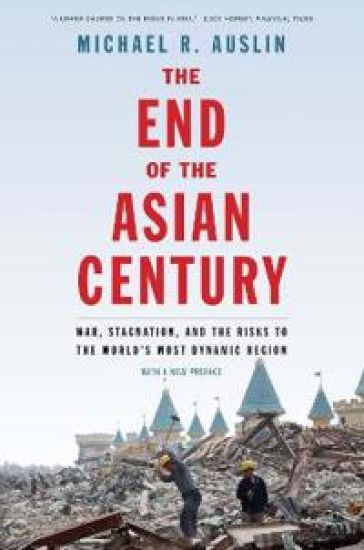
The End of the Asian Century

The End of the Asian Century

Michael R. Auslin

Yale University Press
2018
pokkari
An urgently needed “risk map” of the many dangers that could derail Asia’s growth and stability"A point-by-point debunking of the 'Asiaphoria' that gripped so many imaginations a decade ago . . . Auslin argues that the conditions are building for major-power conflict in Asia and the Pacific."—David Frum, Atlantic Since Marco Polo, the West has waited for the “Asian Century.” Today, the world believes that Century has arrived. Yet from China’s slumping economy to war clouds over the South China Sea and from environmental devastation to demographic crisis, Asia’s future is increasingly uncertain. Historian and geopolitical expert Michael Auslin argues that far from being a cohesive powerhouse, Asia is a fractured region threatened by stagnation and instability. Here, he provides a comprehensive account of the economic, military, political, and demographic risks that bedevil half of our world, arguing that Asia, working with the United States, has a unique opportunity to avert catastrophe – but only if it acts boldly. Bringing together firsthand observations and decades of research, Auslin’s provocative reassessment of Asia’s future will be a must-read for industry and investors, as well as politicians and scholars, for years to come.
The Meiji Restoration

The Meiji Restoration

W. G. Beasley; Michael R. Auslin

Stanford University Press
2018
pokkari
For Japan, the Meiji Restoration of 1868 has something of the significance that the French Revolution has for France: it is the point from which modern history begins. In this now classic work of Japanese history, the late W. G. Beasley offers a comprehensive account of the origins, development, and immediate aftermath of the events that restored Imperial rule to Japan. He makes the case that the origins of the Meiji Restoration are not found in economic distress or class struggle, but in a growing sense of national danger and national pride spurred by Japan's contacts with the West. Nationalism provided the impetus for overthrowing the Tokugawa military government and reuniting Japan under the Emperor Meiji. Only when the Tokugawa were gone did their successors turn, of necessity, to the making of modern Japan, seeking strength and stability in new social patterns. Originally published in 1972, this new paperback edition contains a foreword written by Michael R. Auslin that celebrates Beasley's legacy.
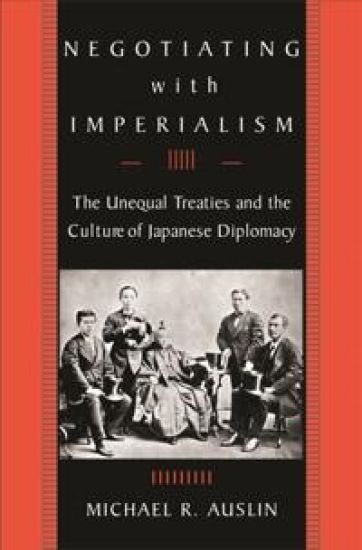
Negotiating with Imperialism

Negotiating with Imperialism

Michael R. Auslin

Harvard University Press
2006
nidottu
Japan's modern international history began in 1858 with the signing of the "unequal" commercial treaty with the United States. Over the next fifteen years, Japanese diplomacy was reshaped to respond to the Western imperialist challenge. Negotiating with Imperialism is the first book to explain the emergence of modern Japan through this early period of treaty relations.Michael Auslin dispels the myth that the Tokugawa bakufu was diplomatically incompetent. Refusing to surrender to the West's power, bakufu diplomats employed negotiation as a weapon to defend Japan's interests. Tracing various visions of Japan's international identity, Auslin examines the evolution of the culture of Japanese diplomacy. Further, he demonstrates the limits of nineteenth-century imperialist power by examining the responses of British, French, and American diplomats. After replacing the Tokugawa in 1868, Meiji leaders initially utilized bakufu tactics. However, their 1872 failure to revise the treaties led them to focus on domestic reform as a way of maintaining independence and gaining equality with the West.In a compelling analysis of the interplay among assassinations, Western bombardment of Japanese cities, fertile cultural exchange, and intellectual discovery, Auslin offers a persuasive reading of the birth of modern Japan and its struggle to determine its future relations with the world.