Kirjojen hintavertailu. Mukana 12 657 676 kirjaa ja 12 kauppaa.

Kirjailija

Michael S. Shur

Kirjat ja teokset yhdessä paikassa: 11 kirjaa, julkaisuja vuosilta 1987-2024, suosituimpien joukossa Introduction to Device Modeling and Circuit Simulation. Vertaile teosten hintoja ja tarkista saatavuus suomalaisista kirjakaupoista.

Mukana myös kirjoitusasut: Michael S Shur

11 kirjaa

Kirjojen julkaisuhaarukka 1987-2024.

Introduction to Device Modeling and Circuit Simulation

Introduction to Device Modeling and Circuit Simulation

Tor A. Fjeldly; Trond Ytterdal; Michael S. Shur

John Wiley Sons Inc
1997
sidottu
A detailed guide to SPICE-oriented design and testing of electronic devices SPICE allows engineers to simulate individual semiconductor devices and electronic circuits and to perform the large number of different analyses needed for tasks such as verification of circuit designs and prediction of circuit performance. However, these simulations are only as good as the device models and parameters used in the simulations. Wrong models yield unreliable results. Introduction to Device Modeling and Circuit Simulation links electronic device modeling to simulation of these devices using the SPICE program. Ideal as a reference for professional engineers or as a text for courses in semiconductor device modeling, it presents*A combination of background device physics and technology*A review of existing device models*A set of new and improved models compatible with the most advanced technology*Descriptions of device models and examples of circuit simulationsFollowing an introduction to SPICE, this book covers charge transport in semiconductors, two-terminal devices, bipolar junction transistors, field effect transistors, and advanced FET modeling. With its concentration on modeling and simulation, Introduction to Device Modeling and Circuit Simulation is the core book on SPICE-oriented semiconductor device modeling.

Oxide Thin Film Transistors

Oxide Thin Film Transistors

Yue Kuo; Hideo Hosono; Michael S. Shur; Jin Jang

JOHN WILEY SONS INC
2024
sidottu
Comprehensive resource reviewing fundamentals, device physics and reliability, fabrication processes, and numerous emerging applications of oxide thin film transistor technology over performing traditional thin film transistor technologies Oxide Thin Film Transistors book presents a comprehensive overview of oxide thin film transistor (TFT) science and technology, including fundamental material properties, device operation principles, modeling, fabrication processes, and applications. Split into four sections, the book first details oxide TFT materials including material parameters, and electrical and contact properties. The next section describes oxide TFT devices including designs, reliability, and comparison with other TFT types. The third part delves into the fabrication processes of oxide TFTs. The last section provides insight into existing and emerging applications of oxide TFTs including displays, imagers, circuits, sensors, flexible electronics, and circuits. Written by a team of well-reputed researchers in the field including the inventor of the IGZO TFT, Oxide Thin Film Transistors include information on: Electronic and crystal structure of widegap oxides, covering electronic structure of n- and p-type oxide semiconductors as well as doping limit and band alignmentDevice physics, covering operation principles, reliability, comparison with other TFT types, and high-frequency performanceFabrication processes, covering deposition methods, gate insulators, and passivation layersApplications, covering liquid crystal, light emitting diode, and electrophoretic displays, flexible electronics, imagers, and integrated circuits Oxide Thin Film Transistors is an ideal textbook resource for students who want to learn about oxide TFTs and a useful, up-to-date reference for researchers and engineers working on oxide TFTs and in related areas.
Introduction to Solid-State Lighting

Introduction to Solid-State Lighting

Arturas Zukauskas; Michael S. Shur; Remis Gaska

John Wiley Sons Inc
2015
muu
A thorough reference that sheds light on the promising field of solid-state lighting. Solid-state lighting is a rapidly emerging field. Light emitting diodes are already used in traffic signals, signage/contour lighting, large area displays, and automotive applications. But its greatest future lies in the possibility of applying solid-state lamps to general lighting. Solid-state lighting promises to reduce energy consumption as much as fifty percent, cut down on carbon-dioxide emission, and even spur the development of a completely new lighting industry. Giving this important emerging field the attention it deserves, "Introduction to Solid-State Lighting" comprehensively covers: the history of lighting; the characterization of visible light; conventional light sources; LED basics; extraction of light from high-brightness LEDs; White LED; applications of solid-state lamps.
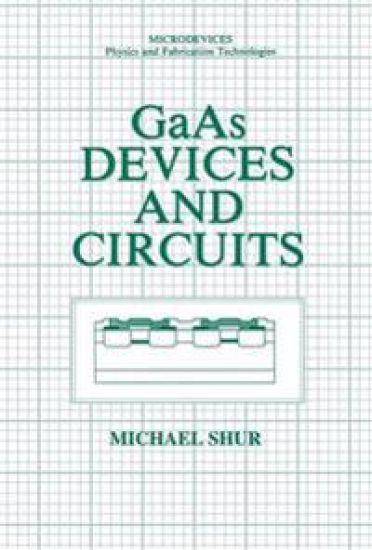
GaAs Devices and Circuits

GaAs Devices and Circuits

Michael S. Shur

Springer-Verlag New York Inc.
2013
nidottu
GaAs devices and integrated circuits have emerged as leading contenders for ultra-high-speed applications. This book is intended to be a reference for a rapidly growing GaAs community of researchers and graduate students. It was written over several years and parts of it were used for courses on GaAs devices and integrated circuits and on heterojunction GaAs devices developed and taught at the University of Minnesota. Many people helped me in writing this book. I would like to express my deep gratitude to Professor Lester Eastman of Cornell University, whose ideas and thoughts inspired me and helped to determine the direction of my research work for many years. I also benefited from numerous discussions with his students and associates and from the very atmosphere of the pursuit of excellence which exists in his group. I would like to thank my former and present co-workers and colleagues-Drs. Levinstein and Gelmont of the A. F. Ioffe Institute of Physics and Technology, Professor Melvin Shaw of Wayne State University, Dr. Kastalsky of Bell Communi­ cations, Professor Gary Robinson of Colorado State University, Professor Tony Valois, and Dr. Tim Drummond of Sandia Labs-for their contributions to our joint research and for valuable discussions. My special thanks to Professor Morko.;, for his help, his ideas, and the example set by his pioneering work. Since 1978 I have been working with engineers from Honeywell, Inc.-Drs.
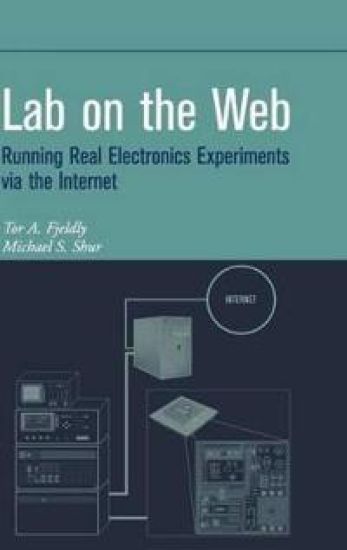
Lab on the Web

Lab on the Web

Tor A. Fjeldly; Michael S. Shur

John Wiley Sons Inc
2003
sidottu
A groundbreaking resource for remote study of interactive electronics applications The widespread use of the Internet as a communication medium has opened up a broad range of possibilities for extending its use into new areas. One such area is remote education, a rapidly growing part of today’s university curricula. Using the Internet and Web technology, courses can be offered to students anywhere in the world with no more technical requirements than a personal computer and an Internet connection. Until recently however, lab courses have been considered impractical for remote access. But thanks to technical advances of the past decade, even these courses with their often complex interactive techniques have been made accessible to remote students. Lab on the Web: Running Real Electronics Experiments via the Internet is the first text to present, in detail, experiments that can be run over the Web, specifically in the area of electronics. The authors present detailed descriptions of approximately 100 experiments in solid state electronics that can be used by engineering and science students at all levels, anywhere in the world, as well as by researchers working on semiconductor devices. Topics covered include: *Electronics laboratory experiments accessible through the Internet *MIT Microelectronics WebLab *Instrumentation on the Web *Next Generation Laboratory: a solution for remote characterization of analog integrated circuits *A Remote Lab for electrical experiments *The Remote Lab as it can be applied to semiconductor devices The book has achieved widespread collaboration that will enable universities around the world to participate in these remote access experiments. Enhanced by interactive Web sites which will accommodate a growing array of experimental modules from participating institutions, the text opens up a virtual Pandora’s box of possibilities for students to access a wide variety of real experiments, and for institutions, jointly or individually, to establish their own remote laboratory sites.
Introduction to Solid-State Lighting

Introduction to Solid-State Lighting

Arturas Žukauskas; Michael S. Shur; Remis Gaska

John Wiley Sons Inc
2002
sidottu
A thorough reference that sheds light on the promising field of solid-state lighting Solid-state lighting is a rapidly emerging field. Light Emitting Diodes are already used in traffic signals, signage/contour lighting, large area displays, and automotive applications. But its greatest future lies in the possibility of applying solid-state lamps to general lighting. Solid-state lighting promises to reduce energy consumption as much as fifty percent, cut down on carbon-dioxide emission, and even spur the development of a completely new lighting industry. Giving this important emerging field the attention it deserves, Introduction to Solid-State Lighting comprehensively covers: *The history of lighting *The characterization of visible light *Conventional light sources *LED basics *Extraction of light from high-brightness LEDs *White LED *Applications of solid-state lamps
Silicon And Beyond: Advanced Device Models And Circuit Simulators

Silicon And Beyond: Advanced Device Models And Circuit Simulators

Tor A Fjeldly; Michael S Shur

World Scientific Publishing Co Pte Ltd
2000
sidottu
The steady downscaling of device-feature size combined with a rapid increase in circuit complexity as well as the introduction of new device concepts based on non-silicon-material systems poses great challenges for device and circuit designers. One of the major tasks is the development of new and improved device models needed for accurate device and circuit design. Another task is the development of new circuit-simulation tools to handle very large and complex circuits. This book addresses both these issues with up-to-date reviews written by leading experts in the field.The first three chapters of the book discuss advanced device models both for existing technologies and for new, emerging technologies. Among the topics covered are models for MOSFETs, thin-film transitors (TFTs), and compound semiconductor devices, including GaAs HEMTs and HFETs, heterodimensional devices, quantum-tunneling devices, as well as wide-bandgap devices. Chapters 4 and 5 discuss advanced circuit simulators that hold promise for handling circuits of much higher complexity than what is possible for typical state-of-the-art circuit simulators today.
Handbook Series On Semiconductor Parameters - Volume 2: Ternary And Quaternary Iii-v Compounds
The Handbook Series on Semiconductor Parameters will consist of 5 volumes and will include data on the most popular semiconductor materials. These volumes aim to be a basic reference for scientists, engineers, students and technicians working in semiconductor materials and devices. The books have been kept compact but comprehensive and contain the values of frequently needed parameters selected and commented by leading experts on these materials. The first volume will include data on Si, Ge, diamond, GaAs, GaP, GaSb, InAs, InP, and InSb.
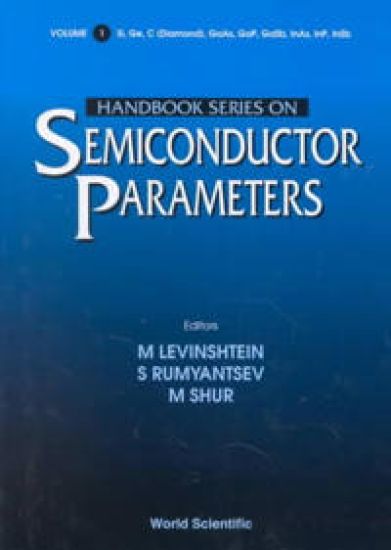
Handbook Series On Semiconductor Parameters - Volume 1: Si, Ge, C (Diamond), Gaas, Gap, Gasb, Inas, Inp, Insb
The Handbook Series on Semiconductor Parameters will consist of 5 volumes and will include data on the most popular semiconductor materials. These volumes aim to be a basic reference for scientists, engineers, students and technicians working in semiconductor materials and devices. The books have been kept compact but comprehensive and contain the values of frequently needed parameters selected and commented by leading experts on these materials. The first volume will include data on Si, Ge, diamond, GaAs, GaP, GaSb, InAs, InP, and InSb.
Introduction to Electronic Devices

Introduction to Electronic Devices

Michael S. Shur

John Wiley Sons Inc
1995
nidottu
This book gives readers enough knowledge of the required principles so they can adapt the knowledge to new materials and types of devices. As device dimensions shrink and more exotic compound semiconductor materials are used in electronic circuits, the physics involved in understanding the device behavior becomes more complicated and more fascinating.
GaAs Devices and Circuits

GaAs Devices and Circuits

Michael S. Shur

Kluwer Academic/Plenum Publishers
1987
sidottu
GaAs devices and integrated circuits have emerged as leading contenders for ultra-high-speed applications. This book is intended to be a reference for a rapidly growing GaAs community of researchers and graduate students. It was written over several years and parts of it were used for courses on GaAs devices and integrated circuits and on heterojunction GaAs devices developed and taught at the University of Minnesota. Many people helped me in writing this book. I would like to express my deep gratitude to Professor Lester Eastman of Cornell University, whose ideas and thoughts inspired me and helped to determine the direction of my research work for many years. I also benefited from numerous discussions with his students and associates and from the very atmosphere of the pursuit of excellence which exists in his group. I would like to thank my former and present co-workers and colleagues-Drs. Levinstein and Gelmont of the A. F. Ioffe Institute of Physics and Technology, Professor Melvin Shaw of Wayne State University, Dr. Kastalsky of Bell Communi­ cations, Professor Gary Robinson of Colorado State University, Professor Tony Valois, and Dr. Tim Drummond of Sandia Labs-for their contributions to our joint research and for valuable discussions. My special thanks to Professor Morko.;, for his help, his ideas, and the example set by his pioneering work. Since 1978 I have been working with engineers from Honeywell, Inc.-Drs.