

Kirjailija
Michael Schwartz
Kirjat ja teokset yhdessä paikassa: 19 kirjaa, julkaisuja vuosilta 1987-2025, suosituimpien joukossa Armored. Vertaile teosten hintoja ja tarkista saatavuus suomalaisista kirjakaupoista.
19 kirjaa
Kirjojen julkaisuhaarukka 1987-2025.

Docker for Developers
Richard Bullington-McGuire; Andrew K. Dennis; Michael Schwartz
Packt Publishing Limited
2020
nidottu
Learn how to deploy and test Linux-based Docker containers with the help of real-world use casesKey FeaturesUnderstand how to make a deployment workflow run smoothly with Docker containersLearn Docker and DevOps concepts such as continuous integration and continuous deployment (CI/CD)Gain insights into using various Docker tools and librariesBook DescriptionDocker is the de facto standard for containerizing apps, and with an increasing number of software projects migrating to containers, it is crucial for engineers and DevOps teams to understand how to build, deploy, and secure Docker environments effectively. Docker for Developers will help you understand Docker containers from scratch while taking you through best practices and showing you how to address security concerns. Starting with an introduction to Docker, you'll learn how to use containers and VirtualBox for development. You'll explore how containers work and develop projects within them after you've explored different ways to deploy and run containers. The book will also show you how to use Docker containers in production in both single-host set-ups and in clusters and deploy them using Jenkins, Kubernetes, and Spinnaker. As you advance, you'll get to grips with monitoring, securing, and scaling Docker using tools such as Prometheus and Grafana. Later, you'll be able to deploy Docker containers to a variety of environments, including the cloud-native Amazon Elastic Kubernetes Service (Amazon EKS), before finally delving into Docker security concepts and best practices. By the end of the Docker book, you'll be able to not only work in a container-driven environment confidently but also use Docker for both new and existing projects.What you will learnGet up to speed with creating containers and understand how they workPackage and deploy your containers to a variety of platformsWork with containers in the cloud and on the Kubernetes platformDeploy and then monitor the health and logs of running containersExplore best practices for working with containers from a security perspectiveBecome familiar with scanning containers and using third-party security tools and librariesWho this book is forIf you're a software engineer new to containerization or a DevOps engineer responsible for deploying Docker containers in the cloud and building DevOps pipelines for container-based projects, you'll find this book useful. This Docker containers book is also a handy reference guide for anyone working with a Docker-based DevOps ecosystem or interested in understanding the security implications and best practices for working in container-driven environments.

It's no secret that the 1%-the business elite that commands the largest corporations and the connected network of public and private institutions-exercise enormous control over the US government. While this control is usually attributed to campaign donations and lobbying, Levers of Power argues that corporate power derives from control over the economic resources on which daily life depends. Government officials must constantly strive to keep capitalists happy, lest they go on "capital strike"-that is, refuse to invest in particular industries or locations, or move their holdings to other countries-and therefore impose material hardship on specific groups or the economy as a whole. For this reason, even politicians who are not dependent on corporations for their electoral success must fend off the interruption of corporate investment. Levers of Power documents the pervasive power of corporations and other institutions with decision-making control over large pools of capital, particularly the Pentagon. It also shows that the most successful reform movements in recent US history-for workers' rights, for civil rights, and against imperialist wars-succeeded by directly targeting the corporations and other institutional adversaries that initiated and benefitted from oppressive policies. Though most of today's social movements focus on elections and politicians, movements of the 99% are most effective when they inflict direct costs on corporations and their allied institutions. This strategy is also more conducive to building a revolutionary mass movement that can replace current institutions with democratic alternatives.

Die Studie besch ftigt sich mit der Geschichte eines Vorurteils - dass n mlich Homosexuelle zur Bildung einflussreicher, oft transnationaler Netzwerke tendierten, die gef hrlich seien f r "gesunde" nationale Politik. Die Untersuchung geht aus vom Skandal um einen Freundeskreis des deutschen Kaisers Wilhelm II. 1907/08 und vom sterreichisch-ungarischen Spionagefall Redl 1913. Auf die 1934 ermordete SA-F hrung um Ernst R hm wird als herrschende "homosexuelle Clique" neues Licht geworfen. Weiterhin wird die Jagd auf homosexuelle "Verr ter" in staatlichen Elitepositionen betrachtet, die in den 1950er und 1960er Jahren die USA und Gro britannien, aber auch die Bundesrepublik und die DDR pr gte. Im Zuge sexueller Liberalisierung erlebte das homophobe Stereotyp einen Relevanzverlust. Doch noch 1983/84 konnte einer der rangh chsten Bundeswehrgener le als angebliches homosexuelles Sicherheitsrisiko aus dem Amt gedr ngt werden. Noch immer existieren heute Restbest nde des alten Feindbildes.

Leverage existing free open source software to build an identity and access management (IAM) platform that can serve your organization for the long term. With the emergence of open standards and open source software, it’s now easier than ever to build and operate your own IAM stack.The most common culprit of the largest hacks has been bad personal identification. In terms of bang for your buck, effective access control is the best investment you can make. Financially, it’s more valuable to prevent than to detect a security breach. That’s why Identity and Access Management (IAM) is a critical component of an organization’s security infrastructure. In the past, IAM software has been available only from large enterprise software vendors. Commercial IAM offerings are bundled as “suites” because IAM is not just one component. It’s a number of components working together, including web, authentication, authorization, cryptographic, and persistence services. Securing the Perimeter documents a recipe to take advantage of open standards to build an enterprise-class IAM service using free open source software. This recipe can be adapted to meet the needs of both small and large organizations. While not a comprehensive guide for every application, this book provides the key concepts and patterns to help administrators and developers leverage a central security infrastructure.Cloud IAM service providers would have you believe that managing an IAM is too hard. Anything unfamiliar is hard, but with the right road map, it can be mastered. You may find SaaS identity solutions too rigid or too expensive. Or perhaps you don’t like the idea of a third party holding the credentials of your users—the keys to your kingdom. Open source IAM provides an alternative. Take control of your IAM infrastructure if digital services are key to your organization’s success. What You’ll Learn Understand why you should deploy a centralized authentication and policy management infrastructureUse the SAML or Open ID Standards for web or single sign-on, and OAuth for API Access ManagementSynchronize data from existing identity repositories such as Active DirectoryDeploy two-factor authentication servicesWho This Book Is For Security architects (CISO, CSO), system engineers/administrators, and software developers

Noodles The Schnoodle -- The Puppy Who Broke His Tablet
Brad Kleinman; Michael Schwartz
Lulu.com
2018
pokkari
The Adventures of Noodles the Schnoodle are stories about our friend Noodles, who is always doing something exciting. Join us in our first Episode, where Noodles breaks his tablet, and quickly learns that life without technology is not that bad. Who knows, maybe Noodles will someday go to Mars?

Leadership is Warfare: How to become the Modern Day Machiavelli and Sun Tzu and slaughter your competition in Business
Michael Schwartz
Createspace Independent Publishing Platform
2018
nidottu
Over time, war has been made to seem like an evil and barbaric act of annihilation. This book is a juxtaposition of practical and theoretical war methods fused with real-time lessons for leaders in the business world. It is made up 10 chapters that look to serve as a step-by-step guide for all business leaders and employees alike. The book starts by clearly comparing the warfront and the business world; then it goes on to find similarities and use methods from Asian warlord Sun Tzu. The book goes on to outline the methods of proper leadership in the business world using examples from the world of business, sports, etc. Proper planning and why a 21st century leader should never underestimate its importance is shown in this powerful book. This amazing piece of literature also goes beyond outlining tips on how to fight against enemies or competitors as it also serves as a flashlight that will help you to find your real time enemies and engage them in battle. Leadership warfare also talks about winning the war within, as it is important to have your own home in check before you can go out to war against others. The author also talks about getting power with real-life examples of how power is gotten and maintained. This great book talks about how you can use alliance as means of gaining control. Furthermore, the author touches issues of conflict resolution, flexibility in the business world, branding and so on. The author also offers honest advice on how to get to the top and remain there. It is a lovely book and its conversational nature makes you feel as though the author is talking to you personally. This book is not even for business owners only. So, if you are a student, a worker, an entrepreneur, a politician, a sportsperson or whatever you decide to dedicate your life to, as long as you want to win and stay ahead of your competition, this book is perfect for you.
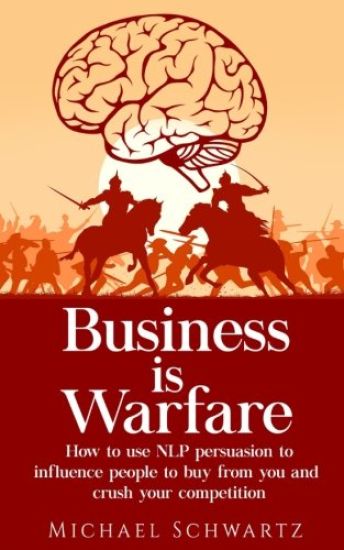
Business is Warfare: How to use NLP persuasion to influence people to buy from you or crush your competition
Michael Schwartz
Createspace Independent Publishing Platform
2017
nidottu
Business is Warfare is a book which is thrilling, fascinating, and all encompassing. It is based on how you can grow your business in the world of reality. Life is full of ups and downs, friends and foes, competitors and customers. It is a book which tends to educate business personnel on how to use Neuro Linguistic Programming to achieve two things. These are basically to influence customers and crush your competition. With a skillful mastery of this kind of programming, you, the business personnel, will be able to be the best among other competitors. This book intricately discusses the basics of Neuro Linguistic Programming, the theory of persuasion, the techniques which can be used to influence customers, the strategies, and above all, how to retain your customers. In reading this book, you will learn how to convert war strategies into your business in order to yield tremendous results. There are several war strategies which can be applied in a bid to crush your competition, thereby getting all the customers. Business is Warfare has real life experiences of how people have made it using the various techniques in the book. Above all, it is an engaging book which will educate you on how to get to the top without laying a finger on your competitor. Language is focused on, thereby showing that your words are greater than a sword. Read this book and you will need no other guide on how to be the best and beat the rest; set the pace and hold the ace, and be the number one business man.

Ethnische "S uberungen" sind die dunkle Kehrseite unserer modernen Demokratisierung und Nationalstaatsbildung. Bereits im 19. Jahrhundert entwickelten sich der Balkan und die au ereurop ischen Kolonien zu Lernorten dieser Form von nationaler Probleml sung. Ab 1914 schlugen diese Gewalttechniken auf Europa zur ck. In den beiden Weltkriegen bertraf ihr Vernichtungspotential alle Vorstellungen. Seither pr gten sie die Weltentwicklung - von Pal stina, Indien/Pakistan bis zu Ruanda, wobei es hier wie fr her friedliche Alternativen gegeben h tte. Michael Schwartz beschreibt diese globalen Zusammenh nge und f hrt die ersch tternde Vielfalt ethnischer Gewalttaten in unserer modernen Welt beispielhaft vor. Eindringlicher und engagierter ist diese Problematik noch nie dargestellt worden.

Die Frage nach der "braunen Vergangenheit" f hrender deutscher Vertriebenenpolitiker wird seit langem diskutiert. Bereits in den 1960er Jahren mussten zwei Bundesvertriebenenminister - Theodor Oberl nder und Hans Kr ger - wegen NS-Vorw rfen zur cktreten. Kr ger war zugleich der erste Pr sident des 1957/58 gegr ndeten "Bundes der Vertriebenen." In j ngster Zeit ist das Verhalten der gesamten dreizehnk pfigen ersten F hrung des BdV im "Dritten Reich" zum Thema geworden. Michael Schwartz gibt in seiner Studie - entstanden im Auftrag des Bundesministerium des Innern - eine differenzierte Einordnung der ersten F hrungsriege des BdV zwischen NS-Belastung und NS-Gegnerschaft und beleuchtet damit zugleich den Umgang mit der NS-Vergangenheit in der fr hen Bundesrepublik der 1950er und 1960er Jahre.


End of Academic Freedom
William M. Bowen; Michael Schwartz; Lisa Camp
Information Age Publishing
2014
nidottu
This book is premised upon the assumption that the core purpose of universities is to create, preserve, transmit, validate, and find new applications for knowledge. It is written in the perspective of critical university studies, in which university governance processes should take ideas and discourse about ideas seriously, far more seriously than they are often taken within many of to day's universities, since doing so is the key to achieving this purpose. Specifically, we assert that the best way for universities to take ideas seriously, and so to best achieve their purpose, is to consciously recognize and conserve the entire range of available ideas. Though the current emphasis upon factors such as student headcounts, increased efficiency and job creation are undoubtedly important, far more is at stake in universities than only these factors.From this premise, we deduce insights and arguments about academic freedom, as well as factors such control and monitoring of the market place of ideas, the structure of information flows within universities, the role of language in university governance, and relationships between administrators, faculty members and students. We identify impediments to achieving the core purpose of universities, including the idea vetting systems of authoritarianism, corporatism, illiberalism, supernaturalism and political correctness. We elucidate how these impediments inhibit successful achievement of the core purpose of the university. In response to these impediments we prescribe relatively autonomous universities characterized by openness, transparency, dissent, and the maintenance of balance between conflicting perspectives, values, and interests.

End of Academic Freedom
William M. Bowen; Michael Schwartz; Lisa Camp
Information Age Publishing
2014
sidottu
This book is premised upon the assumption that the core purpose of universities is to create, preserve, transmit, validate, and find new applications for knowledge. It is written in the perspective of critical university studies, in which university governance processes should take ideas and discourse about ideas seriously, far more seriously than they are often taken within many of to day's universities, since doing so is the key to achieving this purpose. Specifically, we assert that the best way for universities to take ideas seriously, and so to best achieve their purpose, is to consciously recognize and conserve the entire range of available ideas. Though the current emphasis upon factors such as student headcounts, increased efficiency and job creation are undoubtedly important, far more is at stake in universities than only these factors.From this premise, we deduce insights and arguments about academic freedom, as well as factors such control and monitoring of the market place of ideas, the structure of information flows within universities, the role of language in university governance, and relationships between administrators, faculty members and students. We identify impediments to achieving the core purpose of universities, including the idea vetting systems of authoritarianism, corporatism, illiberalism, supernaturalism and political correctness. We elucidate how these impediments inhibit successful achievement of the core purpose of the university. In response to these impediments we prescribe relatively autonomous universities characterized by openness, transparency, dissent, and the maintenance of balance between conflicting perspectives, values, and interests.

Ethnische "S uberungen" sind die dunkle Kehrseite unserer modernen Demokratisierung und Nationalstaatsbildung. Bereits im 19. Jahrhundert entwickelten sich der Balkan und die au ereurop ischen Kolonien zu Lernorten dieser Form von nationaler Probleml sung. Ab 1914 schlugen diese Gewalttechniken auf Europa zur ck. In den beiden Weltkriegen bertraf ihr Vernichtungspotential alle Vorstellungen. Seither pr gten sie die Weltentwicklung - von Pal stina, Indien/Pakistan bis zu Ruanda, wobei es hier wie fr her friedliche Alternativen gegeben h tte. Michael Schwartz beschreibt diese globalen Zusammenh nge und f hrt die ersch tternde Vielfalt ethnischer Gewalttaten in unserer modernen Welt beispielhaft vor. Eindringlicher und engagierter ist diese Problematik noch nie dargestellt worden.

Funktionäre Mit Vergangenheit: Das Gründungspräsidium Des Bundesverbandes Der Vertriebenen Und Das Dritte Reich
Michael Schwartz
de Gruyter Oldenbourg
2012
sidottu
Die Frage nach der "braunen Vergangenheit" f hrender deutscher Vertriebenenpolitiker wird seit langem diskutiert. Bereits in den 1960er Jahren mussten zwei Bundesvertriebenenminister - Theodor Oberl nder und Hans Kr ger - wegen NS-Vorw rfen zur cktreten. Kr ger war zugleich der erste Pr sident des 1957/58 gegr ndeten "Bundes der Vertriebenen". In j ngster Zeit ist das Verhalten der gesamten dreizehnk pfigen ersten F hrung des BdV im "Dritten Reich" zum Thema geworden. Michael Schwartz gibt in seiner Studie - entstanden im Auftrag des Bundesministerium des Innern - eine differenzierte Einordnung der ersten F hrungsriege des BdV zwischen NS-Belastung und NS-Gegnerschaft und beleuchtet damit zugleich den Umgang mit der NS-Vergangenheit in der fr hen Bundesrepublik der 1950er und 1960er Jahre.

In this razor-sharp analysis, TomDispatch.com commentator Michael Schwartz shows how the US occupation is fuelling civil war in Iraq and beyond. He punctures all the myths used to sell the idea of an endless war in this incisive and hard-hitting argument.


"Michael Schwartz's book is really three books in one—an analysis of the structural changes that produced one of the most oppressive social systems the world has known (the one-crop cotton tenancy economy and the system of institutionalized racism and authoritarian one-party politics that was required to preserve the fragile economic arrangement); a theoretical analysis of the origins, mobilization, and outcome of insurgent challenges; and a meticulous application of that theory to the rise and collapse of the Populist movement."—Craig Jenkins, Theory and Society

The Power Structure of American Business
Beth A. Mintz; Michael Schwartz
University of Chicago Press
1987
nidottu
Mintz and Schwartz offer a fascinating tour of the corporate world. Through an intensive study of interlocking corporate directorates, they show that for the first time in American history the loan making and stock purchasing and selling powers are concentrated in the same hands: the leadership of major financial firms. Their detailed descriptions of corporate case histories include the forced ouster of Howard Hughes from TWA in the late fifties as a result of lenders' pressure; the collapse of Chrysler in the late seventies owing to banks' refusal to provide further capital infusions; and the very different "rescues" of Pan American Airlines and Braniff Airlines by bank intervention in the seventies.