Kirjojen hintavertailu. Mukana 12 595 353 kirjaa ja 12 kauppaa.

Kirjailija

Michael Shurkin

Kirjat ja teokset yhdessä paikassa: 15 kirjaa, julkaisuja vuosilta 2013-2026, suosituimpien joukossa Reducing the Time Burdens of Army Company Leaders. Vertaile teosten hintoja ja tarkista saatavuus suomalaisista kirjakaupoista.

15 kirjaa

Kirjojen julkaisuhaarukka 2013-2026.

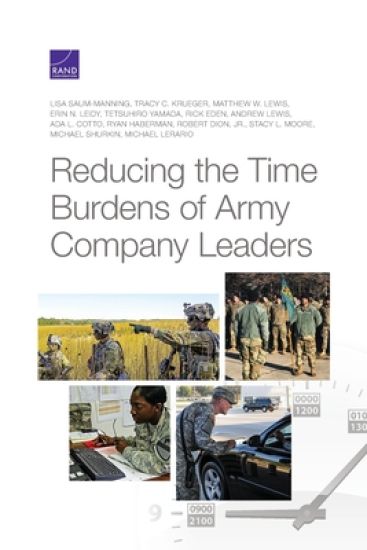
Reducing the Time Burdens of Army Company Leaders

Reducing the Time Burdens of Army Company Leaders

Lisa Saum-Manning; Tracy C Krueger; Matthew W Lewis; Erin N Leidy; Tetsuhiro Yamada; Rick Eden; Andrew Lewis; Ada L Cotto; Ryan Haberman; Robert Dion; Stacy L Moore; Michael Shurkin; Michael Lerario

RAND
2020
nidottu
Company leaders in the U.S. Army have long been recognized as overworked, partly because of the number of requirements imposed on them by higher headquarters. This report is intended to help the Army identify ways to reduce and manage the time burdens on Active Component company leaders in garrison by addressing the challenges of reducing time burdens at both organizational and individual worker levels.
Reimagining the Character of Urban Operations for the U.S. Army

Reimagining the Character of Urban Operations for the U.S. Army

Gian Gentile; David E. Johnson; Lisa Saum-Manning; Raphael S. Cohen; Shara Williams; Carrie Lee; Michael Shurkin; Brenna Allen; Sarah Soliman; James L. Doty

RAND
2017
pokkari
Provides a historical analysis of the ways in which militaries have deployed light and mechanized infantry with armored forces during close urban combat in order to to identify the advantages and costs of this warfighting approach and inform how the Army might confront foes in complex, urban environments in the future.
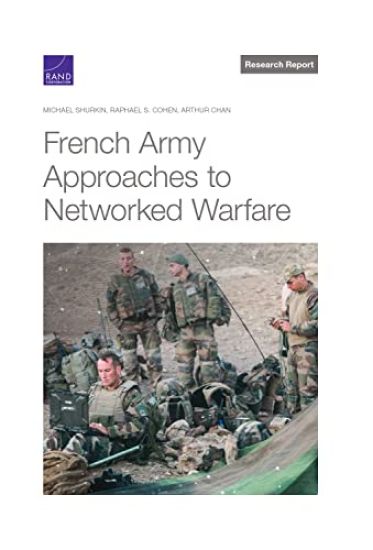
French Army Approaches to Networked Warfare

French Army Approaches to Networked Warfare

Michael Shurkin; Raphael S Cohen; Arthur Chan

RAND Corporation
2022
pokkari
The French concept of network-centric warfare argues that information-sharing enables forces to forgo armor and mass. The concept underpins France's push for a middle-weight force--one that can deploy to Africa but is still robust enough for higher-end threats. By contrast, the U.S. Army's modernization challenge starts with a different strategic premise and makes different assumptions about available logistical capabilities.
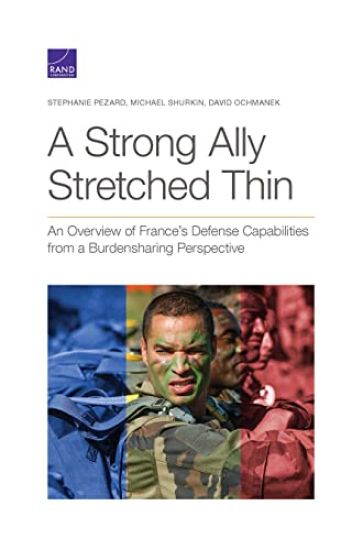
A Strong Ally Stretched Thin

A Strong Ally Stretched Thin

Stephanie Pezard; Michael Shurkin; David Ochmanek

RAND
2021
nidottu
In this report, researchers examine the role that the French military might play as a coalition partner in a hypothetical high-intensity conventional conflict in Europe. Researchers drew on a wide range of publications in French and English, as well as on conversations with French defense experts.
A History of the Third Offset, 2014-2018

A History of the Third Offset, 2014-2018

Gian Gentile; Michael Shurkin; Alexandra T Evans; Michelle Grisé; Mark Hvizda; Rebecca Jensen

RAND
2021
nidottu
The authors document the history of the Third Offset, a U.S. strategy that focused on the potential of technology to offset Chinese and Russian military advances and that shaped the 2018 National Defense Strategy. The authors describe efforts to effect change within the U.S. Department of Defense and interview key defense leaders who did so, providing an example of how to bring about organizational change in large military institutions.
Building Armies, Building Nations

Building Armies, Building Nations

Michael Shurkin; John Gordon; Bryan Frederick

RAND
2018
nidottu
This report explores the relationship between armies and nation-building and argues that U.S.-sponsored Security Force Assistance (SFA) could become more effective by focusing less on force structure, military capabilities, and readiness, and focusing more on ideology and the extent to which a client army complements a host nation's larger nation-building project.
The Evolution of U.S. Military Policy from the Constitution to the Present

The Evolution of U.S. Military Policy from the Constitution to the Present

Gian Gentile; Michael E Linick; Michael Shurkin

RAND
2017
nidottu
Tracing the evolution of the U.S. Army throughout American history, the authors show that there is no such thing as a "traditional" U.S. military policy. Rather, the laws that authorize, empower, and govern the U.S. armed forces emerged from long-standing debates and a series of legislative compromises between 1903 and 1940.
Enabling the Global Response Force

Enabling the Global Response Force

Christopher G. Pernin; Katharina Ley Best; Jeremy M. Eckhause; John Gordon; Dan Madden; Katherine Pfrommer; Anthony D. Rosello; Michael Schwille; Michael Shurkin; Jonathan P. Wong

RAND
2016
pokkari
The Global Response Force (GRF) is built for rapid response to unforeseen operations. This study determined access strategies for each geographic combatant command given constraints in aircraft, intermediate staging bases, operational capabilities, and other factors. Global access requires both well-established and austere staging bases; complex joint deployment concepts are necessary to ensure access.
Achieving Peace in Northern Mali

Achieving Peace in Northern Mali

Stephanie Pezard; Michael Shurkin

RAND
2015
pokkari
This report examines the prospects for stabilization in Mali following the political and military crisis that began in 2012. To this end, it examines Mali s peace settlements since the early 1990s to identify flaws and successes. The report also explores whether Mali s neighbor Niger owes its current stability to a more favorable context, shrewd policies, or sheer luck, and whether it might offer a model of resilience for Mali."
Readiness Reporting for an Adaptive Army

Readiness Reporting for an Adaptive Army

Christopher G. Pernin; Dwayne M. Butler; Louay Constant; Lily Geyer; Duncan Long; Dan Madden; John E. Peters; Jim Powers; Michael Shurkin

RAND
2013
pokkari
This study examines the readiness reporting system in light of changes experienced by Army units in the past decade, a period in which the Army learned to adapt to emerging requirements by adding new capabilities quickly and flexibly. The current readiness reporting system captures only a portion of those changes in capabilities and has some important limitations. The study recommends ways to improve the reporting system for an adaptive Army.
Setting Priorities in the Age of Austerity
Examines the British, French, and German armies' approaches to accommodating significant budget cuts while attempting to sustain their commitment to full spectrum operations. Specifically, it looks at the choices these armies are making with respect to how they spend dwindling resources: What force structure do they identify as optimal? How much readiness do they regard as necessary? Which capabilities are they abandoning?