Kirjojen hintavertailu. Mukana 12 657 676 kirjaa ja 12 kauppaa.
Kirjailija
Michael Spirtas
Kirjat ja teokset yhdessä paikassa: 8 kirjaa, julkaisuja vuosilta 2008-2024, suosituimpien joukossa Multiple Dilemmas. Vertaile teosten hintoja ja tarkista saatavuus suomalaisista kirjakaupoista.
Miranda Priebe; Douglas C Ligor; Bruce McClintock; Michael Spirtas; Karen Schwindt; Caitlin Lee; Ashley L Rhoades; Derek Eaton; Quentin E Hodgson; Bryan Rooney
The U.S. Air Force has embarked on a new round of strategic planning under the auspices of its 2015 Strategic Master Plan (SMP). This report represents a general survey of the state of the art in strategy and planning. We found that basic concept and approach of the SMP has promise, but its emphasis on pre-set planning could obstruct, rather than facilitate, its objectives.
What can the United States learn from other militaries about how better to prepare for full-spectrum operations - simultaneous offensive, defensive, and stability or civil support operations - and deployments? The authors examine the militaries of China, France, the UK, India, and Israel to identify different approaches to readiness, adaptability, and operational issues, including using subject-matter experts to improve training for specific deployments * using staff training to prepare forces for multiple contingencies; allowing combat training centers to focus on foundational skills; and, preparing units for a specific operational environment prior to deployment. The authors also examine how the United States, France, and the UK prepare for and conduct train, advise, and assist (TAA) missions, finding that the three countries employ significantly different approaches to staff selection, TAA deployments, staff training, and career progression.
The nature of recent challenges and the types of missions the U.S. Department of Defense has undertaken highlight the need for it to consider ways to help the military prepare to work with other government agencies, international organizations, private and non governmental organizations, and foreign militaries. Current training programs aimed at headquarters staffs need to be revamped to focus on high-priority tasks that are amenable to training.Integrated operations require the U.S. military to work with other government agencies, organizations, and foreign militaries. Current headquarter-staff training needs to be revamped to focus on high-priority tasks.
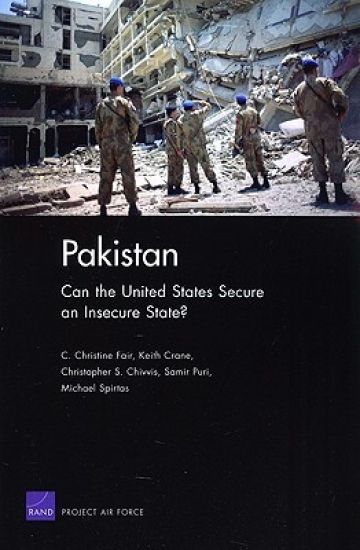
Describing Pakistan's likely future course, this volume seeks to inform U.S. efforts to achieve an effective foreign policy strategy toward the country. Drawing on interviews of elites, polling data, and statistical data on Pakistan's armed forces, the book presents a political and political-military analysis. The authors exposit likely developments in Pakistan's internal and external security environment over the coming decade, assess Pakistan's national will and capacity to solve its problems, and suggest policies for the U.S. government to pursue in order to secure its interests.
When appropriate, the U.S. Air Force needs to be prepared to supply joint task force (JTF) headquarters. The authors discuss the theory and practice of JTFs, survey command-related developments in the Department of Defense, examine four JTF operations, and consider requirements for JTF headquarters. They use this analysis to develop recommendations to improve U.S. Air Force-led JTF headquarters.