Kirjojen hintavertailu. Mukana 12 390 323 kirjaa ja 12 kauppaa.

Kirjailija

Michael Taussig

Kirjat ja teokset yhdessä paikassa: 33 kirjaa, julkaisuja vuosilta 1991-2025, suosituimpien joukossa Postcards for Mia. Vertaile teosten hintoja ja tarkista saatavuus suomalaisista kirjakaupoista.

33 kirjaa

Kirjojen julkaisuhaarukka 1991-2025.

What Color Is the Sacred?

What Color Is the Sacred?

Michael Taussig

University of Chicago Press
2009
nidottu
Over the past thirty years, visionary anthropologist Michael Taussig has crafted a highly distinctive body of work. Playful, enthralling, and whip-smart, his writing makes ingenious connections between ideas, thinkers, and things. An extended meditation on the mysteries of color and the fascination they provoke, "What Color Is the Sacred?" is the next step on Taussig's remarkable intellectual path. Following his interest in magic and surrealism, his earlier work on mimesis, and his recent discussion of heat, gold, and cocaine in "My Cocaine Museum", this book uses color to explore further dimensions of what Taussig calls 'the bodily unconscious' in an age of global warming. Drawing on classic ethnography as well as the work of Benjamin, Burroughs, and Proust, he takes up the notion that color invites the viewer into images and into the world. Yet, as Taussig makes clear, color has a history - a manifestly colonial history rooted in the West's discomfort with color, especially bright color, and its associations with the so-called primitive. He begins by noting Goethe's belief that Europeans are physically averse to vivid color while the uncivilized revel in it, which prompts Taussig to reconsider colonialism as a tension between chromophobes and chromophiliacs. And he ends with the strange story of coal, which, he argues, displaced colonial color by giving birth to synthetic colors, organic chemistry, and IG Farben, the giant chemical corporation behind the Third Reich. Nietzsche once wrote, 'So far, all that has given colour to existence still lacks a history'. With "What Color Is the Sacred?", Taussig has taken up that challenge with all the radiant intelligence and inspiration we've come to expect from him.
What Color Is the Sacred?

What Color Is the Sacred?

Michael Taussig

University of Chicago Press
2009
sidottu
Over the past thirty years, visionary anthropologist Michael Taussig has crafted a highly distinctive body of work. Playful, enthralling, and whip-smart, his writing makes ingenious connections between ideas, thinkers, and things. An extended meditation on the mysteries of color and the fascination they provoke, "What Color Is the Sacred?" is the next step on Taussig's remarkable intellectual path. Following his interest in magic and surrealism, his earlier work on mimesis, and his recent discussion of heat, gold, and cocaine in "My Cocaine Museum", this book uses color to explore further dimensions of what Taussig calls 'the bodily unconscious' in an age of global warming. Drawing on classic ethnography as well as the work of Benjamin, Burroughs, and Proust, he takes up the notion that color invites the viewer into images and into the world. Yet, as Taussig makes clear, color has a history - a manifestly colonial history rooted in the West's discomfort with color, especially bright color, and its associations with the so-called primitive. He begins by noting Goethe's belief that Europeans are physically averse to vivid color while the uncivilized revel in it, which prompts Taussig to reconsider colonialism as a tension between chromophobes and chromophiliacs. And he ends with the strange story of coal, which, he argues, displaced colonial color by giving birth to synthetic colors, organic chemistry, and IG Farben, the giant chemical corporation behind the Third Reich. Nietzsche once wrote, 'So far, all that has given colour to existence still lacks a history'. With "What Color Is the Sacred?", Taussig has taken up that challenge with all the radiant intelligence and inspiration we've come to expect from him.
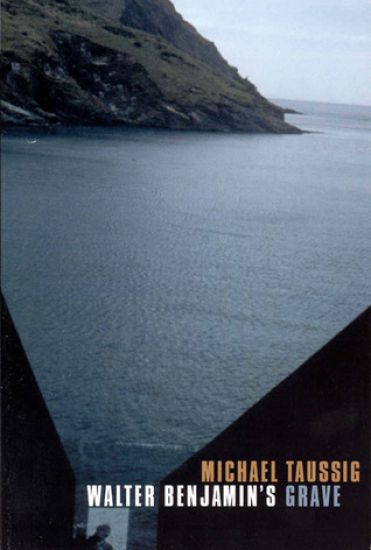
Walter Benjamin's Grave

Walter Benjamin's Grave

Michael Taussig

University of Chicago Press
2006
nidottu
In September 1940, Walter Benjamin committed suicide in Port Bou on the Spanish-French border when it appeared that he and his travelling partners would be denied passage into Spain in their attempt to escape the Nazis. In 2002, one of anthropology's - and indeed today's - most distinctive writers, Michael Taussig, visited Benjamin's grave in Port Bou. The result is "Walter Benjamin's Grave," a moving essay about the cemetery, eyewitness accounts of Benjamin's border travails, and the circumstances of his demise. It is the most recent of eight revelatory essays collected in this volume of the same name. "Looking over these essays written over the past decade," writes Taussig, "I think what they share is a love of muted and defective storytelling as a form of analysis. Strange love indeed; love of the wound, love of the last gasp." Although thematically these essays run the gamut - covering the monument and graveyard at Port Bou, discussions of peasant poetry in Colombia, a pact with the devil, the peculiarities of a shaman's body, transgression, the disappearance of the sea, New York City cops, and the relationship between flowers and violence - each shares Taussig's highly individual brand of storytelling, one that depends on a deep appreciation of objects and things as a way to retrieve even deeper philosophical and anthropological meanings. Whether he finds himself in Australia, Colombia, Manhattan, or Spain, in the midst of a book or a beach, whether talking to friends or staring at a monument, Taussig makes clear through these marvelous essays that materialist knowledge offers a crucial alternative to the increasingly abstract, globalized, homogenized, and digitized world we inhabit. Pursuing an adventure that is part ethnography, part autobiography, and part cultural criticism refracted through the object that is Walter Benjamin's grave, Taussig, with this collection, provides his own literary memorial to the twentieth century's greatest cultural critic.
Walter Benjamin's Grave

Walter Benjamin's Grave

Michael Taussig

University of Chicago Press
2006
sidottu
In September 1940, Walter Benjamin committed suicide in Port Bou on the Spanish-French border when it appeared that he and his travelling partners would be denied passage into Spain in their attempt to escape the Nazis. In 2002, one of anthropology's - and indeed today's - most distinctive writers, Michael Taussig, visited Benjamin's grave in Port Bou. The result is "Walter Benjamin's Grave," a moving essay about the cemetery, eyewitness accounts of Benjamin's border travails, and the circumstances of his demise. It is the most recent of eight revelatory essays collected in this volume of the same name. "Looking over these essays written over the past decade," writes Taussig, "I think what they share is a love of muted and defective storytelling as a form of analysis. Strange love indeed; love of the wound, love of the last gasp." Although thematically these essays run the gamut - covering the monument and graveyard at Port Bou, discussions of peasant poetry in Colombia, a pact with the devil, the peculiarities of a shaman's body, transgression, the disappearance of the sea, New York City cops, and the relationship between flowers and violence - each shares Taussig's highly individual brand of storytelling, one that depends on a deep appreciation of objects and things as a way to retrieve even deeper philosophical and anthropological meanings. Whether he finds himself in Australia, Colombia, Manhattan, or Spain, in the midst of a book or a beach, whether talking to friends or staring at a monument, Taussig makes clear through these marvelous essays that materialist knowledge offers a crucial alternative to the increasingly abstract, globalized, homogenized, and digitized world we inhabit. Pursuing an adventure that is part ethnography, part autobiography, and part cultural criticism refracted through the object that is Walter Benjamin's grave, Taussig, with this collection, provides his own literary memorial to the twentieth century's greatest cultural critic.
Law in a Lawless Land

Law in a Lawless Land

Michael Taussig

University of Chicago Press
2005
nidottu
A modern nation in a state of total disorder, Colombia is an international flash-point - wracked by more than half a century of civil war, political conflict, and drug-trade related violence - despite a multibillion dollar American commitment that makes it the third-largest recipient of U.S. foreign aid. "Law in a Lawless Land" offers a rare and penetrating insight into the nature of Colombia's present peril. In a nuanced account of the human consequences of a disintegrating state, anthropologist Michael Taussig chronicles two weeks in a small town in Colombia's Cauca Valley taken over by paramilitaries that brazenly assassinate adolescent gang members. Armed with automatic weapons and computer-generated lists of names and photographs, the paramilitaries have the tacit support of the police and even many of the desperate townspeople, who are seeking any solution to the crushing uncertainty of violence in their lives. Concentrating on everyday experience, Taussig forces readers to confront a kind of terror to which they have become numb and complacent.
My Cocaine Museum

My Cocaine Museum

Michael Taussig

University of Chicago Press
2004
nidottu
In this book, a make-believe cocaine museum becomes a disturbing vantage point from which to assess the lives of Afro-Colombian gold miners drawn into the dangerous world of cocaine production in the rain forest of Colombia's Pacific Coast. Although modeled on the famous Gold Museum in Colombia's central bank, the Banco de la Republica, Taussig's "museum" is also a parody aimed at the museum's lack of acknowledgment of the African slaves who mined the country's wealth for almost four hundred years. In a work combining natural history with political history, Taussig exploits the show-and-tell modality of a museum to engage with the inner life - both material and spiritual - of "artifacts" such as heat, rain, stone, and swamp. As much a contribution to literature as to the study of literature, My Cocaine Museum strives to combine a history of things with a history of people. This effort to find a poetry of words becoming things is brought to a head by the explosive qualities of those supreme fetishes of evil beauty: gold and cocaine. At its core, Taussig's "museum" is about the lure of forbidden things, matter out of place.
My Cocaine Museum

My Cocaine Museum

Michael Taussig

University of Chicago Press
2004
sidottu
In this book, a make-believe cocaine museum becomes a disturbing vantage point from which to assess the lives of Afro-Colombian gold miners drawn into the dangerous world of cocaine production in the rain forest of Colombia's Pacific Coast. Although modeled on the famous Gold Museum in Colombia's central bank, the Banco de la Republica, Taussig's "museum" is also a parody aimed at the museum's lack of acknowledgment of the African slaves who mined the country's wealth for almost four hundred years. In a work combining natural history with political history, Taussig exploits the show-and-tell modality of a museum to engage with the inner life - both material and spiritual - of "artifacts" such as heat, rain, stone, and swamp. As much a contribution to literature as to the study of literature, My Cocaine Museum strives to combine a history of things with a history of people. This effort to find a poetry of words becoming things is brought to a head by the explosive qualities of those supreme fetishes of evil beauty: gold and cocaine. At its core, Taussig's "museum" is about the lure of forbidden things, matter out of place.
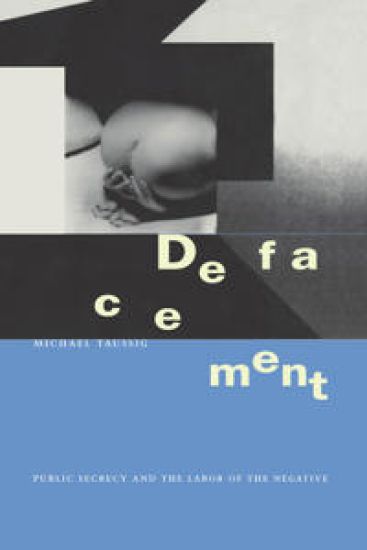
Defacement

Defacement

Michael Taussig

Stanford University Press
1999
sidottu
Defacement asks what happens when something precious is despoiled. It begins with the notion that such activity is attractive in its very repulsion, and that it creates something sacred even in the most secular of societies and circumstances. In specifying the human face as the ideal type for thinking through such violation, this book raises the issue of secrecy as the depth that seems to surface with the tearing of surface. This surfacing is made all the more subtle and ingenious, not to mention everyday, by the deliberately partial exposures involved in "the public secret"—defined as what is generally known but, for one reason or another, cannot easily be articulated. Arguing that this sort of knowledge ("knowing what not to know") is the most powerful form of social knowledge, Taussig works with ideas and motifs from Nietzsche, William Burroughs, Elias Canetti, Georges Bataille, and the ethnography of unmasking in so-called primitive societies in order to extend his earlier work on mimesis and transgression. Underlying his concern with defacement and the public secret is the search for a mode of truth telling that unmasks, but only to reenchant, thereby underlining Walter Benjamin's notion that "truth is not a matter of exposure of the secret, but a revelation that does justice to it."
The Magic of the State

The Magic of the State

Michael Taussig

Routledge
1997
sidottu
Set in the enchanted mountain of a spirit-queen presiding over an unnamed, postcolonial country, this ethnographic work of ficto-criticism recreates in written form the shrines by which the dead--notably the fetishized forms of Europe's Others, Indians and Blacks--generate the magical powers of the modern state.
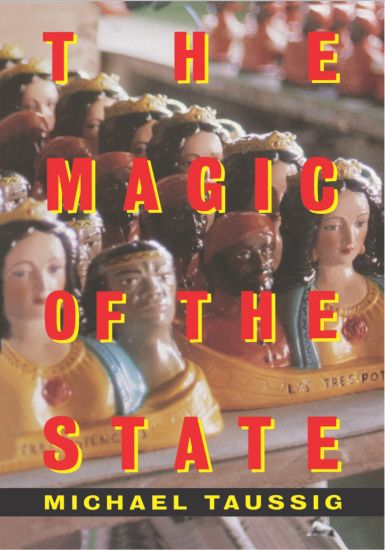
The Magic of the State

The Magic of the State

Michael Taussig

Routledge
1997
nidottu
Set in the enchanted mountain of a spirit-queen presiding over an unnamed, postcolonial country, this ethnographic work of ficto-criticism recreates in written form the shrines by which the dead--notably the fetishized forms of Europe's Others, Indians and Blacks--generate the magical powers of the modern state.
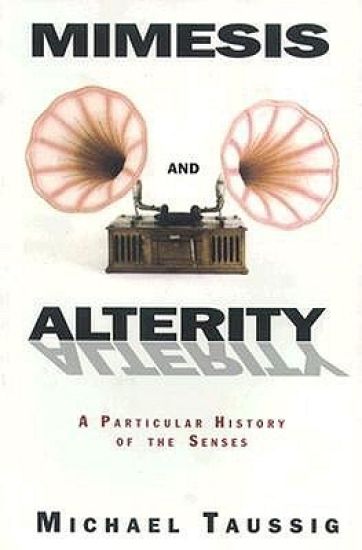
Mimesis and Alterity

Mimesis and Alterity

Michael Taussig

Routledge
1992
nidottu
In his most ambitious and accomplished work to date, Michael Taussig undertakes a history of mimesis, the practice of imitation, and its relation to alterity, the opposition of Self and Other. Drawing upon such diverse sources as theories of Benjamin, Adorno and Horckheimer, research on the Cuna Indians, and theories of colonialism and postcolonialism, Taussig shows that the history of mimesis is deeply tied to colonialism, and more specifically, to the colonial trade's construction of "savages." With analysis that is vigorous, unorthodox, and often breathtaking, Taussig's cross-cultural discussion of mimesis deepens our understanding of the relationship between ethnography, racism and society.
The Nervous System

The Nervous System

Michael Taussig

Routledge
1991
nidottu
In a series of intriguing essays ranging over terror, State fetishism, shamanic healing in Latin America, homesickness, and the place of the tactile eye in both magic and modernity, anthropologist Michael Taussig puts into representational practice a curious type of engaged writing. Based on a paranoiac vision of social control and its understanding as in a permanent state of emergency leaving no room for contemplation between signs and things, these essays hover between story-telling and high theory and thus create strange new modes of critical discourse. The Nervous System will appeal to writers, scholars, artists, film makers, and readers interested in critical theory, aesthetics, and politics.