Kirjojen hintavertailu. Mukana 12 595 353 kirjaa ja 12 kauppaa.

Kirjailija

Michael Taylor

Kirjat ja teokset yhdessä paikassa: 112 kirjaa, julkaisuja vuosilta 1982-2026, suosituimpien joukossa Michael Taylor. Vertaile teosten hintoja ja tarkista saatavuus suomalaisista kirjakaupoista.

112 kirjaa

Kirjojen julkaisuhaarukka 1982-2026.

Daggers and Ink

Daggers and Ink

Michael Taylor

Lulu.com
2007
nidottu
Polo (Apolinaris) lives in the little farm town of Karanis, far up the Nile, in the year 173 A.D. A family friend, a retired Roman officer, has written letters of recommendation for him so that he can join the Praetorian Fleet, and now he is on his way to Alexandria, on the coast of Egypt, as the first stage of his journey to Rome. But the officer included a mysterious list of names along with his letters, and someone wants it destroyed. Brigands attack Polo and his party in the desert, someone pushes him into a pool full of crocodiles, and finally a traveling companion steals the list. River pirates assault the boat carrying Polo and his friend Apion down the Nile, and elsewhere Antonius Longus - the boy who stole the list - finds that joining a conspiracy against Rome is not as simple as he thought. The three meet again in the baths of Alexandria, where an agent of the prefect of Egypt chases the conspirators and tries to reclaim the list.

Hallowed Ground

Hallowed Ground

Michael Taylor

Lulu.com
2006
pokkari
If you search the scripture, you will find that there is a place where every man can meet his maker and that place is on Hallowed Ground. It was no accident that the believers written of in the Bible had a much closer relationship with God than many of us, if not all of us, do today. God's word repeatedly emphasizes that it was their obedience that was the key, for God will not allow the rebellious to remain in His presence. Isaiah 59: 1-2 Behold, the LORD'S hand is not shortened, that it cannot save; neither his ear heavy, that it cannot hear: But your iniquities have separated between you and your God, and your sins have hid his face from you, that he will not hear. Since it would be impossible for anyone to live a life of continual obedience and true faith towards God without having experienced the new birth, this work was created to explain the highly misunderstood process of true conversion, the marks of the new birth, and the fundamentals of the Christian Faith.
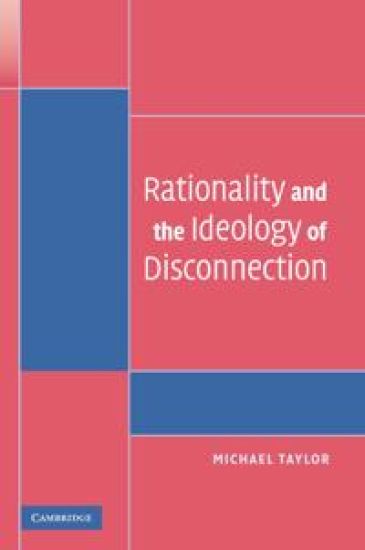
Rationality and the Ideology of Disconnection

Rationality and the Ideology of Disconnection

Michael Taylor

Cambridge University Press
2006
pokkari
A powerful and provocative critique of the foundations of Rational Choice theory and the economic way of thinking about the world, written by a former leading practitioner. The target is a dehumanizing ideology that cannot properly recognize that normal people have attachments and commitments to other people and to practices, projects, principles, and places, which provide them with desire-independent reasons for action, and that they are reflective creatures who think about what they are and what they should be, with ideals that can shape and structure the way they see their choices. The author's views are brought to bear on the economic way of thinking about the natural environment and on how and when the norm of fair reciprocity motivates us to do our part in cooperative endeavors. Throughout, the argument is adorned by thought-provoking examples that keep what is at stake clearly before the reader's mind.
Rationality and the Ideology of Disconnection

Rationality and the Ideology of Disconnection

Michael Taylor

Cambridge University Press
2006
sidottu
A powerful and provocative critique of the foundations of Rational Choice theory and the economic way of thinking about the world, written by a former leading practitioner. The target is a dehumanizing ideology that cannot properly recognize that normal people have attachments and commitments to other people and to practices, projects, principles, and places, which provide them with desire-independent reasons for action, and that they are reflective creatures who think about what they are and what they should be, with ideals that can shape and structure the way they see their choices. The author's views are brought to bear on the economic way of thinking about the natural environment and on how and when the norm of fair reciprocity motivates us to do our part in cooperative endeavors. Throughout, the argument is adorned by thought-provoking examples that keep what is at stake clearly before the reader's mind.
Eat, Drink and Be Merry, for Tomorrow We Live
Eat, Drink and Be Merry for Tomorrow we Live is a collection of essays by a world authority on Christianity and global ethics. Each essay is intellectually rigorous, but written in non-technical language for the thoughtful reader. They explore a broad range of topics, including: the exhaustion of the Western Christian tradition and its need to 'cross boundaries' if it is to find renewal; why the North should be interested in development; how to respond to highly divergent views about the effects of the global economy; advice to Christian campaigners and demonstrators; differences and similarities between those who set out to reform the global economy and those who reject it wholesale; ways of doing social theology or social ethics; and some of the challenges made by faith traditions in the 'South' to the mainstream development tradition. Michael Taylor not only explores issues that have been neglected from an inter-faith perspective, but also engages with development practitioners and tries to contribute to the ongoing debate as to how poverty reduction and human development should be tackled.
Macmillan Revision Guides for CSEC® Examinations: Chemistry
"Macmillan Revision Guides for CSEC Examinations" are the perfect companions for exam preparation and success. They feature: total coverage of the CXC syllabus; numerous practice exercises and worked examples; exam tips and practical advice from teachers and examiners; and, vital last-minute revision and practice to boost grades and improve chances of success. They are ideal for self-study. They include revision check-lists.
Layer Potentials, the Hodge Laplacian and Global Boundary Problems in Nonsmooth Riemannian Manifolds
The general aim of the present monograph is to study boundary-value problems for second-order elliptic operators in Lipschitz sub domains of Riemannian manifolds. In the first part (ss1-4), we develop a theory for Cauchy type operators on Lipschitz submanifolds of co dimension one (focused on boundedness properties and jump relations) and solve the $L^p$-Dirichlet problem, with $p$ close to $2$, for general second-order strongly elliptic systems. The solution is represented in the form of layer potentials and optimal non tangential maximal function estimates are established.This analysis is carried out under smoothness assumptions (for the coefficients of the operator, metric tensor and the underlying domain) which are in the nature of best possible. In the second part of the monograph, ss5-13, we further specialize this discussion to the case of Hodge Laplacian $\Delta:=-d\delta-\delta d$. This time, the goal is to identify all (pairs of) natural boundary conditions of Neumann type. Owing to the structural richness of the higher degree case we are considering, the theory developed here encompasses in a unitary fashion many basic PDE's of mathematical physics. Its scope extends to also cover Maxwell's equations, dealt with separately in s14. The main tools are those of PDE's and harmonic analysis, occasionally supplemented with some basic facts from algebraic topology and differential geometry.
Pseudodifferential Operators and Nonlinear PDE

Pseudodifferential Operators and Nonlinear PDE

Michael Taylor

Birkhauser Boston Inc
1991
nidottu
For the past 25 years the theory of pseudodifferential operators has played an important role in many exciting and deep investigations into linear PDE. Over the past decade, this tool has also begun to yield interesting results in nonlinear PDE. This book is devoted to a summary and reconsideration of some used of pseudodifferential operator techniques in nonlinear PDE. One goal has been to build a bridge between two approaches which have been used in a number of papers written in the last decade, one being the theory of paradifferential operators, pioneered by Bony and Meyer, the other the study of pseudodifferential operators whose symbols have limited regularity. The latter approach is a natural successor to classical devices of deriving estimates for linear PDE whose coefficients have limited regularity in order to obtain results in nonlinear PDE. After developing the requisite tools, we proceed to demonstrate their effectiveness on a range of basic topics in nonlinear PDE. For example, for hyperbolic systems, known sufficient conditions for persistence of solutions are both sharpened and extended in scope. In the treatment of parabolic equations and elliptic boundary problems, it is shown that the results obtained here interface particularly easily with the DeGiorgi-Nash-Moser theory, when that theory applies. To make the work reasonable self-contained, there are appendices treating background topics in harmonic analysis and the DeGiorgi-Nash-Moser theory, as well as an introductory chapter on pseudodifferential operators as developed for linear PDE. The book should be of interest to graduate students, instructors, and researchers interested in partial differential equations, nonlinear analysis in classical mathematical physics and differential geometry, and in harmonic analysis.
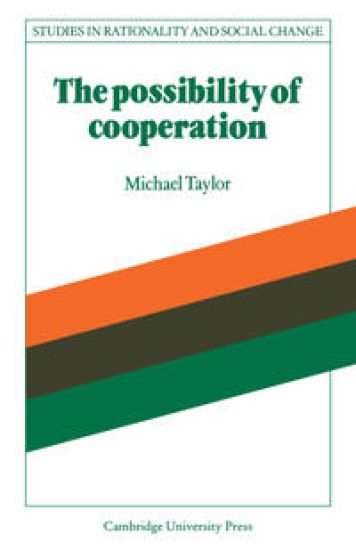
The Possibility of Cooperation

The Possibility of Cooperation

Michael Taylor

Cambridge University Press
1987
pokkari
This 1987 book offers a critique of the liberal theory of the state, focusing on a detailed study of cooperation in the absence of the state and of other kinds of coercion. The discussion includes an analysis of collective action and of the Prisoners' Dilemma supergame. It is a revised and expanded edition of the author's classic work of rational choice theory Anarchy and Cooperation, originally published with John Wiley in 1976. The analysis has been recast and developed here to make it more accessible to non-mathematical readers and to provide a more comprehensive and self-contained treatment of the theory of collective action. The book will be of interest to a range of readers in political and social philosophy and in economics.
Matisse

Matisse

Pierre Schneider; Michael Taylor

Thames Hudson Ltd
1984
sidottu
Written by a foremost authority on Matisse, this book traces the evolution of his art from the sombre palette of his first works in the 1890s, through his Fauvism, drawings and sculpture, to the dazzling paper cut-outs of his final years. The text is backed by over 900 representative illustrations.
Community, Anarchy and Liberty

Community, Anarchy and Liberty

Michael Taylor

Cambridge University Press
1982
pokkari
Can social order be maintained in a stateless society? Is anarchy viable? This book contends that stateless social order is possible only if relations between people are those characteristic of community. It uses case studies to show that their methods can be used only on a small scale.
Community, Anarchy and Liberty

Community, Anarchy and Liberty

Michael Taylor

Cambridge University Press
1982
sidottu
Can social order be maintained in a stateless society? Is anarchy viable? The contention of this book is that stateless social order is possible only if relations between people are those characteristic of community. Rejecting the libertarian argument that the goods and services which make up ‘social order’ can be provided by private firms competing in the marketplace, and the liberal argument that because social order is a public good its maintenance requires the state, Michael Taylor goes on to examine the methods actually used to maintain order in anarchic and quasi-anarchic societies and shows how these methods can be effective only in a small and stable community. Community in turn requires a rough economic equality. But according to a traditional argument (recently revitalised by Robert Nozick), no equality would survive for long without state interference - so that communitarian anarchy must break down. Here this argument is shown to be fallacious: the development of gross inequality can be prevented in an anarchic community. At the same time, the small community is not portrayed as continuously harmonious, free from constraint and coercion - the contention is rather that community is necessary if we are to live without the state or substantially reduce its role. But community is defended against the charge of being incompatible with individual liberty. That claim is shown to be no more accurate than the opposite and equally simple assumption, that liberty is possible only in community. For evidence and illustration, the book draws on the experience of stateless primitive societies, peasant communities and utopian and other ‘intentional’ communities. It sets a new standard of clarity and rigour for theoretical studies in anarchism and will interest a wide range of readers, including political theorists, political anthropologists and sociologists, and anyone concerned with the justification of the state.