Kirjojen hintavertailu. Mukana 12 595 353 kirjaa ja 12 kauppaa.

Kirjailija

Michael W. McConnell

Kirjat ja teokset yhdessä paikassa: 4 kirjaa, julkaisuja vuosilta 2020-2025, suosituimpien joukossa The Walter Berns Constitution Day Lectures: 2011-24. Vertaile teosten hintoja ja tarkista saatavuus suomalaisista kirjakaupoista.

Mukana myös kirjoitusasut: Michael W McConnell

4 kirjaa

Kirjojen julkaisuhaarukka 2020-2025.

The Walter Berns Constitution Day Lectures: 2011-24

The Walter Berns Constitution Day Lectures: 2011-24

James W Ceasar; Liz Cheney; Christopher Demuth; Philip Hamburger; Leon R Kass; Brett M Kavanaugh; Yuval Levin; Wilfred M McClay; Michael W McConnell; Michael B Mukasey; Jeremy a Rabkin; Neomi Rao; Diana Schaub; James R Stoner; Catherine H Zuckert; Michael P Zuckert

AEI PRESS
2025
pokkari
In September 2011, AEI honored longtime AEI colleague Walter Berns with a panel dedicated to discussing his scholarship on the Constitution and the republican polity it supports. At this event, former AEI President Arthur C. Brooks announced that henceforth, AEI's annual Constitution Day celebration would be named in honor of Walter. This volume is a collection of the 13 Walter Berns Constitution Day Lectures given since 2012. Walter's own work ranged widely, addressing issues on such diverse topics as civil and religious liberties, free speech, capital punishment, political philosophy, political science, presidential selection, and patriotism. It's fitting that the lectures named after him cover an equally broad array of topics related to the Constitution and the American republic.
Agreeing to Disagree

Agreeing to Disagree

Nathan S. Chapman; Michael W. McConnell

OXFORD UNIVERSITY PRESS INC
2023
sidottu
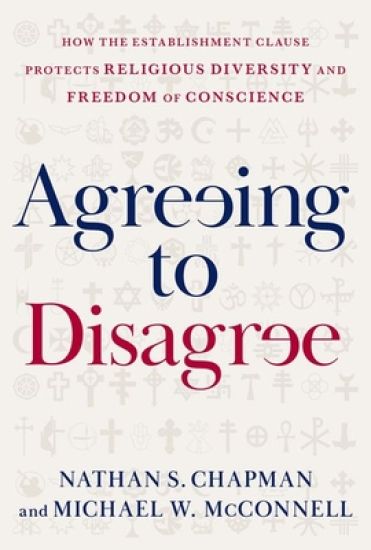
In one of the most thorough accounts of the Establishment Clause of the First Amendment, Nathan S. Chapman and Michael W. McConnell provide an insightful overview of the legal history and meaning of the clause, as well as its value for promoting equal religious freedom and diversity in contemporary America. The Establishment Clause of the First Amendment, "Congress shall make no law respecting an establishment of religion", may be the most contentious and misunderstood provision of the entire U.S. Constitution. It lies at the heart of America's culture wars. But what, exactly, is an "establishment of religion"? And what is a law "respecting" it? Many commentators reduce the clause to "the separation of church and state." This implies that church and state are at odds, that the public sphere must be secular, and that the Establishment Clause is in tension with the Free Exercise of Religion Clause. All of these implications misconstrue the Establishment Clause's original purpose and enduring value for a religiously pluralistic society. The clause facilitates religious diversity and guarantees equality of religious freedom by prohibiting the government from coercing or inducing citizens to change their religious beliefs and practices. In Agreeing to Disagree, Nathan S. Chapman and Michael W. McConnell detail the theological, political, and philosophical underpinnings of the Establishment Clause, state disestablishment, and the disestablishment norms applied to the states by the Fourteenth Amendment. Americans in the early Republic were intimately acquainted with the laws used in England, the colonies, and early states to enforce religious uniformity. The Establishment Clause was understood to prohibit the government from incentivizing such uniformity. Chapman and McConnell show how the U.S. Supreme Court has largely implemented these purposes in cases addressing prayer in school, state funding of religious schools, religious symbols on public property, and limits on religious accommodations. In one of the most thorough accounts of the Establishment Clause, Chapman and McConnell argue that the clause is best understood as a constitutional commitment for Americans to agree to disagree about matters of faith.
The President Who Would Not Be King

The President Who Would Not Be King

Michael W. McConnell

PRINCETON UNIVERSITY PRESS
2022
pokkari
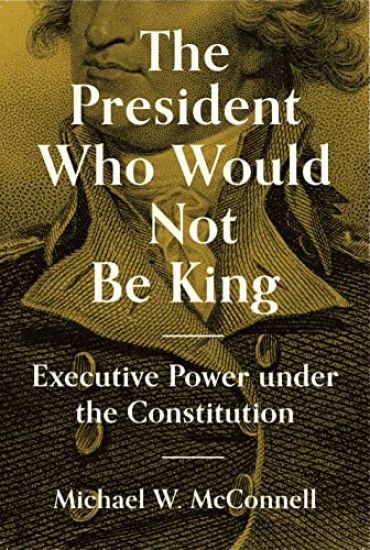
Vital perspectives for the divided Trump era on what the Constitution's framers intended when they defined the extent—and limits—of presidential powerOne of the most vexing questions for the framers of the Constitution was how to create a vigorous and independent executive without making him king. In today's divided public square, presidential power has never been more contested. The President Who Would Not Be King cuts through the partisan rancor to reveal what the Constitution really tells us about the powers of the president.Michael McConnell provides a comprehensive account of the drafting of presidential powers. Because the framers met behind closed doors and left no records of their deliberations, close attention must be given to their successive drafts. McConnell shows how the framers worked from a mental list of the powers of the British monarch, and consciously decided which powers to strip from the presidency to avoid tyranny. He examines each of these powers in turn, explaining how they were understood at the time of the founding, and goes on to provide a framework for evaluating separation of powers claims, distinguishing between powers that are subject to congressional control and those in which the president has full discretion.Based on the Tanner Lectures at Princeton University, The President Who Would Not Be King restores the original vision of the framers, showing how the Constitution restrains the excesses of an imperial presidency while empowering the executive to govern effectively.
The President Who Would Not Be King

The President Who Would Not Be King

Michael W. McConnell

PRINCETON UNIVERSITY PRESS
2020
sidottu
Vital perspectives for the divided Trump era on what the Constitution's framers intended when they defined the extent—and limits—of presidential powerOne of the most vexing questions for the framers of the Constitution was how to create a vigorous and independent executive without making him king. In today's divided public square, presidential power has never been more contested. The President Who Would Not Be King cuts through the partisan rancor to reveal what the Constitution really tells us about the powers of the president.Michael McConnell provides a comprehensive account of the drafting of presidential powers. Because the framers met behind closed doors and left no records of their deliberations, close attention must be given to their successive drafts. McConnell shows how the framers worked from a mental list of the powers of the British monarch, and consciously decided which powers to strip from the presidency to avoid tyranny. He examines each of these powers in turn, explaining how they were understood at the time of the founding, and goes on to provide a framework for evaluating separation of powers claims, distinguishing between powers that are subject to congressional control and those in which the president has full discretion.Based on the Tanner Lectures at Princeton University, The President Who Would Not Be King restores the original vision of the framers, showing how the Constitution restrains the excesses of an imperial presidency while empowering the executive to govern effectively.