Kirjojen hintavertailu. Mukana 12 595 353 kirjaa ja 12 kauppaa.

Kirjailija

Michael Weinstock

Kirjat ja teokset yhdessä paikassa: 4 kirjaa, julkaisuja vuosilta 2010-2011, suosituimpien joukossa Emergent Technologies and Design. Vertaile teosten hintoja ja tarkista saatavuus suomalaisista kirjakaupoista.

4 kirjaa

Kirjojen julkaisuhaarukka 2010-2011.

The Architecture of Emergence

The Architecture of Emergence

Michael Weinstock

John Wiley Sons Inc
2010
sidottu
Emergence is one of the most exciting new fields in architecture today, gaining interest from not only academics and students but also leading professionals, with directors from Fosters, Arup and Bentley Systems all attending the most recent symposium on the subject at the Architects Association, London. As a concept, Emergence has captured the zeitgeist, embodying the pervasive cultural interest in genetics and biological sciences. In the sciences, Emergence is an explanation of how natural systems have evolved and maintained themselves, and it has also been applied to artificial intelligence, information systems, economics and climate studies. The potential of the mathematics of Emergence that underlie the complex systems of nature is now being realised by engineers and architects for the production of complex architectural forms and effects, in advanced manufacturing of ‘smart’ materials and processes, and in the innovative designs of active structures and responsive environments. The first book to provide a detailed exploration of the architectural and engineering consequences of this paradigm, and a detailed analysis of geometries, processes and systems to be incorporated into new methods of working.Sets out a new model of ‘Metabolism’ that uses natural systems and processes as a model far beyond the minimising environmental strategies of ‘sustainability’.www.architectureofemergence.om
The Architecture of Emergence

The Architecture of Emergence

Michael Weinstock

JOHN WILEY SONS INC
2010
nidottu
Emergence is one of the most exciting new fields in architecture today, gaining interest from not only academics and students but also leading professionals, with directors from Fosters, Arup and Bentley Systems all attending the most recent symposium on the subject at the Architects Association, London. As a concept, Emergence has captured the zeitgeist, embodying the pervasive cultural interest in genetics and biological sciences. In the sciences, Emergence is an explanation of how natural systems have evolved and maintained themselves, and it has also been applied to artificial intelligence, information systems, economics and climate studies. The potential of the mathematics of Emergence that underlie the complex systems of nature is now being realised by engineers and architects for the production of complex architectural forms and effects, in advanced manufacturing of ‘smart’ materials and processes, and in the innovative designs of active structures and responsive environments. The first book to provide a detailed exploration of the architectural and engineering consequences of this paradigm, and a detailed analysis of geometries, processes and systems to be incorporated into new methods of working.Sets out a new model of ‘Metabolism’ that uses natural systems and processes as a model far beyond the minimising environmental strategies of ‘sustainability’.www.architectureofemergence.om
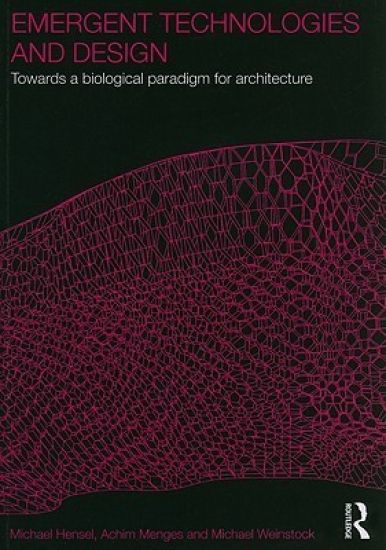
Emergent Technologies and Design

Emergent Technologies and Design

Michael Hensel; Achim Menges; Michael Weinstock

Routledge
2010
nidottu
Emergence - the process by which new and coherent structures, patterns and properties ‘emerge’ from within complex systemsTraditional architecture starts from the premise that architectural structures are singular and fixed, and however well integrated are separate from their environment and context. Emergence requires that the opposite is true – that those structures are complex energy and material systems that have a lifespan, exist as part of an environment of other active systems, and develop in an evolutionary way.This book, based on the authors’ internationally renowned Emergent Technologies and Design course at the Architectural Association in London, introduces a new approach to the practice of architecture. The authors use essays and projects to demonstrate the interrelationship of concepts such as emergence and self-organisation with the latest technologies in design, manufacturing and construction.With projects from their course, and critiques and commentary from some of the world’s leading design theorists and practitioners, the authors of Emergent Technologies and Design have introduced a radical new way of understanding the way in which architecture is conceived, designed and produced.