Kirjojen hintavertailu. Mukana 12 390 323 kirjaa ja 12 kauppaa.

Kirjailija

Michaela Trippl

Kirjat ja teokset yhdessä paikassa: 4 kirjaa, julkaisuja vuosilta 2007-2019, suosituimpien joukossa Regional Knowledge Economies. Vertaile teosten hintoja ja tarkista saatavuus suomalaisista kirjakaupoista.

4 kirjaa

Kirjojen julkaisuhaarukka 2007-2019.

Advanced Introduction to Regional Innovation Systems

Advanced Introduction to Regional Innovation Systems

Bjørn T. Asheim; Arne Isaksen; Michaela Trippl

Edward Elgar Publishing Ltd
2019
nidottu
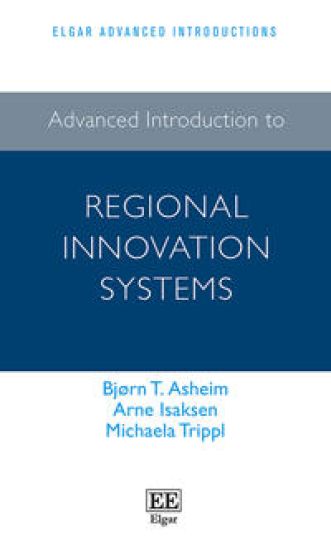
Elgar Advanced Introductions are stimulating and thoughtful introductions to major fields in the social sciences and law, expertly written by the world's leading scholars. Designed to be accessible yet rigorous, they offer concise and lucid surveys of the substantive and policy issues associated with discrete subject areas.Over the past 25 years, the regional innovation system (RIS) approach has become a powerful framework for explaining the uneven geographical distribution of innovation, as well as for developing policies geared towards boosting the innovation capability of regional economies. This Advanced Introduction provides a critical review and discussion of research on RIS to answer a set of core questions covering the origins of the concept and its theoretical underpinnings, conceptual advances, empirical applications in different spatial contexts, the policy relevance of RIS and the challenges for future scholarly work. Key features include: •a comprehensive introduction to the RIS approach and its development• a critical review of the development of research on RIS• an analysis of empirical varieties of RIS• in-depth discussion linking RIS to other important concepts in studies of regional economic development, including industrial districts, regional clusters, knowledge bases and regional industrial path development.Ideal as an introductory textbook at both bachelor and master levels in economic geography, regional economic development and innovation studies, this concise Advanced Introduction will be a vital tool for understanding regional innovation studies.
Advanced Introduction to Regional Innovation Systems

Advanced Introduction to Regional Innovation Systems

Bjørn T. Asheim; Arne Isaksen; Michaela Trippl

Edward Elgar Publishing Ltd
2019
sidottu
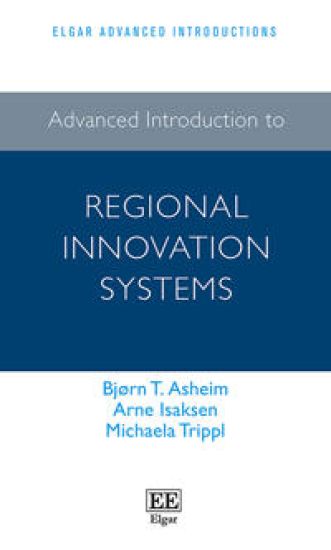
Elgar Advanced Introductions are stimulating and thoughtful introductions to major fields in the social sciences and law, expertly written by the world's leading scholars. Designed to be accessible yet rigorous, they offer concise and lucid surveys of the substantive and policy issues associated with discrete subject areas.Over the past 25 years, the regional innovation system (RIS) approach has become a powerful framework for explaining the uneven geographical distribution of innovation, as well as for developing policies geared towards boosting the innovation capability of regional economies. This Advanced Introduction provides a critical review and discussion of research on RIS to answer a set of core questions covering the origins of the concept and its theoretical underpinnings, conceptual advances, empirical applications in different spatial contexts, the policy relevance of RIS and the challenges for future scholarly work. Key features include: •a comprehensive introduction to the RIS approach and its development• a critical review of the development of research on RIS• an analysis of empirical varieties of RIS• in-depth discussion linking RIS to other important concepts in studies of regional economic development, including industrial districts, regional clusters, knowledge bases and regional industrial path development.Ideal as an introductory textbook at both bachelor and master levels in economic geography, regional economic development and innovation studies, this concise Advanced Introduction will be a vital tool for understanding regional innovation studies.
Regional Knowledge Economies

Regional Knowledge Economies

Philip Cooke; Carla De Laurentis; Franz Tödtling; Michaela Trippl

Edward Elgar Publishing Ltd
2009
nidottu
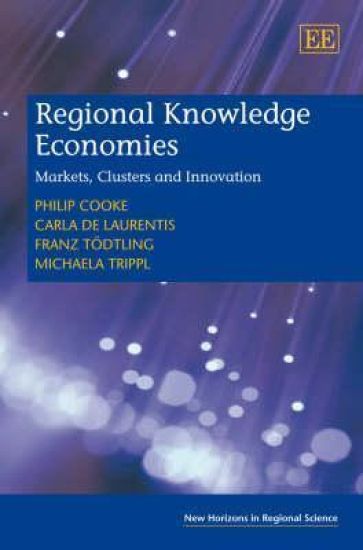
This original and timely book presents the most comprehensive, empirically based analysis of clustering dynamics in the high-technology sector across liberal and co-ordinated market economies. By carefully exploring and comparing ICT and biotechnology in the UK and Austria, the authors find evidence that industry innovation characteristics can overcome some of the supposed constraints of such 'varieties of capitalism' and themselves usher in regulatory reforms. They also provide a first examination of the ways in which firms utilize knowledge spillovers in such settings. In addition, the book highlights the practices of 'free-riders' and the excess land rents that they and more collaborative firms endure as 'diseconomies of agglomeration'. Finally, arising from these findings, the authors present a new post-sectoral, post-cluster policy methodology called 'Innovative Platform Policy', which they believe is more attuned to the dynamics of the knowledge economy.This book will be of great interest to academics, especially regional and industrial economists, economic geographers, regional scientists, political scientists and economic sociologists. It will also appeal to students and researchers, as well as government officials in industry, trade and economic development at national and regional levels.
Regional Knowledge Economies

Regional Knowledge Economies

Philip Cooke; Carla De Laurentis; Franz Tödtling; Michaela Trippl

Edward Elgar Publishing Ltd
2007
sidottu
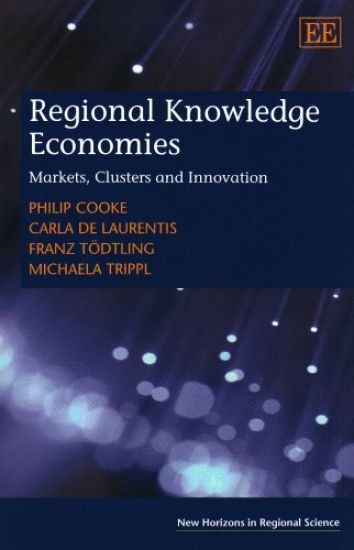
This original and timely book presents the most comprehensive, empirically based analysis of clustering dynamics in the high-technology sector across liberal and co-ordinated market economies. By carefully exploring and comparing ICT and biotechnology in the UK and Austria, the authors find evidence that industry innovation characteristics can overcome some of the supposed constraints of such 'varieties of capitalism' and themselves usher in regulatory reforms. They also provide a first examination of the ways in which firms utilize knowledge spillovers in such settings. In addition, the book highlights the practices of 'free-riders' and the excess land rents that they and more collaborative firms endure as 'diseconomies of agglomeration'. Finally, arising from these findings, the authors present a new post-sectoral, post-cluster policy methodology called 'Innovative Platform Policy', which they believe is more attuned to the dynamics of the knowledge economy.This book will be of great interest to academics, especially regional and industrial economists, economic geographers, regional scientists, political scientists and economic sociologists. It will also appeal to students and researchers, as well as government officials in industry, trade and economic development at national and regional levels.